
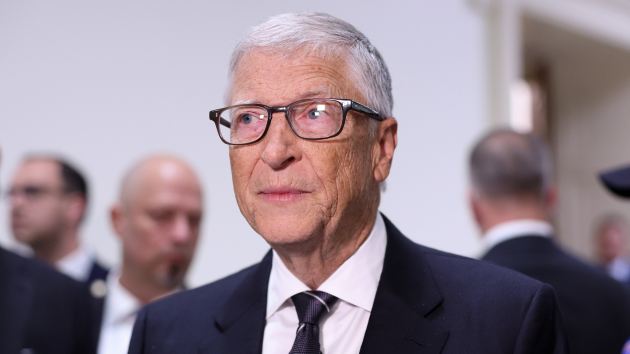
(WASHINGTON) — After Microsoft co-founder Bill Gates tried to end his relationship with Jeffrey Epstein, the convicted sex offender attempted to use compromising information about Gates’ extramarital affairs to force his way back into Gates’ life — but never explicitly threatened him, Gates told the House Oversight Committee earlier this month, according to a transcript of the closed-door session released Tuesday.
Gates appeared before the panel on June 10 as part of its ongoing probe into the government’s handling of its investigations into Epstein.
Gates, according to the transcript, said Epstein used an adviser to send him “veiled” threats, appeared to coach Gates’ adviser on how to potentially blackmail him, and mixed fact and fiction to leverage compromising information against the software billionaire.
“I was not blackmailed, but, you know, as you look at these emails, you know, it looks like Mr. Epstein’s brainstorming was going in that direction,” Gates said about materials from the Epstein files released earlier this year by the Department of Justice. “It appears that in many cases he, at least in emails to himself, was sort of rehearsing how either he or he coaching someone else might choose to blackmail me, but none of those messages were ever sent to me.”
During the interview, Gates acknowledged having at least three extramarital affairs, though he said that Epstein was involved with none of the women and that Epstein only learned about them after he and Epstein had cut ties.
The testimony offers a rare window into how Epstein allegedly tried to use compromising information to manipulate at least one powerful public figure. The Department of Justice said last year it found no credible evidence that Epstein blackmailed prominent individuals.
Gates told lawmakers that his interactions with Epstein were limited to business, that he never witnessed Epstein commit a crime, and that he did not suspect that the women who were traveling with the disgraced financier were victims of sex trafficking. Asked about photos showing him with some of Epstein’s victims, Gates said Epstein occasionally asked to take photographs of Gates with women who Gates said he believed were Epstein’s assistants.
“I have never victimized anyone. While he may have sought to foster a personal relationship, I was never interested in that and never reciprocated,” Gates told lawmakers.
Gates told the Oversight panel that he first began to meet with Epstein in 2011 because he thought the financier’s purported connections with the wealthy could help advance the Gates Foundation’s global health work. When they first began to meet, Gates said he was aware of Epstein’s “bad reputation stemming from his criminal conviction,” but continued to see Epstein.
“I was aware that he had a criminal conviction,” Gates said. “I knew that it was of a sexual nature, but, no, I don’t think I knew, dug into the specifics, although I probably should have.”
Gates said he only became aware of the full extent of Epstein’s crimes in 2018 after the Miami Herald’s in-depth reporting on Epstein’s lenient deal with federal prosecutors.
Gates said he thought the other high-profile individuals with whom Epstein socialized helped create an “image of legitimacy,” acknowledging that his own relationship with Epstein likely bolstered that image.
“I was so focused on the possibility of raising funds for global health that I allowed that goal to override my better judgment,” Gates said. “If the time I spent with Epstein lent him credibility, I am deeply sorry. I’ve learned a significant lesson and am now far more careful about who I engage with, even in a limited capacity.”
Describing Epstein as a “dilettante” with a surface-level knowledge of science and academics, Gates said that Epstein suggested he “provided advice to lots of billionaires” who might be able to advance philanthropic causes.
“He talked about Wall Street billionaires, he talked about Middle East billionaires. He made it sound very extensive … maybe for me to have a good impression of him,” Gates said.
While Gates insisted that his meetings with Epstein “weren’t social,” he recounted that some of those dinners involved “wide ranging discussion” with academics and bankers, including one dinner that included entertainment from magician David Blaine. Gates also said that Epstein repeatedly invited him to his private island, as well as an erotic show in Paris — invites that Gates said he refused.
According to Gates, his science adviser claimed they could likely go backstage to meet some of the performers that Epstein had dated, but Gates said he did not want to be spotted at an erotic show with Epstein.
“It wasn’t consistent with the relationship I had with Epstein,” Gates said. “I guess not only is my appearing at an erotic event a risk to my reputation, it would be compounded by appearing with somebody who, although I didn’t know the full extent of it, had been convicted of a sexually related crime.”
After occasionally meeting with Epstein for about three years, Gates said he began to express concerns that Epstein was “stringing” him along with his claims that he could deliver “meaningful philanthropic support.” According to Gates, Epstein set up a series of meetings in 2014 with high-profile individuals including hotel billionaire Thomas Pritzker, media billionaire Mort Zuckerman, and private equity investor Leon Black to demonstrate his connections to purportedly help Gates’ philanthropy work, though Gates said the meetings were a “dead end.”
“At that point, I concluded Epstein would never deliver on his promises. I told him we would go no further and stopped communicating or meeting with him,” Gates told the panel.
After Gates tried to cut ties with Epstein in 2014, he said the disgraced financier attempted to force his way back into his life, including by leveraging his knowledge of Gates’ extramarital affairs.
While Gates said he never disclosed the affairs to Epstein, he speculated that Epstein learned about the indiscretions through his relationship with Gates’ science adviser Boris Nikolic. Gates said that Nikolic was aware of the affairs because of their close relationship, including at least one instance when he used meeting with Nikolic as an alibi to rendezvous with one of the women.
“One time it was a scheduling thing, when we were in London, where I said to him I was going to disappear and wanted him to show that I was meeting with him at that time,” Gates said.
When Nikolic began the process of leaving the Gates Foundation, he engaged Epstein to help him negotiate the terms of his departure, Gates said. Epstein traveled to Seattle at one point to assist in Nikolic’s negotiation, Gates said, and Nikolic eventually began to make “veiled” threats via email.
“It’s hard to characterize the Epstein stuff because there was never a direct threat of any kind. There was always this veiled language like ‘we should remain friends,’ you know, which made me wonder what Dr. Nikolic had shared with him,” Gates said.
Asked about two draft emails released by the Department of Justice seemingly written by Epstein on behalf of Nikolic, Gates said the notes — which vaguely referenced the affairs and suggested that Gates has contracted a sexually transmitted disease — appeared to be part of a plot to attempt to “blackmail” him.
While Gates acknowledged at least three affairs, he explicitly denied contracting a sexually transmitted disease from the affairs, suggesting Epstein mixed falsehoods with known compromising information to use as leverage.
“If those emails that contained some truth and some false things were ever sent, then we could say there was an attempt at blackmail that never happened,” Gates said.
After he severed his relationship with Epstein, Gates claimed that the disgraced financier attempted to force his way back into his orbit, including by seeking reimbursement for money he claimed to have paid a woman with whom Gates had an affair. He told lawmakers that Epstein had nothing to do with the relationship and said he was unaware of any money that Epstein may have paid the woman, telling lawmakers that he believed the requests for payment were a “tactic [for Epstein] to reengage” him.
“I’d never asked him to do anything with respect to the person we’re discussing, so I was rather surprised. That was the first time I knew explicitly that he’d become aware of that affair,” Gates told lawmakers.
ABC News’ John Parkinson contributed to this report.
Copyright © 2026, ABC Audio. All rights reserved.