
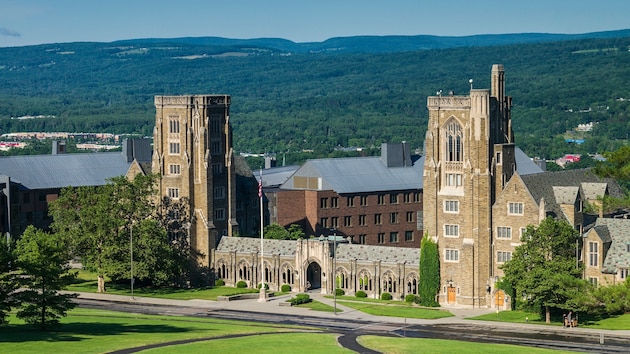
(NEW YORK) — Prosecutors in central New York say they are reopening the investigation of alleged “gang rape” at a Cornell University fraternity in 2024 after a civil lawsuit filed earlier this month sparked outrage about the incident.
Tompkins County District Attorney Matthew Van Houten said in a statement that his office is considering whether to bring criminal charges related to the incident, though he said the allegations in the civil complaint are “dramatically different” than the woman’s statement to police two years ago.
“It’s our intention to present the case to the Tompkins County grand jury with Jane Doe’s cooperation,” Van Houten told ABC News. “We want to reexamine whether there’s additional evidence that we were not aware of in November of 2024, that exists now that would change our assessment of the case and would result in the grand jury finding that there was criminal conduct.”
The reopening of the case comes less than two weeks after a former Cornell student filed a civil lawsuit alleging that she was drugged, assaulted and gang raped by seven former and current members of the Chi Phi fraternity at Cornell.
Cornell’s Chi Phi chapter was barred from campus after the alleged incident, though none of the individuals allegedly involved faced criminal charges, according to the DA. Van Houten said his office did not bring charges in 2024 because the woman’s statement to authorities did not allege she was drugged or that she did not consent to engage in sexual activities.
“She never says that she was drugged without her knowledge. She admits to taking drugs and alcohol voluntarily and with knowledge. She does not allege that she was forced to engage in any acts. She does not say that she was physically helpless or unconscious or incapacitated at any point during the time at the fraternity house,” Van Houten said.
Thomas P. Giuffra, attorney for Jane Doe, disputed Van Houten’s description of the woman’s initial statement to the Cornell University Police Department and faulted authorities for never following up with his client.
“In my experience, speaking with an abuse survivor requires delicacy, understanding and specialized training. An average University Police officer would not have these skills. It would be the role of a specially trained detective or district attorney. However, Ms. Doe was never contacted by anybody with those skills,” he said.
In an interview with ABC News, Van Houten acknowledged that he relied on the investigation conducted by Cornell Police and said his office didn’t “independently investigate” the allegations – a policy he said was in line with many upstate New York counties.
Van Houten also said that a screen shot of part of a Snapchat group chat included in the complaint — in which Jane Doe claims members of the fraternity discuss the alleged incident — was never provided to his office. Giuffra said the messages are a “critical piece of evidence” that were provided to authorities in 2024.
“My client went to the Cornell University Police because a crime was committed. It was the obligation of the police to investigate the complaints. They were given the group chat inviting the members of the fraternity to rape my client. This was a critical piece of evidence supporting that a crime had occurred. Despite this there was no follow-up with Ms. Doe either by the Cornell Police or the Tompkins County District Attorney,” he said.
ABC News has reached out to the named defendants in the lawsuit, including the seven fraternity members, Cornell and others.
Cornell said in a Sept. 21 statement that it takes allegations of sexual violence “extremely seriously” and that its Office of Civil Rights and Office of Student Conduct and Community Standards “investigated and adjudicated the allegations consistent with university policies.”
The university said federal privacy law prevents it from publicly disclosing specific information about individual students or disciplinary responses. Cornell said violations of university policies could result in sanctions up to and including suspension or expulsion.
Cornell also said the Xi chapter of Chi Phi “remains barred from our campus.”
The university said in a new statement on Monday that it “supports the decision of the Tompkins County District Attorney (DA) to provide an opportunity for the victim’s story, in the 2024 Chi Phi fraternity Sexual Assault case, to be heard by a criminal grand jury.”
“Cornell also conducted a thorough Title IX investigation, which is separate from a criminal proceeding, over the course of several months,” Monday’s statement said. “During that investigation temporary suspensions and other restrictive measures were used. After investigation, and pursuant to federal law, the matter was sent to a hearing where a panel of trained faculty and staff heard evidence over multiple days. The complainant and respondents had the opportunity to testify and present evidence. At its conclusion, the hearing panel issued a range of sanctions, which included expulsions and suspensions from Cornell. None of the individuals charged were offered the opportunity to write essays as a sole consequence of their involvement.”
Jane Doe’s lawyers allege that the fraternity members “were afforded the opportunity to mitigate their conduct by submitting essays to Cornell.”
The fraternity was closed in 2024, the school said.
“Any suggestion that the University did not impose consequential punishments for those involved is false,” Cornell said on Monday. “A continuation of the false narrative that there were minimal consequences in this case is irresponsible, will make survivors feel less safe and supported, and will perpetuate the underreporting of sexual assault.”
An attorney for defendant Scott Kretzschmar denied the allegations and said the incident detailed in the complaint “did not happen.”
“At bottom, Scott never sexually assaulted or even touched the plaintiff in any way. Period,” said attorney Jeremy Saland. “We look forward to confronting the plaintiff in a court of law for her selfishly false claims with both the evidence and her own words.”
Defendant Scott Norris denied engaging in sexual activity or drug use, though he acknowledged that he sent a message that was included in the complaint.
“I did not participate in any sexual activity or drug use. I was not found responsible by Cornell for any of the accusations involving sexual activity and drug use for which others received serious consequences. I thoughtlessly engaged in Snapchat and briefly stopped in the room where misconduct happened but not when it happened,” he said through an attorney.
Copyright © 2026, ABC Audio. All rights reserved.