
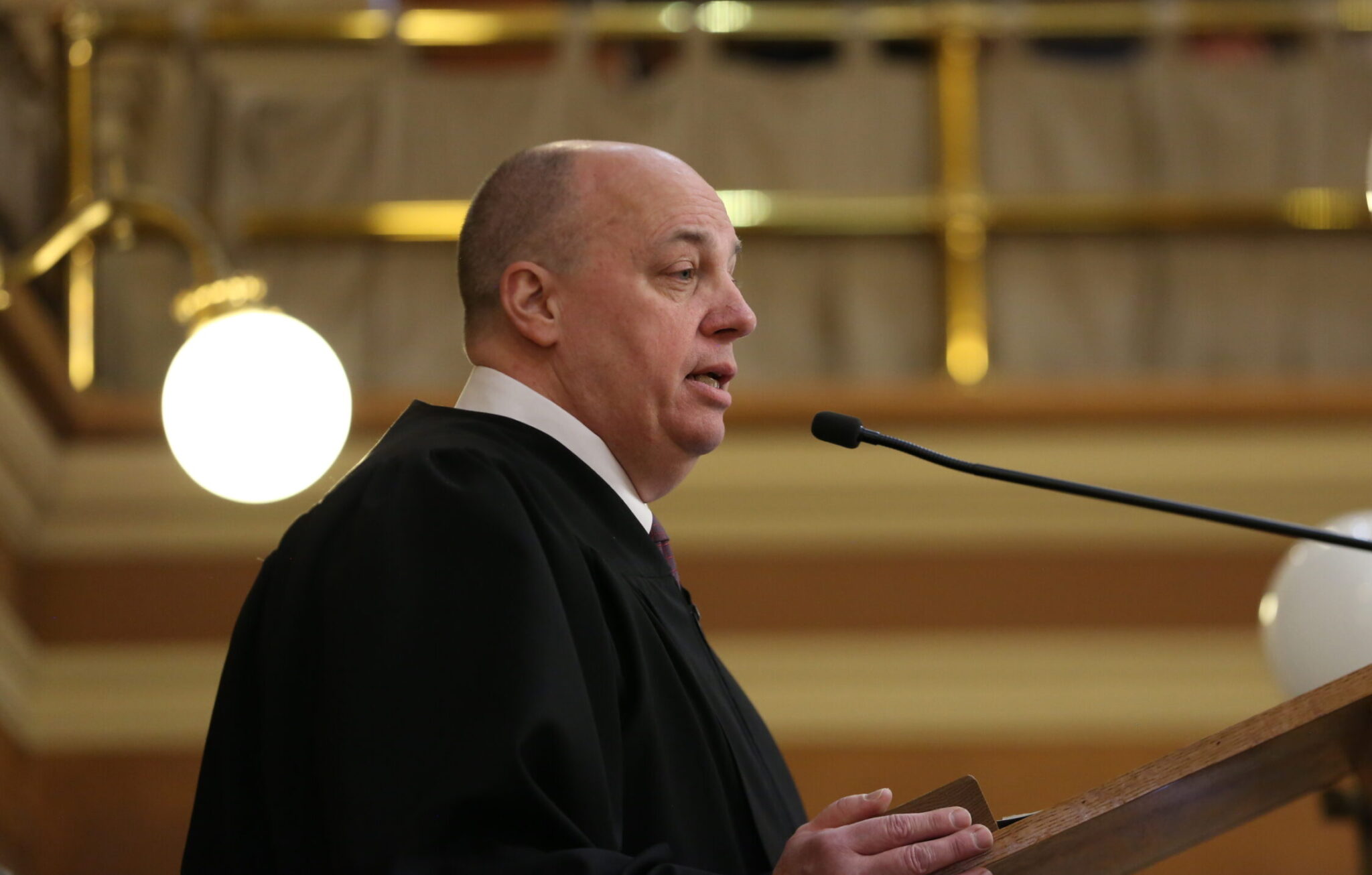
John Hult/South Dakota Searchlight
PIERRE — South Dakota will expand a specialty program for people facing drug charges, a move spurred by a decision last year to lessen the penalties for drug use.
The state will also pilot a program meant to keep a closer eye on people serving probation sentences, South Dakota Supreme Court Chief Justice Steven Jensen said Wednesday during his State of the Judiciary message to lawmakers.
Until last year’s vote to change it, South Dakota’s ingestion law was the only one in the nation to explicitly allow felony penalties for drug use alone. Since the new law took effect in July, first- and second-offense ingestion of a controlled substance is a misdemeanor, punishable by jail time and a fine.
The law change directed the court system to lean on the HOPE program as an option for monitoring people charged with drug use in the state. Under the terms of that program, which originated in Hawaii, participants call a number each day to find out if they’ll need to take a drug test. Those who fail to come when called or fail their test are jailed.
At the time Gov. Larry Rhoden signed the bill into law, however, South Dakota had used the program sparingly, and only for people facing felony charges.
The state’s court system is “in the process of expanding HOPE probation to misdemeanor cases,” Jensen told lawmakers.
The Unified Judicial System does not intend to ask for additional funds from lawmakers just yet, Jensen said, although the expansion will require oversight at the state level.
It will also require buy-in from county leaders, who would administer the program.
Currently, all but a handful of South Dakota’s 66 counties use the 24-7 sobriety program, which typically asks participants to prove their sobriety with daily breath tests for alcohol or thrice-weekly tests for drug use.
Separately, the state has specialty drug courts, which aim to help addicted people who’ve pleaded guilty to felony charges stay sober through incentives and weekly, support-group style meet-ups with judges and the court’s other participants.
“HOPE probation has the most potential in rural counties, where monitoring services such as 24-7 and specialty courts are scarce,” Jensen said.
Sen. Tamara Grove, R-Lower Brule, was the sponsor of last year’s ingestion bill. She said after the speech that she was pleased to hear the chief justice commit to expanding HOPE probation.
“The reason why I even brought the bill was because of what he said on the floor about the success of drug courts in general,” Grove said. “I worked a lot with those in Lower Brule, so I had a passion for that.”
Pre-trial supervision
The issue of pre-trial probation more broadly is the focus of a pilot program in Pennington County, Jensen said.
Currently, the courts have no authority to “provide services” to people who haven’t been convicted or pleaded guilty to a crime, Jensen said. That could mean helping judges set the conditions for release for a person jailed as they await trial, or monitoring a person who’s been released as they await trial to make sure they’re behaving as their bond conditions dictate and that they show up for court dates.
The pilot program in Pennington County to allow for pre-trial supervision in the Rapid City area will be paid for by grant funds.
“We will report to the Governor’s Office and the Legislature on our progress and hope to expand these services statewide in the future,” Jensen said.
Lawmakers will need to authorize the pilot program by passing a court system-sponsored bill that awaits a hearing in the House of Representatives.
The state also aims to train court service officers on the best ways to deal with offenders between 18 and 25 years of age, and to work with partners to expand youth mentoring programs for people in that age group.
“Research shows that brain development continues through the early- to mid-20s, meaning young adults often think, learn, and respond more impulsively than older adults,” Jensen said.
The training and expansion of mentoring will help the courts, he added, “implement tailored supervision techniques to improve outcomes for emerging adults.”
Indigent legal services
Another area where Jensen said lawmakers might one day be asked to pitch in additional funding involves legal aid for those who can’t afford it.
South Dakota leans on counties to shoulder the financial burden of court-appointed attorneys in criminal cases. Last year, lawmakers approved funding for a state public defender’s office, which handles appeals in criminal and abuse and neglect cases.
That office has improved efficiencies in the court system, Jensen said, and removed some of the financial strain from counties.
The next step will be state intervention on the front-end of criminal cases. A state Commission on Indigent Legal Services has concluded that training for defense attorneys through the state public defender’s office, higher compensation rates and the creation of regional public defenders offices to handle “high-level felony cases” in the counties would reduce potential errors upfront and improve the system as a whole.
“A system that is efficient and effective, while also accessible in both rural and urban counties, is essential to ensure the rights the courts must uphold,” Jensen said.
The Legislature needn’t take any action this year, he said, as the commission works to “solidify the plans for future expansion for another year.”