
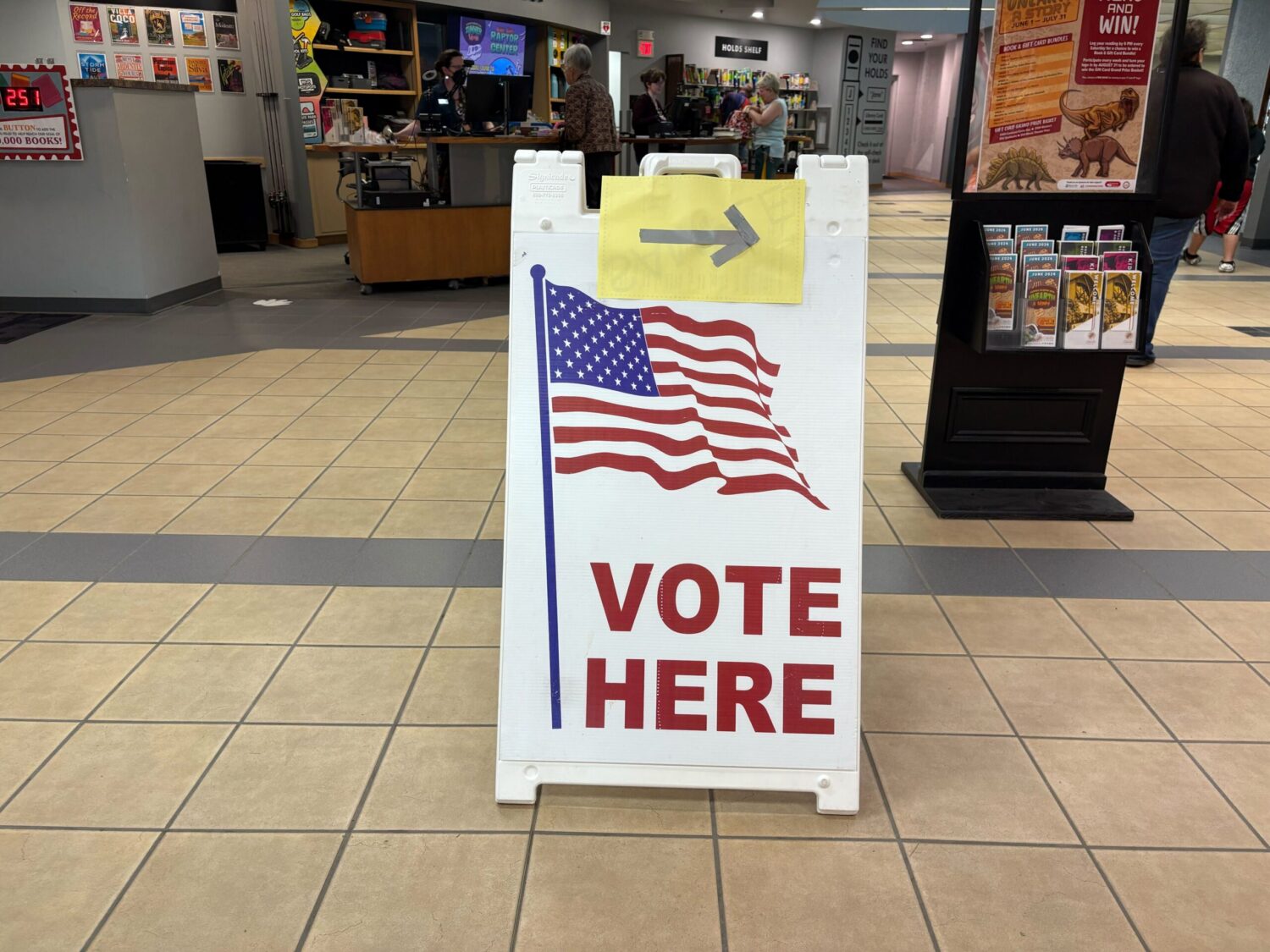
John Hult/South Dakota Searchlight
An organization that advocates for South Dakota voters wants new rules clarifying the administration of what one of its members called a “hastily constructed bill allowed to become a poorly constructed law” on voter registration.
The League of Women Voters petitioned the state Board of Election to create eight rules in response to Senate Bill 175, which became law when Republican Gov. Larry Rhoden signed it in March.
The bill changed South Dakota’s laws on registration and the kinds of ballots voters get. It requires that first-time registrants show proof of citizenship in the form of a birth certificate, passport, driver’s license, non-driver’s identification card or tribal identification card, or “any other type of acceptable documentation” under federal law. A photocopy of that proof is acceptable for any of those forms except a state- or tribally issued identification card.
The law was also designed to dull the impact of voters who register in South Dakota but don’t live in the state, such as full-time travelers. It defines residency for the purposes of voter registration, and says voters without a physical address in the state get ballots for federal races, but not state or local contests.
At least 1,500 people were designated as federal-only voters ahead of the June 2 primary election, according to a South Dakota Searchlight analysis of voter registration data.
The proposed rules would make a handful of adjustments to voter registration, designed in some cases to clarify the rules, and in others to offer impacted voters a chance to challenge their designation as ineligible or federal only.
Among the proposals:
- Allowing photocopies or pictures of tribal identification cards or state-issued ID cards to be used as proof of citizenship.
- Recognizing tribal IDs from any federally recognized tribe, rather than just the nine tribes in South Dakota.
- Allowing voters given federal-only ballots an opportunity to cast provisional ballots for local elections as they appeal their eligibility to participate.
- Adding specific language to the state’s voter registration form to explain that not offering a physical South Dakota address would cause them to be designated as federal-only voters.
- Adding language to notifications confirming a voter’s registration clearly saying if the registrant is a federal-only voter, as well as language explaining how to remedy the situation.
Supporters: It should be easier to vote
On Tuesday in Pierre, representatives with the League of Women Voters were joined by supporters from groups for sexual assault and domestic violence survivors, advocates for disability rights and civil rights, and a tribal representatives through about two hours of testimony on rules, which the supporters say would protect legitimate voters from disenfranchisement.
County auditors have applied the law inconsistently around the state, according to Amy Scott-Stoltz, a Sioux Falls-based board member for the League. She said one woman contacted the board after trying to switch her registration to Republican in order to vote in that party’s primary on June 2. The voter was asked to show proof of citizenship, Scott-Stolz said, “even though the law explicitly states that it only applies to people registering to vote for the first time.”
The person had proof of citizenship, Scott-Stoltz said, but “she never should’ve needed it, and many South Dakotans in her position wouldn’t have had it.”
People fleeing domestic violence might be among them, according to Melissa McCauley of the South Dakota Network Against Family Violence and Sexual Assault. Women on the run, jumping from location to location to avoid contact with their abuser, will often leave documents like birth certificates behind, McCauley said.
Getting replacement copies can be a hassle for people dealing with such stressful situations, and McCauley said they shouldn’t have to worry about losing their right to vote in local contests because they don’t have them.
“Voting is more than casting a ballot for many survivors. It’s a powerful step towards reclaiming their independence and having a voice in decisions that are affecting their lives and their communities,” McCauley said. “We should be making it easier for eligible citizens to participate in democracy, not more difficult.”
Tribal citizens also struggle at times to get replacement documents, according to Cody Russell, vice chairman of the Lower Brule Sioux Tribe.
Russell was among those testifying who said photocopies of ID cards ought to be accepted, just as photocopies of a birth certificate might be.
“That clarification matters directly to all of our members,” Russell said.
Russell also said it’s important for the state to recognize the citizenship of tribal citizens whose ID cards were issued by a federally recognized tribe outside the state’s borders, as some tribal residents of South Dakota maintain membership in out-of-state tribes.
‘Hastily-written bill’
Erin Rudner, a longtime social studies teacher in Aberdeen, identified herself as a member of that city’s chapter of the League of Women Voters but said she was testifying on her own behalf.
Rudner said she’d spent years guiding students through the registration process after her classes, in which she’d discuss the importance of civic engagements and the right to vote. The students were sometimes a little unsure of what to do when faced with registration forms before the law change. Now, she said, “some kids will be fine” when asked for a birth certificate or ID card to prove their citizenship, but others won’t be prepared for the additional steps.
Rudner thanked the League “for spearheading this push to make right a hastily constructed bill that was allowed to become a poorly constructed law,” and said that the Legislature had left the group to deal with the unintended consequences.
“It shouldn’t be the job of the League of Women Voters to fix this,” Rudner said, adding that “it wouldn’t be the first time some bright and able prairie women” have had to clean up messes created by the Legislature.
Secretary of State Monae Johnson, who heads the Board of Elections, was not in attendance. Tom Deadrick, the deputy secretary of state, ran the meeting in her absence, which he said was due to illness.
The League’s petition for a rule change, submitted on June 2, would typically need a response in 30 days. The group’s lawyer said at the start of the meeting that the League is willing to waive that requirement, but hopes to have an answer from the board by July 7 – one week after Tuesday’s meeting – to make sure the rules can make it through the multi-step administrative process in time for the Nov. 3 general election.
Supportive votes from the board for the rules would open up a public comment period, after which the rules would get a public hearing. The Legislature’s Rules Review Committee would ultimately vote to adopt or reject the rules.
Possible vote on rules next week
Deadrick promised to try and get the board back together by July 7. He told the board, however, that “you are all busy” and suggested that it might be a heavy lift. He noted that two board members weren’t able to come to Tuesday’s meeting due to other commitments.
No one from Johnson’s office spoke for or against any of the proposed rules on Tuesday, but her office did submit written comments on some of them.
Adding language on the impact of registering without a South Dakota physical address would make the registration form “unwieldy,” the document says, and voter confirmation notices with a rundown of how to appeal federal-only status would also create an “unwieldy” document. Allowing photocopies of licenses would put the rules in conflict with the text of the law, Johnson’s office said, suggesting that a change to state law would offer a more appropriate fix.
Board member Kent Alberty of Sioux Falls thanked the people who came to the meeting to offer input. He did not throw support behind any particular rule change, but said the law did spark a need for some rule changes, and that “it certainly is worth our time to take this under serious consideration.”
Board member Kristin Matsuda of Spearfish said she didn’t “agree wholeheartedly” with every aspect of the proposed rules, but said “I do generally agree that we need uniformity and consistency.”