
Meghan O’Brien/South Dakota Searchlight
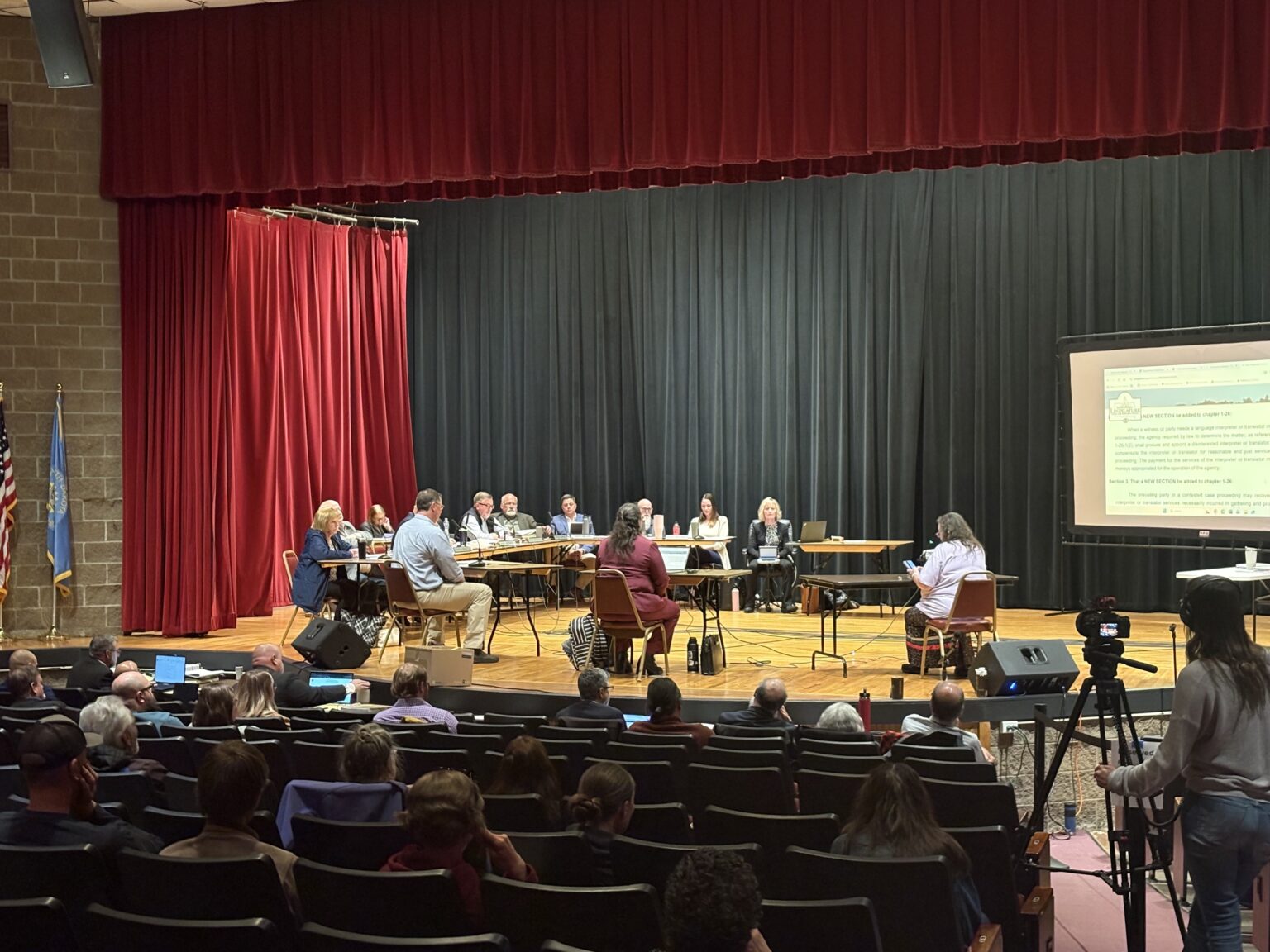
HOT SPRINGS, S.D. — Persistent, drizzling rain didn’t keep dozens of people from rallying against a proposed uranium drilling project in the southern Black Hills on the first day of a weeklong hearing to decide on a permit application.
Law enforcement officers and vehicles flanked the parking lot and theater doors Monday at the Mueller Civic Center, where the hearing took place.
Opponents cited concerns about Craven Canyon, which is near the proposed drilling sites and is marked with ancient Native American petroglyphs. Opponents said they’re also concerned about the potential to contaminate underground water, and to negatively affect the state’s agriculture and tourism industries.

“A lot of the people in this room don’t live near Craven Canyon, but that doesn’t mean that you ditch the responsibility to protect it,” said project opponent Anissa Martin. She then referenced the Lakota name for the Black Hills. “So I ask you, where will we go when the He Sapa are uninhabitable, when we have no water in the Black Hills? And I ask you, what water will you drink?”
The hearing drew public testimony from not only residents of the Black Hills, but also from Wyoming, Minnesota and Pennsylvania. People who spoke Monday during the hourslong public comment period were all in opposition to the project.
The company proposing the drilling has maintained that it has gone through all the necessary steps in the permitting process, and the project will not harm the nearby canyon.
The state Board of Minerals and Environment can deny an application to explore for uranium for several reasons, including negative impacts on historical, archaeological or recreational aspects of an area, if those impacts outweigh the benefits of the exploration. The board can also deny the permit if it will negatively affect the productivity of aquifers.
In March 2024, Clean Nuclear Energy Corporation and its Canada-based parent company Nexus Uranium filed an application to drill exploratory holes in search of uranium near Craven Canyon, 7 miles north of Edgemont.

The company plans to use 50 sites to drill holes as deep as 700 feet on state-owned land, according to its application. Each hole will take approximately two weeks to drill.
The company has additional drilling plans on federally owned land. That portion of the project is under review by the U.S. Forest Service, which estimates it will issue a decision next month.
Besides taking public testimony, the state board dealt with several preliminary matters Monday.
The board’s hearing chairman, Bob Morris, declined to require the state’s commissioner of school and public lands to testify in person. That office manages the state land at the proposed project site.
Bruce Ellison, an attorney and project opponent, sought to require the commissioner’s in-person testimony. Ellison said he didn’t receive sufficient evidence from a records request about the commissioner as to “how he did his job.”
Morris said there is written material from the commissioner in the case file, and Morris doesn’t see “how it’s relevant” to question the commissioner.
The board also failed to produce a Lakota interpreter for the hearing, after agreeing to provide one. A staff member for the state Department of Agriculture and Natural Resources said potential interpreters had conflicts of interest or scheduling conflicts that prevented them from accepting the role.
The board decided to have a discussion Tuesday morning about whether to continue the hearing without an interpreter. The hearing is scheduled to continue through Friday.
The proposed drilling near Craven Canyon is separate from another proposal to mine uranium in the Edgemont area that’s been pending since the early 2000s. That proposal, from Texas-based enCore Energy, has met staunch opposition from Native Americans and environmental activists and has been in regulatory and legal limbo. Last year, the federal government’s Permitting Council selected enCore’s project for inclusion in FAST-41, a process intended to improve coordination among permitting agencies and hold them accountable to deadlines.
Uranium is a metallic, radioactive element used as fuel in nuclear weapons and nuclear power plants. Interest in uranium exploration and mining has risen recently, in response to nuclear energy’s potential to meet the growing electricity demands of data centers handling the computing needs of artificial intelligence.
The hearing in Hot Springs comes on the heels of a victory for opponents of another drilling project in the Black Hills. Rapid City-based company Pete Lien & Sons recently withdrew from an exploratory graphite drilling project that was underway near Pe’ Sla, also known as Reynolds Prairie, a sacred site for Lakota people in the central Black Hills. The withdrawal came after two lawsuits from opponents challenging the project and the formation of a protest camp at the drilling site.