
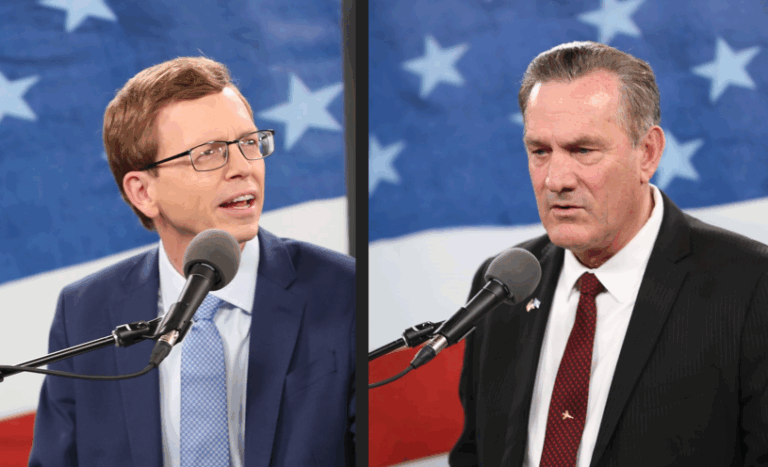
Joshua Haiar and Seth Tupper/South Dakota Searchlight
In South Dakota’s race for governor, a state law limiting individual campaign contributions is proving to be more of a suggestion than a requirement.
The law caps individual contributions to a candidate for statewide office at $4,000 per year.
Yet South Dakota’s wealthiest man, the banking magnate and philanthropist T. Denny Sanford, has given at least $50,000 to support Republican Gov. Larry Rhoden.
Meanwhile, one of Rhoden’s opponents in the June 2 primary election, U.S. Rep. Dusty Johnson, has benefited from about 130 individual contributions above the $4,000 limit. Those include contributions of $17,000 apiece from the Winklevoss twins, Cameron and Tyler, who famously sued Mark Zuckerberg, alleging he stole their idea to start Facebook.
The two campaigns have used a combination of federal and state fundraising committees to raise and transfer the money in ways that circumvent the individual state contribution limit.
It’s all part and parcel of the complicated modern status of campaign finance, explained Brendan Glavin, director of insights for OpenSecrets, a national campaign finance watchdog group.
“While I don’t see anything in South Dakota law that would make this illegal, it clearly undermines the idea of contribution limits for candidates,” Glavin said.
Here’s how it works in the case of the Rhoden campaign. Sanford gave $50,000 to the federally registered Free American Fund, which is an entity known as a “hybrid political action committee.” Other contributions included $30,000 from James Brown of Colorado.
Hybrid PACs maintain two accounts: one for traditional PAC activity, which is subject to contribution and spending limits, and one for “super PAC” activity. The U.S. Supreme Court has ruled that because super PACs are prohibited from coordinating with candidates, they can receive and spend unlimited amounts of money.
The Free American Fund transferred $85,500 to the state-registered Rhoden for Governor campaign committee. The state does not limit PAC contributions to statewide candidates.
Rhoden spokesperson Ian Fury said, “Governor Rhoden is playing by the same campaign finance rules as everybody else.”
“He hasn’t been raising money for years, and he isn’t independently wealthy to bankroll his own campaign,” Fury said.
In the case of the Johnson campaign, individual contributions greater than $4,000 have gone to the federally registered Dusty Johnson Victory Committee, which is an entity known as a joint fundraising committee. Joint committees are made up of other committees that pool their contribution limits, allowing donors to make a larger contribution that’s split among the member committees.
Donations to Johnson’s victory committee have included the Winklevoss contributions, a combined $40,000 from Republican former Lt. Gov. Steve Kirby and his wife, Suzette, and a combined $20,000 from First Premier Bank CEO Dana Dykhouse (who works for Sanford) and his wife, LaDawn.
One of the federal committees that comprises the victory committee, Friends of Dusty Johnson, has transferred $800,000 to Dusty for Governor, Johnson’s state-registered committee. Like Rhoden’s state campaign committee, Johnson’s state committee can receive unlimited contributions from PACs.
Campaign finance watchdogs have argued that joint fundraising committees can be used to circumvent campaign contribution limits. Saurav Ghosh is the director of federal campaign finance reform at Campaign Legal Center.
“Allowing JFCs to pay for candidate advocacy and campaign activity erodes the legal guardrails that exist to prevent actual and apparent corruption, hold candidates and committees accountable to the public, and prevent big-money donors from drowning out the voices of everyday Americans,” Ghosh wrote in a column for the center.
Johnson’s campaign sent a statement from him acknowledging that “South Dakota’s campaign finance laws need a total overhaul.”
“There are too many loopholes and there is too little transparency,” he said. “In my first session as governor, I’ll work with the legislature to fix those problems.”
When asked why his campaign is using those loopholes, he said, “I certainly think we should raise the standard here in South Dakota, but until that happens, my campaign will continue to follow the rules and guidelines as they are currently written.”
Because state and federal campaign finance reporting deadlines vary, it’s difficult to know how much each candidate has raised and spent at any given moment. Johnson has clearly raised the most money, with balances in his various state and federal accounts adding up to about $7 million as of the most recent reporting deadlines. His state campaign committee had spent about $650,000 by the end of last year.
Rhoden’s state committee brought a balance of about $91,000 into last year, raised about $490,000 and spent about $71,000, ending the year with a balance of about $512,000.
Republican candidate for governor Toby Doeden of Aberdeen raised $2.1 million last year, primarily from a $2 million loan he made to his own campaign committee. He spent $2 million and had $41,000 left at the end of the year.
Doeden said critics and competitors are pushing a narrative that he is attempting to buy the governor’s race and that he couldn’t raise money. He said he could have raised a substantial amount of money from his supporters, but chose to self-fund.
Republican candidate for governor Jon Hansen, the speaker of the state House, reported raising $189,000 by the end of last year, spending $135,000, and ending with $54,000 on hand.
The only other candidate for governor, Democrat Dan Ahlers, announced his candidacy earlier this year and won’t have to file his first campaign finance report until the next deadline for state committees, May 18.