
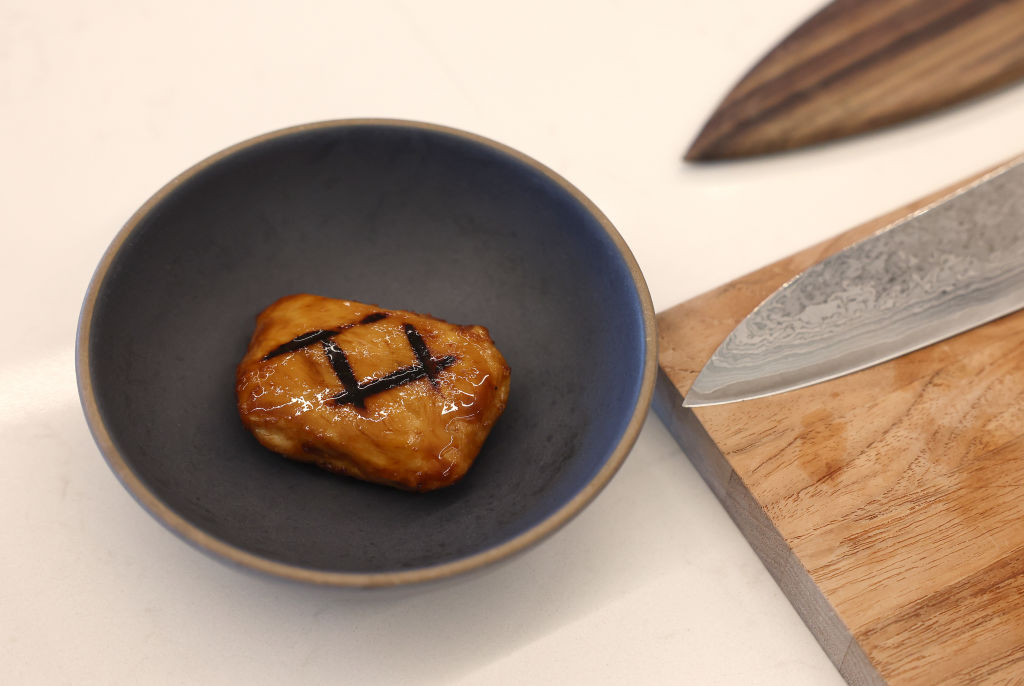
Meghan O’Brien/South Dakota Searchlight
South Dakota’s new five-year ban on cell-cultured protein targets a product whose path to mass market availability is operating on “generational-level timescales,” according to a scientist dedicated to the topic.
Elliot Swartz works for the Good Food Institute, a Washington, D.C.-based nonprofit that describes itself as working to “advance alternative proteins.”
“There might be local retailers that have a few products on store shelves, but there won’t be a nationwide Walmart-, Costco-type of cultivated meat product within the next five years in the United States,” Swartz said. “Over the next five years, more and more products will be reviewed, and we will get an even more thorough understanding.”
Both the U.S. Department of Agriculture and the Food and Drug Administration began approving the sale of cell-cultured products in 2023. While a few products have been approved, there’s really only one product for sale now, Swartz said — cell-cultivated salmon — and it’s on the menu at four restaurants.
Rep. Tesa Schwans, R-Hartford, who supported a ban on cell-cultured protein, described the creation process as “a petri dish that’s full of hormones and sludge.” It’s actually more like “a beer brewery,” according to Swartz.
Cell-cultured protein, sometimes described as lab-grown meat, is produced by taking cells from an animal. The cells are grown in a controlled environment and fed nutrients until they become a large enough piece of tissue to be used as a food product.
It’s a relatively new science, according to Christina Bakker, a South Dakota State University Extension meat science specialist.
“Right now, most companies are kind of in that ramping up of the production phase. They’re trying to get it to a point where the product can be affordable,” Bakker said. “You’re not seeing it in your normal grocery stores or anything like that, so for the most part, it’s not widely available.”
SDSU does not do research on cell-cultured protein and does not collaborate with any companies that produce the product.
Moratorium signed after ban was vetoed
State Rep. Julie Auch, R-Lesterville, attempted during the recently concluded annual legislative session to add cell-cultured protein to South Dakota’s list of “adulterated foods,” which would have essentially banned the products permanently. She told fellow lawmakers that she introduced the bill with concern for the destruction of the livestock industry, which she said is being orchestrated by people claiming the industry is bad for the environment.
The bill made it to the governor’s desk, where it was vetoed.

Lawmakers shouldn’t ban a product because they don’t like it, Republican Gov. Larry Rhoden said. He instead signed into law a five-year prohibition on the sale, manufacture and distribution of cell-cultured protein.
“I think we need to tap the brakes on this product and have a little more research,” Rhoden told reporters in February.
The South Dakota Cattlemen’s Association does not support cell-cultured protein, but it testified against a permanent ban.
“Cell-cultivated products are no competition to real beef raised by real producers, and consumers do not need the government to tell them that,” the association’s president Craig Bieber told South Dakota Searchlight in an emailed statement.
The association also advocates at the national level for “an explicit prohibition on the use of any taxpayer dollars being used to purchase these products in schools, the military or in any nutrition program, and more transparency to address concerns rather than relying on a patchwork of state bans and moratoriums.” South Dakota lawmakers approved a law last year with prohibitions on the spending of taxpayer money to support lab-grown meat, with an exception for university research, and also approved a law requiring lab-grown meat to be clearly labeled.
The state’s Animal Industry Board, which oversees the state meat inspection program, spoke in favor of the labeling requirement.
“One of the foundations of meat inspection is truth and accuracy in labeling,” said Mendel Miller, the state veterinarian and executive secretary of the board. “When that customer picks up a package of meat, they know exactly what’s in the product.”
Motivations, concerns
Cell-cultivated producers don’t want to eliminate conventional meat production, according to Tamar Lieberman, a legislative specialist with the Good Food Institute. But she said the availability of cell-cultured protein could help in times of crises like avian flu or other livestock disease outbreaks.
“The way that meat is produced right now is very vulnerable to supply chain disruptions,” Lieberman said. “Having additional ways to feed people meat — if they choose it, of course — in times of disruption is going to be critical.”
Part of the drive for an alternative protein comes from the global rise in demand for meat products, Swartz said.
“We already know that there’s some negative externalities that come alongside meat production, in terms of the amount of land that’s used, water that’s used, and other resources that are impacted,” Swartz said. “This is a way for us to essentially help meet that growing demand for protein, while hopefully taking away some of those negative externalities that exist with the current system.”
Opponents of cell-cultured products alleged during South Dakota’s legislative session that the products contain carcinogens. Others raised concerns about an alleged lack of studies and transparency about the production process.
Bakker, the SDSU meat science specialist, said future research could unearth concerns, but “right now, what we see is that we’re not concerned, from a scientific side, about the safety.” The industry will rely on USDA and FDA standards that measure safety from chemical, physical or biological standpoints, Bakker said.
Time to learn
The five-year ban in South Dakota will give researchers more time to help answer questions for shoppers, Swartz said, though the products likely still won’t be readily available at mass market stores when the ban expires.
“This is really sort of generational-level timescales that we’re talking about here, rather than year over year, suddenly there’s going to be cultivated meat at Walmart,” Swartz said.
Miller also said the temporary ban could help answer some of the questions people might have about the production process or end product.
“It’s a good step to take until we learn a little bit more about the product itself,” Miller said. “It’s just a matter of the unknowns of what the product is, I guess, from our side of things.”
Miller said people should trust inspection systems, but he understands the concern.
“If there’s confidence in the system and confidence in the way products are approved, that says a lot right there, that it’s been approved,” he said. “However, it is kind of on the cutting edge of technology, so there probably are a lot of things that are unique to that product rather than past things that have been approved.”
The first products consumers will likely see in stores are crumbled products that replicate chicken nuggets or ground meat — something that is “texturally, a little bit easier to deal with,” said Amanda Blair, the assistant director of SDSU West River Research and Extension.
“I don’t know when we’re going to see a fully formed steak or pork chop made from these types of products” using the cell culture process, Blair said. Replicating a whole “muscle cut” like a steak or pork chop would be more difficult for bioprocessors, she said.
Seven other states have banned cell-cultured proteins. A federal appeals court recently upheld Florida’s ban on cell-culture proteins after one of the nation’s two approved cell-cultured chicken producers tried to overturn it. A lawsuit against Texas’ temporary ban is ongoing.