
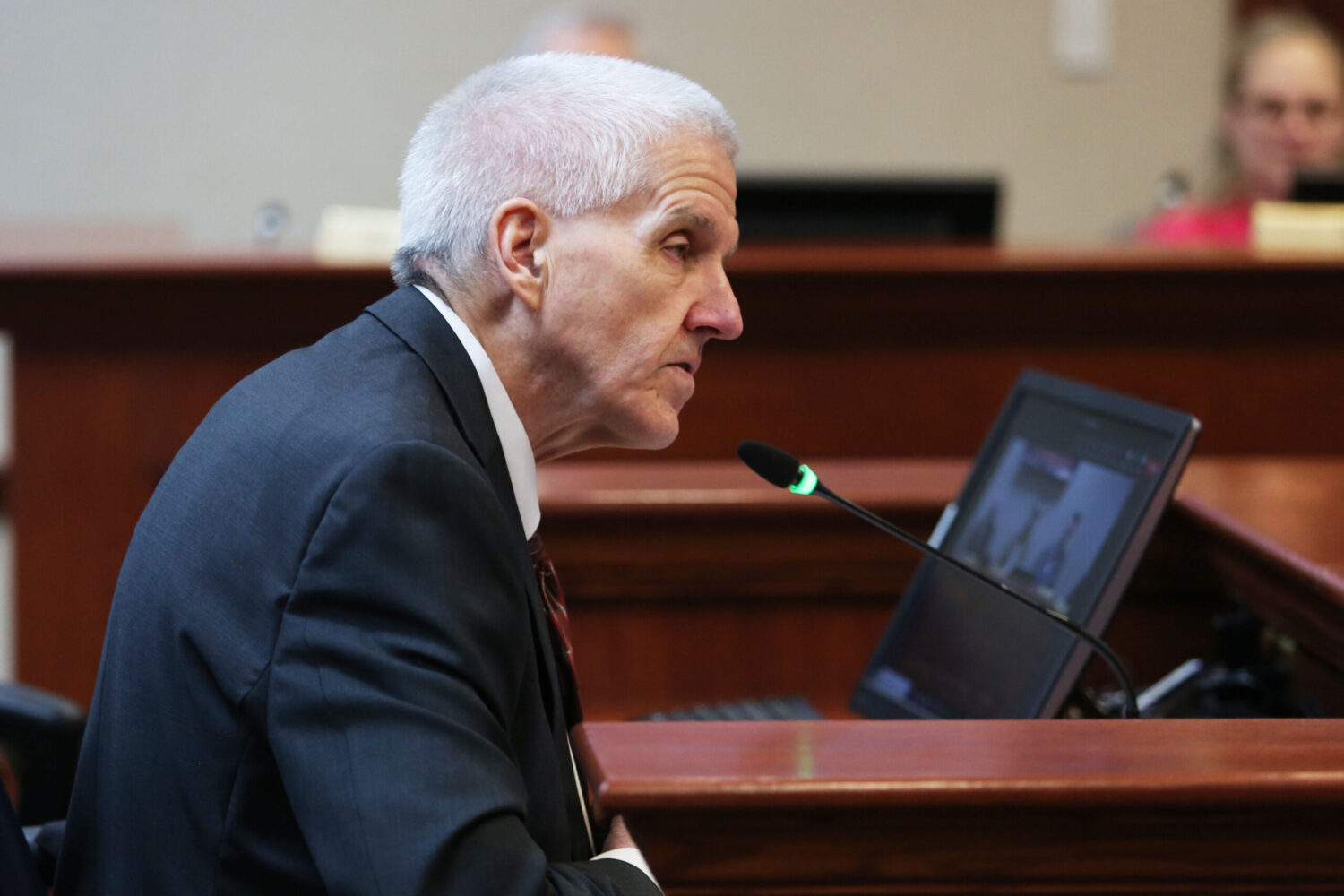
Meghan O’Brien/South Dakota Searchlight
PIERRE — Legislation to address aggressive and violent student behavior passed with full support from the South Dakota House Education Committee on Wednesday, and legislation providing money to build a non-residential treatment center for children also advanced.
The bill addressing aggressive and violent students will be heard next by the full House of Representatives. The funding bill is headed to a budget committee.
Last month, state Education Department Secretary Joe Graves told the House Education Committee that teachers are increasingly facing aggressive and violent behavior from students, sometimes from elementary-age children, resulting in injuries to teachers and property damage.
Under House Bill 1017, a school board or its administrators would be able to send those students to an alternative learning setting with a written notice to parents, who could appeal the decision.
An alternative setting would be any place “other than the student’s regular classroom or educational setting, as designated by a school administrator, where a student is provided educational instruction.” If students are placed outside of school for more than five days, they would have to be referred to a behavioral health specialist.
The bill would also require that school boards report the alternative placements to the state Department of Education each year, which supporters said could help educators find other solutions to behavioral issues.
Mackenzie Decker, chief of staff for Republican Gov. Larry Rhoden, said the bill could lead to a better understanding of the problems teachers face in the classroom.
“The bill is not perfect, but it’s also not required,” she said. “They put in place a data collection system so that we may better understand what our next steps might be.”
Schools can already suspend students or call law enforcement. Supporters of the bill said it gives schools another option.
Terry Dosch, executive director of South Dakota Council of Community Behavioral Health, said the legislation could be a way to help de-escalate aggressive or violent behaviors.
“One of the things that frustrates me is the willingness of people to pay for behavioral health on the back end, when we’re building new prison systems, or when we’re worried about instituting somebody,” he said. “They could have had early identification, interdiction, and some correction on their behavior earlier on. Prevention, early identification, and treatment is always cheaper than a placement alternative.”
The committee also advanced a bill that will be heard next in a joint budget-setting committee. The proposal, brought by Rep. Lana Greenfield, R-Doland, would give the state Department of Education $2 million to grant to a qualified nonprofit to build a non-residential facility providing school-based, therapeutic services for students with behavioral health concerns.
One of the nonprofits that could apply for a grant, Children’s Home Society, has day school locations in Sioux Falls and Rapid City and is considering adding services in Aberdeen. Mike Groher, business development officer at Children’s Home Society, testified in favor of the bill.
“Utilization has remained consistent and predictable as access has expanded,” he said. “A centralized location in Aberdeen would not create new demand. It would bring services closer to home for students who already need them.”