
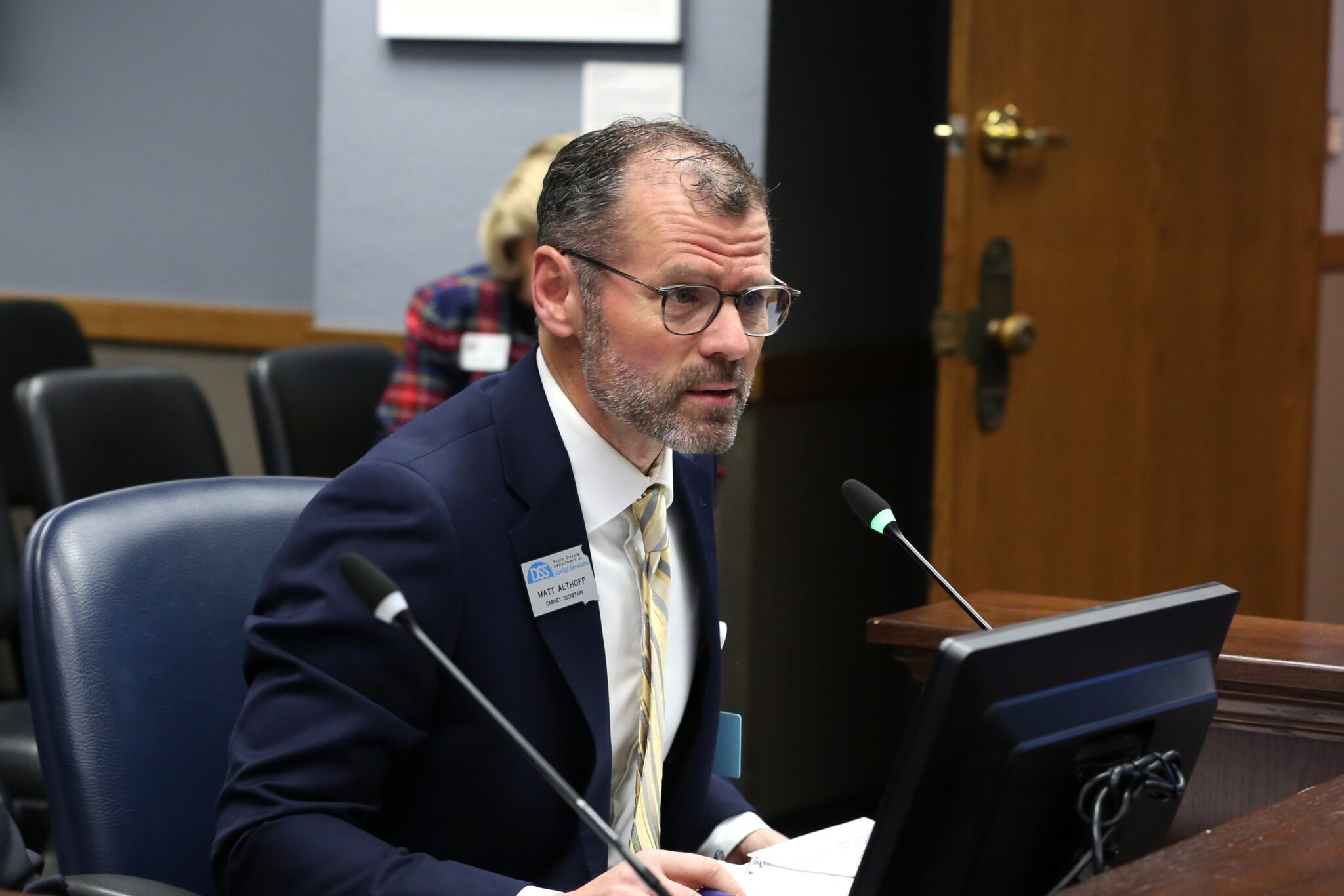
Makenzie Huber/South Dakota Searchlight
South Dakota regularly disenrolled one of the highest percentages of Medicaid patients in the country each month last year, contributing to one of the largest yearly decreases in the state’s Medicaid enrollment in the last decade.
The state often switched places with Oklahoma last year for the first and second highest-percentage of disenrollments in the nation, according to national Medicaid data, with disenrollment rates regularly over one-third of patients up for renewal. Medicaid, which is funded jointly by the federal government and states, provides health insurance for people with disabilities or low incomes.
Overall, South Dakota Medicaid enrollment dropped by about 9,000 people from February to November last year, primarily among traditional Medicaid for adults and children, and has since stabilized around 141,000. That number includes expanded-eligibility Medicaid for adults ages 19 through 64, approved by South Dakota voters in 2022, which has stayed relatively stable at around 30,000 people enrolled.
Department of Social Services Secretary Matt Althoff spoke to South Dakota Searchlight after he presented Medicaid enrollment information to the legislative budget committee on Wednesday at the Capitol in Pierre. He said the reason for the higher disenrollments was a combination of South Dakota’s use of an automatic renewal process known as ex parte, and the lingering impact of post-COVID pandemic removals.
Althoff told lawmakers that while Medicaid is a “big spend” in the department’s budget, it is “super impactful in our efforts to lift people who are downtrodden and facing bad times up.
“Without our ability to work pain free or feel confident that ‘I’m not going to die’ or ‘I’m having my personal health in good order,’ we don’t go forward ambitiously, we don’t take risks, we don’t find jobs that we need,” Althoff said.
The decrease could also be due to a healthy economy, said Jennifer Tolbert, deputy director of the Program on Medicaid and the Uninsured for KFF. The nonprofit health policy organization researches and reports on major health issues in the United States. South Dakota reported one of the lowest unemployment rates in the nation over the last year.
The decrease in enrollment throughout the year matches nationwide decreased enrollment, Tolbert added.
State predicted enrollment decrease
A year ago, Althoff told lawmakers there would be a decrease in enrollment as the department implemented ex parte, or automated renewals, to identify enrollees no longer eligible for the program. At the same time, the process allows states to simplify Medicaid renewals, eliminating the need for people to resubmit eligibility information to the state.
South Dakota was not able to use ex parte until it upgraded to a new online enrollment system, Althoff told lawmakers at the time. He said that once the state was able to use ex parte in late 2024, it used external databases to reference and remove South Dakotans who were “no longer eligible” for enrollment, for reasons such as finding a job that put them outside income limits.
The state is required by law to first attempt to renew patients by crosschecking with other data sources, within the state or through a third party. If a state identifies an ineligible patient on the rolls, patients are sent notification and paperwork to prove otherwise.
But an average of 9% of patients up for renewal were terminated because they were no longer eligible, according to state data. The majority of disenrollments were “procedural terminations,” due to missing and improper paperwork.
Tolbert said for a majority of people who lose Medicaid access, it’s not because they are no longer eligible or because their income exceeds the limit, but rather because they “weren’t able to navigate the renewal process.”
Procedural disenrollment can be due to unreliable mail, and the disenrollment often leads to confusion and a lack of insurance for people who need health care, said Shelly Ten Napel, CEO of Community HealthCare Association of the Dakotas.
Increases in automatic renewals prevent “time consuming” paperwork for patients and the state, and it means fewer people are “showing up for care who have unknowingly lost coverage,” Ten Napel said.
Althoff predicted that fiscal year 2025 average monthly Medicaid enrollees would drop to just under 140,000 by June of last year, a drop of about 8,000 enrollees, before climbing back up.
Medicaid enrollment in reality dropped to 144,310 by June of last year and continued to decrease through September, to 141,012 average monthly enrollees. Enrollment has since plateaued, with 141,151 average monthly enrollees in November, according to the latest Medicaid enrollment report.
Change in ex parte could ‘stabilize’ enrollment
South Dakota’s high disenrollment rate changed after the state Department of Social Services changed its automatic renewal labeling and process, due to modernized enrollment software. The latest national Medicaid report dropped South Dakota’s disenrollment standing to 22nd highest in the nation, at a disenrollment rate of about 20%.
Since July, the state’s number of terminated Medicaid recipients due to procedural disenrollment — often due to failing to fill out required renewal, financial or residential documents — dropped to an average of 17%.
Althoff told Searchlight that the department recognized its comparatively high procedural disenrollment rate and made changes.
Starting in July, the department started retaining “categorically eligible recipients” in the Medicaid program, which includes children in Child Protective Services custody or adults who are older or disabled who receive supplemental security income from the Social Security Administration.
“We changed how we define those administrative functions, and that’s what led to the radical change,” Althoff said.
Many Medicaid cases up for renewal in the first half of 2025 weren’t able to go through the ex parte process as well, according to a state Department of Services spokesperson, because of the modernization of the state’s Medicaid enrollment software. The state continued its standard practice of mailing renewal forms, which historically result in higher procedural disenrollment rates.

It wasn’t until September of last year that all Medicaid cases were in a “ready state” for ex parte with the state’s new enrollment software, according to the department. Department officials expect Medicaid enrollment to stabilize over the next year, due in part to the ex parte process and changes regarding the “categorically eligible recipients.”
More than half of Medicaid recipients up for renewal since July were automatically renewed — over 60% in September and October.
Between ex parte reapproval and approvals through submitted renewal forms in the last three months of reports, over three-fourths of recipients due for renewal are being renewed.