
Makenzie Huber/South Dakota Searchlight
It would cost up to $4 million to cut down Milbank’s ash trees, after state and city officials detected a beetle last summer that threatens to decimate the northeastern South Dakota city’s tree canopy.
It’ll cost roughly 60% of that price, or $2.4 million over 12 years, to reach herd immunity against the emerald ash borer — and the city of roughly 3,500 people will keep most of its trees, said city administrator Steve Pendergrass.
Herd immunity, a term commonly used in public health, happens when a large percentage of a population becomes immune to a disease, either through vaccination and treatment or previous infection, making it difficult for the disease to spread.
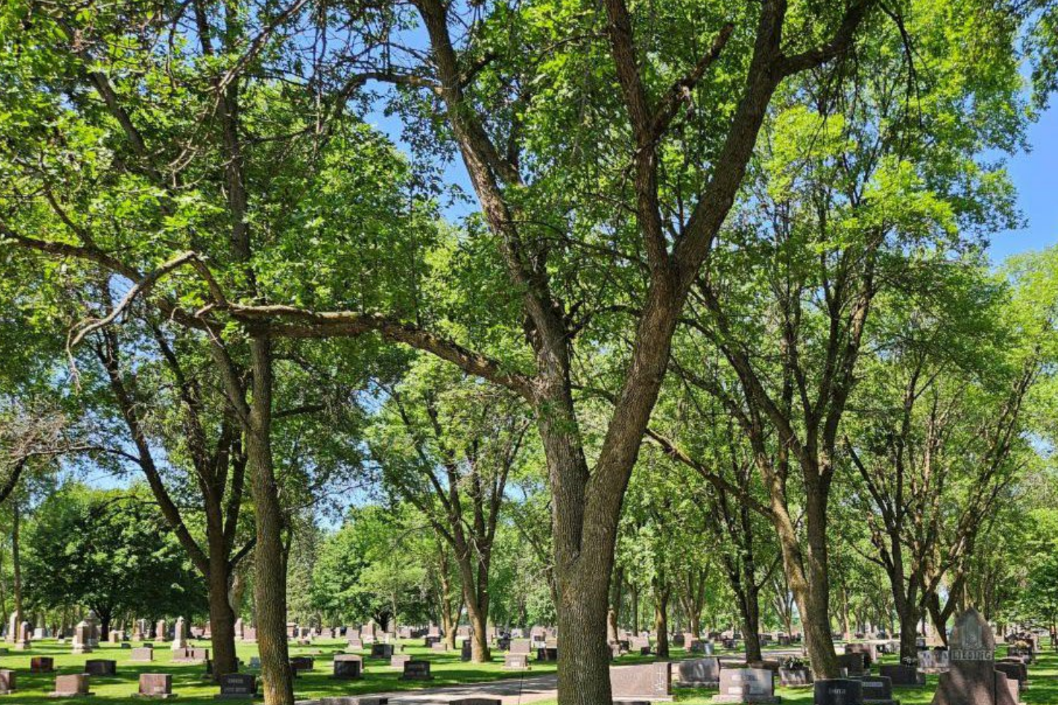
Ash trees comprise over 50% of Milbank’s public tree canopy — 1,657 trees throughout the city’s parks, cemeteries and public right-of-way. The emerald ash borer, an eastern Asian beetle first detected in the United States in 2002, burrows under ash tree bark and eats the tree from the inside out. A chemical injection, applied with a needle-like device after drilling a hole into the tree, kills adult insects, preventing another generation of larvae and protecting the tree.

Many communities across the country — including Sioux Falls, the first place emerald ash borers were found in South Dakota in 2018 — have opted to remove a majority or all of their public ash trees. Pendergrass hopes to avoid that.
“We’re dealing with tax dollars. We need to make sure we’re practicing due diligence while also taking care of public safety and while taking care of as many trees as possible,” Pendergrass said.
Milbank’s approach can serve as an example for other cities across the state, said John Ball, forestry specialist with South Dakota State University Extension. Ash trees typically comprise one-third of a public tree canopy in cities.
“Herd immunity could be a technique applicable in slowing the spread of the insect, controlling the damage it does, and providing long-term survival,” Ball said.
Instead of halving its tree canopy, Milbank is removing about a third of its public ash trees in the next decade — those already too infested, planted too closely together or too small to be worth saving. Officials plan to treat one-sixth of the remaining trees every year, leaving the remainder untreated until they cycle through and treat the remaining trees over the next 12 years.
“Ash trees are tough and can tolerate a low population of emerald ash borer,” Ball said. “The problem is when you end up with incredibly high populations with an epidemic, which is what kills the tree.”
Emerald ash borer is slowly making its way across the state. Watertown in Codington County, just west of Milbank’s Grant County, is the farthest west the insect has been detected in the state so far. Ball expects the insect will infest ash trees throughout South Dakota by 2035.

Ball said other mitigation efforts have helped slow the spread, including firewood quarantines in affected counties.
The South Dakota Game, Fish and Parks Department has been removing ash trees from developed areas of state parks for over a decade. Dakota Dunes benefited from conducting an inventory of their ash trees before emerald ash borer was identified there. The city gradually replaced young or damaged ash trees with new trees before emerald ash borers arrived. The strategy helped the community deal with the infestation without significantly impacting the overall tree canopy.
“They were well along on their plan before we confirmed emerald ash borer there. They’re one of the best in terms of getting on it early,” Ball said.
The treatment effort in Milbank will begin this spring, after ash trees leaf out in May. Hired tree care companies will treat another random one-third of trees two years after the initial treatment. The cycle will continue for over a decade until the beetle population declines. Removals of damaged trees will continue through 2030.
The result will save a majority of the city’s canopy, Pendergrass said. It contrasts with Sioux Falls’ effort to fell every public ash tree in the city. The city has removed 17,000 public ash trees, and it plans to have residents remove or treat the remaining 45,000 trees on private property.
In Milbank, more than 950 ash trees are in boulevards throughout the city, which Pendergrass said homeowners will be responsible for treating. Boulevards — the strip of grass between a street and sidewalk — are technically city property but are cared for by property owners.
“If residents don’t do their part with treatment, all we did was buy ourselves time,” Pendergrass said. “Ideally it buys us our trees and herd immunity works, but if nothing else, it buys us time to remove and replant.”
Milbank will plant about 30 trees every year for the foreseeable future, Pendergrass said. It’ll cost about $20,000 this year.
The selection of the new trees must be diverse, Ball said. Because there will likely be a new threat.
“I don’t know what’s out there and coming. But if only 5% of a tree canopy is affected, that’s almost a yawn compared to 30% or 50%,” Ball said. “One of the things we all need to learn from the emerald ash borer, and that people failed to learn with Dutch elm disease that wiped out a large portion of elm trees in the ’70s, is that we want to plant diversity.”