
Makenzie Huber/South Dakota Searchlight
A new South Dakota law intended to make voting easier is doing the opposite for some of the people running elections.
The new law requires cities and schools to hold their elections with the statewide primary in June or the general election in November, rather than on separate dates. Lawmakers hope the change will increase turnout, but it has some county auditors producing a staggering number of ballot variations in the interest of voter convenience.
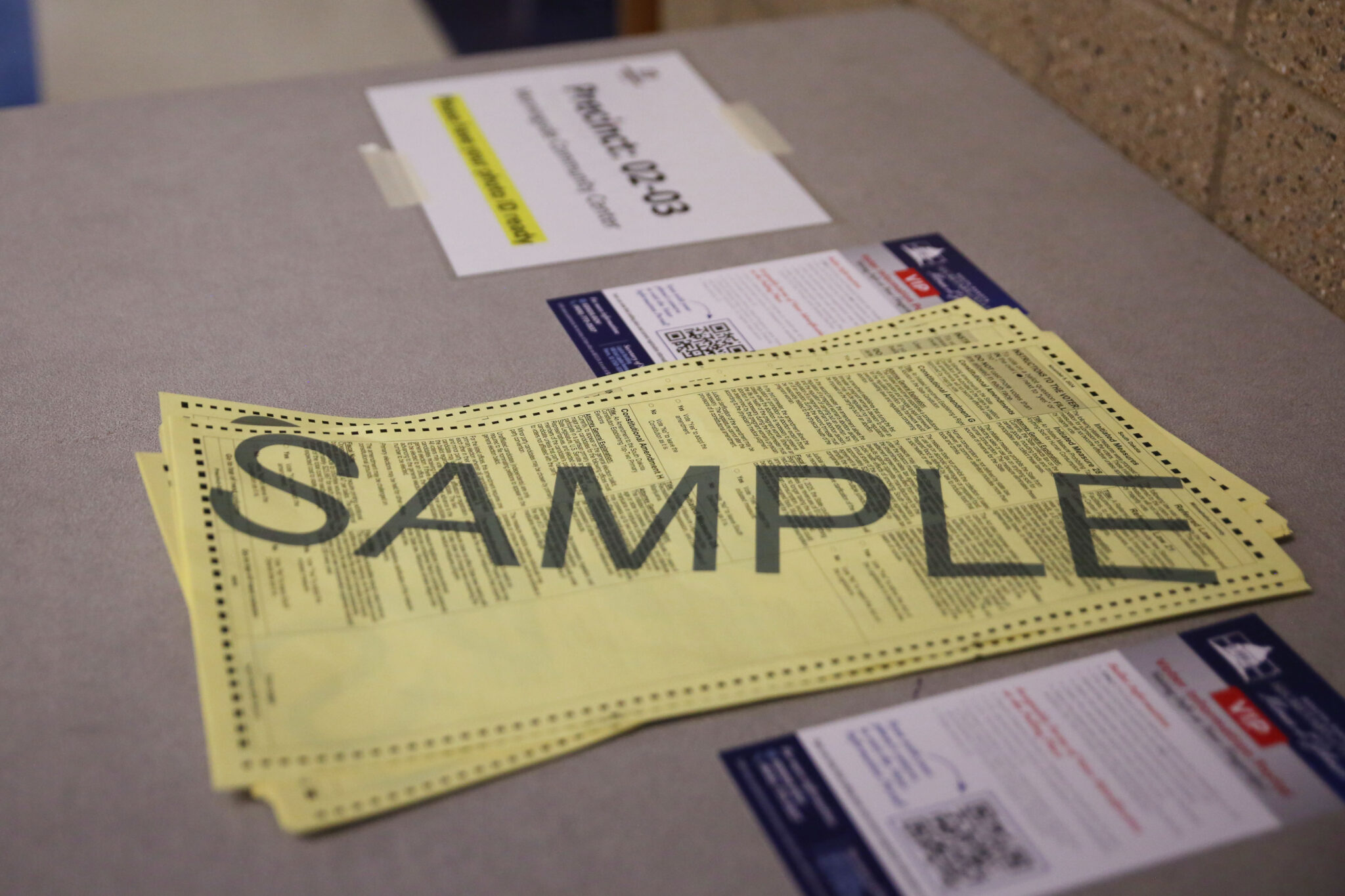
Minnehaha County Auditor Leah Anderson told South Dakota Searchlight her office is printing 324 different types of ballots, known as ballot styles, ahead of the June election. Other county auditors reported a range from a dozen to more than 100.
South Dakota’s most populous county, which includes Sioux Falls, includes nine legislative districts, 10 cities and 13 school districts —- many with overlapping boundaries and some with wards of their own. The county must not only prepare ballots specific to each sub-jurisdiction that has an election, but also political ballots for the closed primary held by Republicans, non-political ballots for non-Republicans, and federal-only ballots due to two law changes that took effect this year.
One law change requires newly registered voters who don’t produce proof of citizenship to be registered as federal-only voters, and to receive ballots with federal races only, such as congressional races. The other law change requires some voters who are registered at P.O. boxes or mail forwarding addresses, without descriptions of where they live in South Dakota, receive federal-only ballots.
Increase in voter turnout is worth administrative headache
South Dakotans need to “do their research” before voting this year because of the combined elections, Anderson said.
“It’s important for people to read their sample ballots or do their studying before they come in. For the city of Sioux Falls, there’s five ballot questions. For the city of Crooks, there’s one,” Anderson said. “There’s just so much on the ballot.”

Stanley County, which has 18 ballot styles, has been combining elections with the local school district for years. This will be the first year adding city elections into the mix.
“We’re a small county. It makes sense financially, but it also makes sense for our election workers,” Burtch said. “Instead of multiple elections throughout the year, it’s easier for them to volunteer for one or two.”
While all counties, school districts and cities are required to combine elections on the same date, they aren’t required to combine on the same ballot — though many, like Minnehaha and Stanley counties are.
McCook County Auditor Geralyn Sherman called that approach a “nightmare” to “come up with umpteen different ballot styles.”
Sherman’s county will have separate ballots for the McCook Central School District and Montrose city elections, both using the same polling locations as the county.
“When we started to try and figure out what those combined ballots would look like, it was like ‘Oh, forget it,’” Sherman said.
Fort Pierre Republican Rep. Will Mortenson introduced House Bill 1130 last year, which set the change into law. He believes the combination will lead to better voter turnout and engagement.
“Whenever there’s a conflict of administrative ease and voter convenience, I try to put the voter first,” Mortenson said.
Voter turnout for the Sioux Falls School Board’s 2025 election was 2.33%, the lowest in over a decade. In 2024, the district’s voter turnout was 7.7%, despite being combined with a city election.
Turnout in Stanley County nearly triples when school elections are combined with state races, Burtch said.
Local governments weigh voter turnout against calendar
According to a survey conducted by the Associated School Boards of South Dakota, 95% of school boards with elections are holding them in June instead of November. Two school boards are holding their elections in November, though the organization did not say which two.
Brookings School Board President Debra DeBates said the board chose June because its fiscal year begins in July and the school year begins in August.
“It seems pretty inconvenient to bring a new board member on in December or January when we’re halfway through the year,” DeBates said.
As for cities, a South Dakota Municipal League survey found 61% of responding cities with elections this year are holding their elections in June instead of November.
Executive Director Sara Rankin said city officials commonly chose June over November because they’d previously held elections in that month or because it fit better into their budget setting process.
The city of Brookings will hold its city council elections in November. Councilwoman Lisa Hager, who is planning to run for reelection this year, said there were benefits and pitfalls to choosing one date or the other.
Local candidates can be more prominent on what is likely to be a shorter ballot in June, but it would lead to smaller voter turnout, she said. November would mean longer ballots and less attention on local races in exchange for more voters at the polls — and South Dakota State University students being back in town.
“From our standpoint, it’s about ensuring all members of our community can vote if they want to,” Hager said. “Students could vote absentee in June, but we didn’t think we should erect barriers for voting for anyone in the community.”
Political scientists raise partisanship concerns
Some political experts worry that most elections being held in June will favor one political ideology over another.
There are no statewide Democratic primaries in June, and there is only one Democratic primary at the legislative level this year. Republicans, on the other hand, have statewide primaries for governor, U.S. representative and U.S. senator, as well as a primary in most legislative districts.
University of South Dakota Professor Julia Hellwege said people most likely to vote in primaries are “strong partisans.”
“You’re going to put local elections on the ballot and select an electorate, knowing that they’ll be the most extreme partisans.” Hellwege said. “The likelihood of electing moderate people to local school boards and city councils will decrease drastically.”
Hellwege is also a member of the Vermillion City Council and is running unopposed. Vermillion has held combined city and June primary elections for years.
Although the combined elections were meant to get more people to the ballot box, if there aren’t bigger races drawing people’s attention, it’ll leave a sizable group of voters and ideologies out, said Michael Card, professor emeritus of political science at the University of South Dakota.
“Vermillion has a charter amendment that I’m worried isn’t going to pass because, if Clay County has more heavily Democratic representation, people might just stay home and not vote for that charter amendment,” Card said, adding that a mayoral race might still entice Democrats and non-partisans to vote.
Mortenson said that no matter the party affiliation, a higher number of voters “leads to better results.”
“Common sense tells us we’re more susceptible to a small, fringe group electing a candidate when turnout is 4% rather than when it’s 40% or 50%,” Mortenson said.
Mortenson said that over time, he believes more local races will gravitate toward dates with higher voter turnout.
“Ask me in 10 years, and I believe most school and city elections will be in November,” Mortenson said. “At least, that is my hope.”