
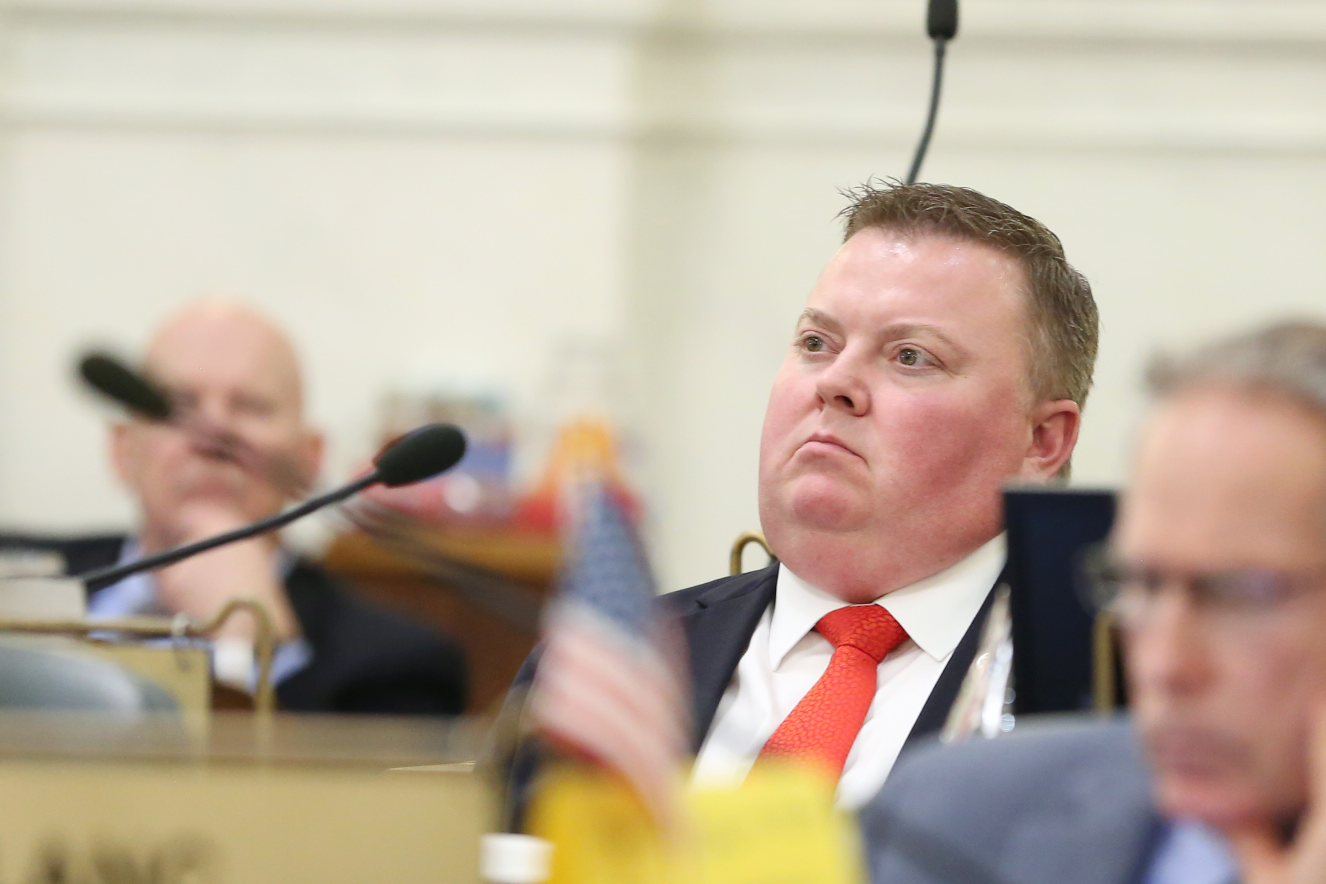
Makenzie Huber/South Dakota Searchlight
PIERRE — A bill aiming to ban student cellphone use in South Dakota schools has a chance to be debated on the state Senate floor after the Senate Education Committee voted 5-2 on Tuesday to send it there without recommendation.
The legislation, introduced by Sen. Chris Karr, R-Sioux Falls, would ban student cellphone use at public school campuses during the day, unless in a health emergency or for educational purposes.
Currently, 38 states and Washington, D.C., have enacted some form of statewide restriction or requirement for districts to limit student phone use. Of those, roughly 18 states and the district have full-day bans or comprehensive statewide restrictions (including during classroom and noninstructional time), according to Stateline.
Most school districts in South Dakota have implemented a policy regarding cellphone use among students during the school day, but those policies vary.
According to a South Dakota Searchlight survey last year, about 60% of districts do not allow cellphones for at least part of the school day, although in some schools, students can keep the devices in their backpacks or lockers. About one-third of the districts in the state remove or lock away high school students’ cellphones for at least part of the school day.
Karr told lawmakers the existing policies aren’t enough, since they vary by school district and don’t all address use in the hallways or lunch room. He added that banning cellphones as a statewide standard would improve student mental health, focus, education and sociability.
South Dakota Department of Education Secretary Joe Graves told lawmakers that although he agreed with the “general premise” of Karr’s bill, he believes most schools are moving toward stricter policies anyway.
“Given that, why violate local control? This is a problem already on its way to a complete solution,” Graves said.
If signed into law, the department would include the policy requirement in its school accreditation process, Graves said. The department wouldn’t monitor students or schools to ensure it would be enforced.
Lawmakers voted to move the bill forward without recommendation after motions to approve and reject the bill failed. Bills with no recommendation need a motion supported by a majority of the Senate to be placed on the calendar for debate.
Committee endorses ‘nonpublic school’ definition
The Senate Education Committee also recommended Senate approval of a bill to define a “nonpublic school” in state law. The bill passed with a 4-3 vote.
Administrative rules define a nonpublic school, but Sen. Lauren Nelson, R-Yankton, said the definition should be codified and extended to non-state-accredited nonpublic schools. The rules currently define a nonpublic school as a private school recognized and accredited by the state, such as Christian or tribal schools.
She added that the separate educational category of alternative instruction currently includes organized and staffed schools with students in the hundreds, as well as online, hybrid and microschools that are unaccredited, or accredited by an entity other than the state. That is “fundamentally different” from homeschooling, Nelson said, and “treating them as somehow equal defies common sense.”
Those schools should be recognized as unaccredited, nonpublic education, said Nelson, who was an administrator for the Missouri Valley Christian Academy. The school is an unaccredited alternative instruction program.
“We are schools. We’re not public schools. We’re not accredited nonpublic schools,” Nelson said. “We’re unaccredited. We have a place, but we’re not homeschooling.”
Alternative instruction lobbyists, including South Dakota Director of Americans for Prosperity Jennifer Beving, opposed the bill. She said nonpublic schools should be “defined at some point,” but that the proposal could limit students’ ability to get an education from a range of public and alternative sources, including online courses or unaccredited, private schools.
“I believe there are a number of unintended ways that it could roll back the rights that homeschoolers fought for in 2021,” Beving said, referencing legislation that made it easier to enroll students in alternative instruction.
Graves also spoke against the bill, saying that it could complicate the state’s efforts to participate in President Donald Trump’s federal education tax credit program.
Under the program, South Dakotans who owe federal income taxes can either send up to $1,700 to the federal government, or they can donate that $1,700 to a government-recognized scholarship granting organization for public, private or homeschool entities in the state. The program starts in 2027.