
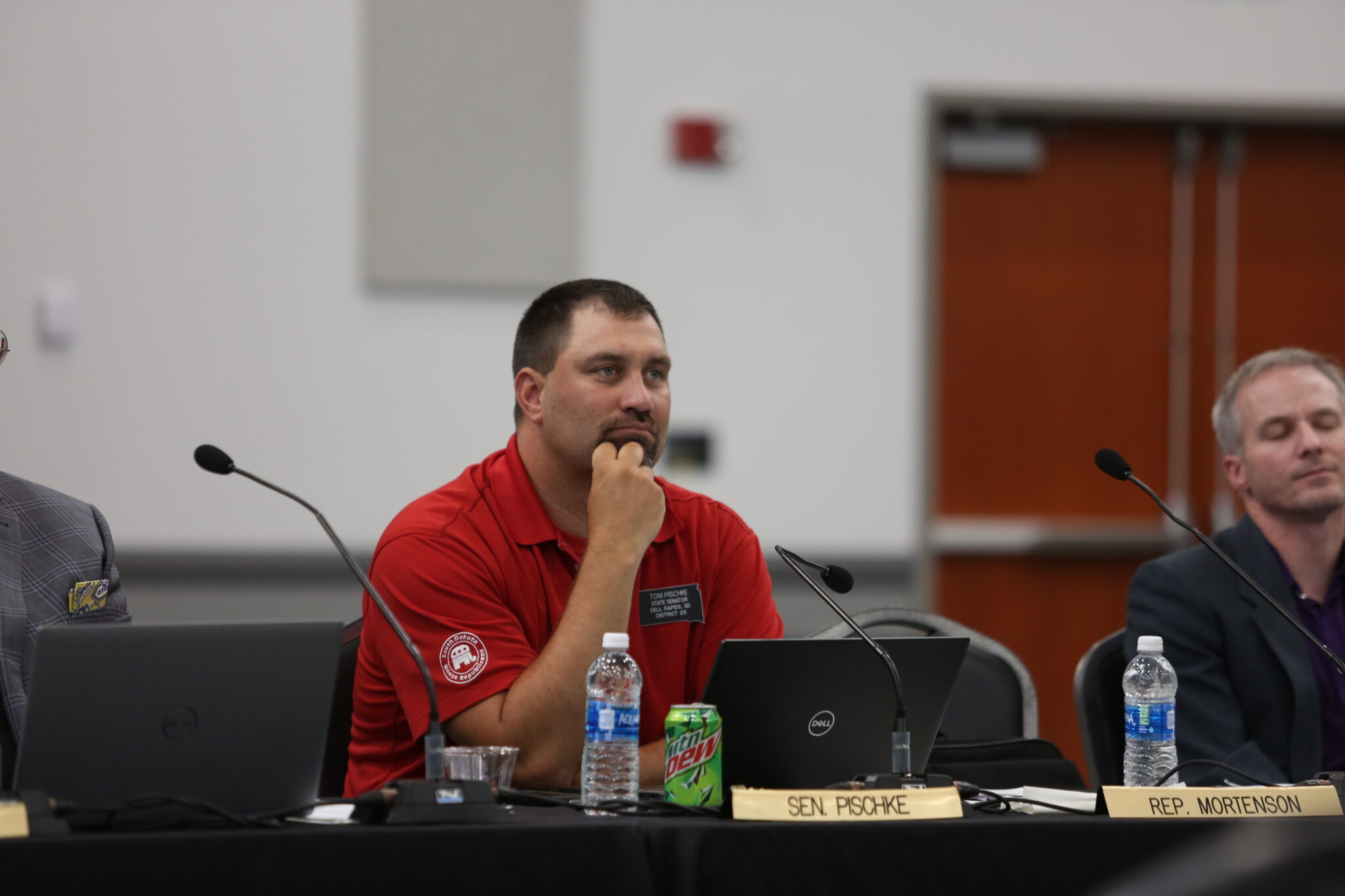
John Hult/South Dakota Searchlight
A South Dakota state senator was charged with two felonies Tuesday for allegedly trying to put candidates for county party leadership posts on the primary election ballot without those candidates’ knowledge.
If convicted on both counts of offering a false or forged instrument for filing, 44-year-old Dell Rapids Republican Tom Pischke faces up to four years in prison.
The charges relate to alleged behavior that took place more than two months before the June 2 primary. Pischke was unopposed in the primary, and faces an independent candidate named Bryan Breitling, who’d previously served in the state legislature as a Republican, in the general election.
Pischke turned himself in on Tuesday morning. He was arrested, booked into the Minnehaha County Jail and released on his own recognizance before the Minnehaha County Sheriff’s Office sent a news release announcing that the charges had been filed.
He directed South Dakota Searchlight to his lawyer, Ryan Kolbeck, who said in a text that his client “is cooperating with the investigation but has no further comment at this time.”
Pischke is the second state lawmaker charged with a felony this month. The first, Newell Republican Rep. Travis Ismay, was charged with felony damage to a roadway. Ismay’s initial appearance is scheduled for July 10 at the Butte County Courthouse. Ismay also won his primary contest on June 2, and is running unopposed in November.
The charges filed against Pischke on Tuesday are linked to 16 fraudulent nominating forms for precinct committeeman and precinct committeewoman, according to a Minnehaha County Sheriff’s office report in Pischke’s criminal case file.
People who hold those positions have a vote at county party meetings and are entitled to be delegates at the state GOP convention, the 2026 version of which begins on Thursday in Rapid City.
As convention delegates, precinct committee members get to vote on the party’s general election nominees for attorney general, secretary of state and other constitutional offices. They also get a vote in decisions made by their county’s party.
Minnehaha County Auditor Leah Anderson told South Dakota Searchlight that none of the candidates tied to Pischke’s case appeared on the June 2 primary ballot.
Phony nomination forms catch auditor’s eye
The questionable nomination forms arrived on March 30, one day before the deadline to appear on the June 2 primary ballot.
While cross-checking the addresses listed on the forms, the court records say, one of Minnehaha County Auditor Leah Anderson’s employees saw that the address of one purported candidate didn’t match the address listed in their voter registration file. That spurred additional scrutiny for all 16 forms, the court records say, which Anderson noted had conspicuously similar handwriting.
Her employees reached out to each person listed as a potential candidate to ask if they had signed the form, and most of them “did not know what the form was for,” the records say.
Anderson also compared signatures from 15 of the 16 purported candidates to other documents bearing their signatures, and “none of the signatures matched the suspected fraudulent forms.”
A detective later spoke with each person for whom a form had been filed. Twelve said they had no idea their name had appeared on such a form. One said Pischke had asked them to run, but that they’d declined to do so.
Three others told the detective that they had wanted to run for the positions, and that Pischke had urged them to do so.
When approached by a detective, the court documents say, Pischke denied signing the forms. He said he wouldn’t expect his DNA or fingerprints to appear on them, the court documents say, and he consented to the collection of a DNA sample.
Shortly thereafter, detectives obtained video footage of a vehicle dropping something off at the Dell Rapids Post office. The video only showed the driver’s hand and wasn’t clear enough to show what was placed in the box, the court documents say, but it was clear enough to show three of the numbers on the vehicle’s license plate and the vehicle’s make, model and approximate year: a 2000-2005 Chevy Impala.
There’s only one Chevy Impala in South Dakota of that vintage with a license plate number bearing the three characters seen in the video, and it’s registered to Pischke.
The South Dakota Forensic Lab, meanwhile, analyzed the envelopes and found DNA from three people. The “major contributor” of DNA was “consistent” with Pischke.
No impact on convention
Pischke won’t be at the state convention, according to Jim Eschenbaum, head of the state Republican Party.
Pischke sent Eschenbaum a text on Monday to say he couldn’t make it, without disclosing details about why.
Eschenbaum told Searchlight on Tuesday that he’d heard rumors about possible fraud charges for Pischke, and that it was a “bummer” to learn that charges were filed.
The convention, Eschenbaum said, will proceed as planned, just without Pischke.
Korry Petterson, chairman of the Minnehaha County Republican Party, said he’s been aware of the investigation for months and had also heard “rumors” that Pischke was involved.
Petterson had clashed with Pischke over the county party’s direction, the chairman said, but “still, I don’t even want to fathom that this is what happened.”
Unless Pischke is convicted, Petterson said, there’s little the county party could do to discipline him.
Attempt to influence balance of power
Petterson told South Dakota Searchlight a few weeks ago that whoever was behind the attempt to influence the county party’s voting membership was likely trying to hamstring his ability to conduct party business.
Minnehaha County is South Dakota’s most populous, and its county GOP’s votes for party nominees at the state convention are weighted to reflect that population.
Eschenbaum said the incident with Pischke is part of “the Minnehaha County drama that never ends” in the Sioux Falls area over “who’s in control of that county party.”
“It’s who’s in control of that county party,” Eschenbaum said. “That’s what this was about.”
There are three factions in the Minnehaha County GOP, Petterson said. The chairman described himself as part of a faction that aims to find middle ground between the party’s more traditional wing and its populists – the category into which Petterson said Pischke falls.
Who’s in control at any given time is in part a function of precinct committee members, who can be elected during primaries or be nominated and voted on at meetings of the county party.
The number of active precinct committee members fluctuates in any county, and not every position is filled. There are 145 now in Minnehaha County, and Pischke is one of them.
To hold a meeting with a voting quorum, Petterson needs 20% of voting members present. The more precinct committee members positions are filled, the more people he needs at a meeting to make decisions.
The difficulty of hitting the 20% attendance figure, Petterson said, could compound if those positions were filled by people unaware of their status as voting members.
Eleven of the 16 forms were submitted for unfilled positions, according to the Sheriff’s office report attached to Pischke’s criminal case file.
If the allegations against Pischke are proven, Petterson said, he hopes prosecutors push for the stiffest punishment possible to show that such behavior “will not be tolerated.”
He said he hopes the party as a whole takes a broader message, regardless of the outcome of the criminal case.
“If anything, I think it will help people realize that the extremism has got to stop,” Petterson said.