
Bart Pfankuch/South Dakota News Watch
Multi-million dollar paydays are in store for the company that excavated the Tyrannosaurus Rex fossil that sold last week for $50.1 million, the rancher whose western South Dakota land it was found on and the firm that conducted the public auction.
While details of auction sale proceeds are proprietary, famed Hill City paleontologist Peter Larson told News Watch that there is a formula typical of other dinosaur auctions that can estimate who received how much from the sale.
Larson, president of the Black Hills Institute for Geological Research, said the actual sale price of Gus, the nickname for the T. rex sold at auction in New York on July 14 was $43 million.
The $50.13 million total includes a roughly $7 million “buyer’s fee” paid to Sotheby’s auction house by the anonymous person or institution that bought the skeleton.
Sotheby’s likely then collected a 10% commission on the sale, which would be roughly $4.3 million and is paid by the sellers.
That leaves more than $38 million to be split between Theropoda Expeditions, which excavated and reassembled the skeleton and prepared it for sale, and Dana Licking, owner of the Harding County ranch where Gus was discovered.
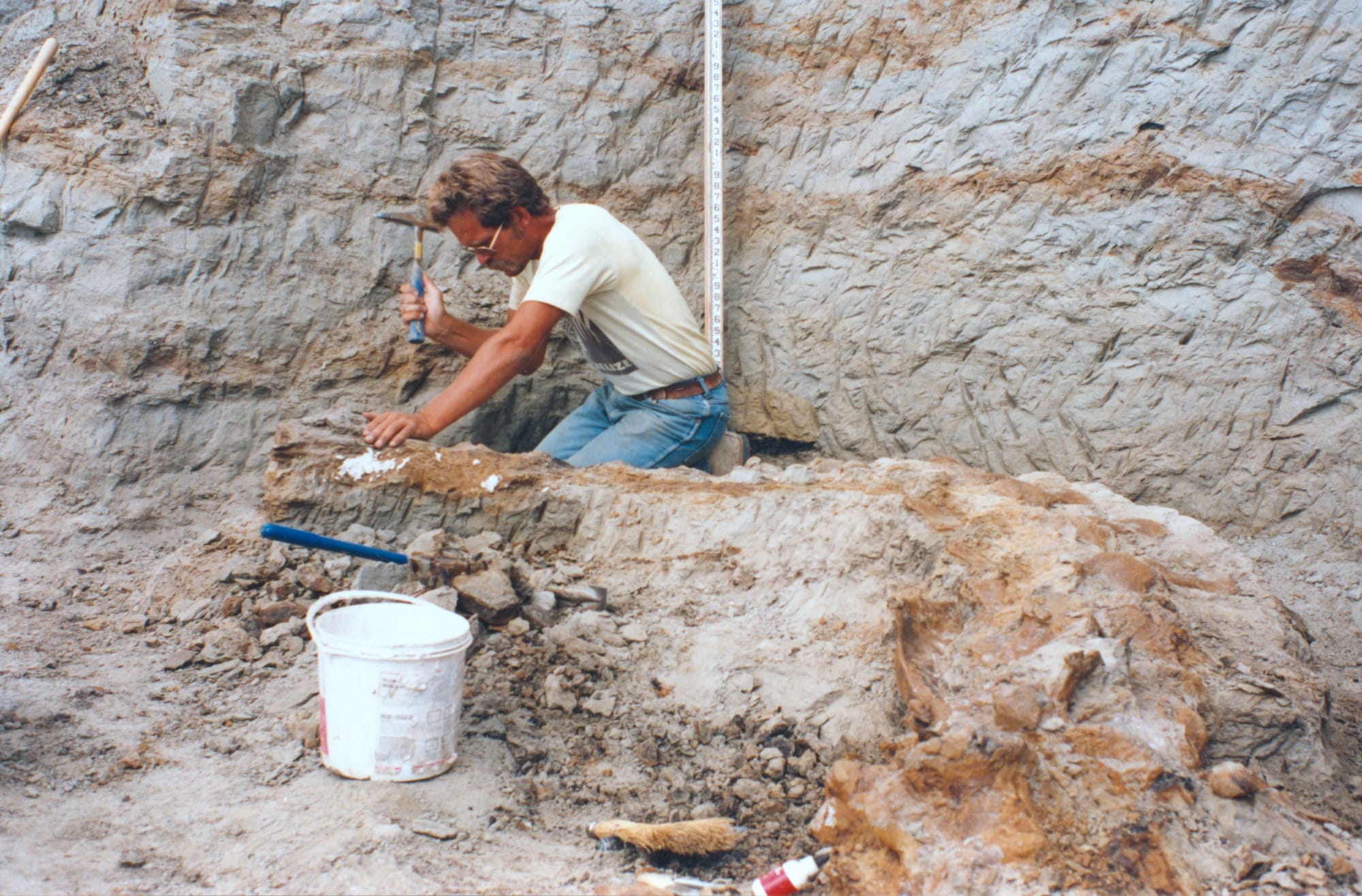
The first bones from Gus were found in 2021 on land owned by Licking and her late husband, Gary, whose nickname was Gus.
Theropoda Expeditions, owned by Thomas Heitkamp, is a Texas company specializing in commercial excavation, preparation and mounting of dinosaur fossils.
25,000 hours of labor required
Larson, who has led numerous fossil discoveries including two T. rex skeletons, said he doesn’t know what type of proceed split was agreed to between Theropoda and Licking.
But Larson said his past excavations that led to auction sales contained a 50-50 split of proceeds between the discoverer and the landowner, which in this case would mean both parties would receive about $19 million.
Any proceeds, however, would be subject to taxation and must cover the costs of the digging and preparation that in this case took five years.
Larson pointed out that the process to discover, excavate and prepare a T. rex skeleton requires about 25,000 hours of manpower. He added that fossil excavation is an arduous process that requires extensive up-front and overhead expenditures and a team of scientists working in tough conditions to properly dig up and protect the bones.
“I think everybody was pretty happy with what it brought,” said Larson, who famously led the extraction of Stan the T. rex in 1987 and Sue the T. rex in 1990, both found in western South Dakota. “It’s nice and very satisfying to see the approval from the public and to realize how much the public understands the true worth of these dinosaurs.”
Angst, then elation during tense auction
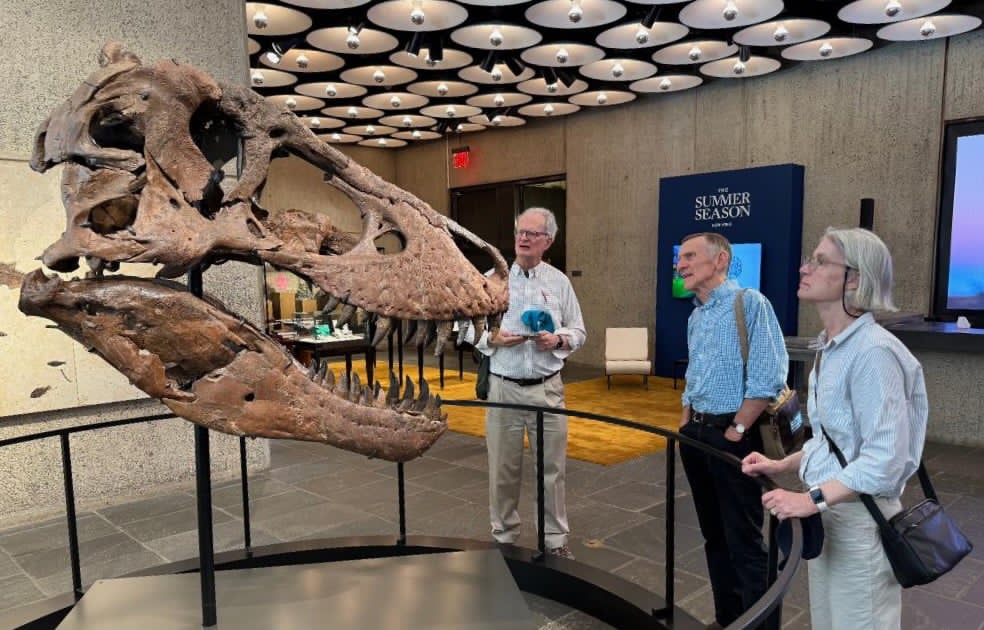
Larson was present at the auction at Sotheby’s offices in New York on July 14, mostly to witness the dinosaur auction and provide support to Heitkamp and Licking, who were also in attendance.
The skeleton of Gus was expected to draw a price tag of up to $30 million due to its condition and the professionalism of its extraction and preparation.
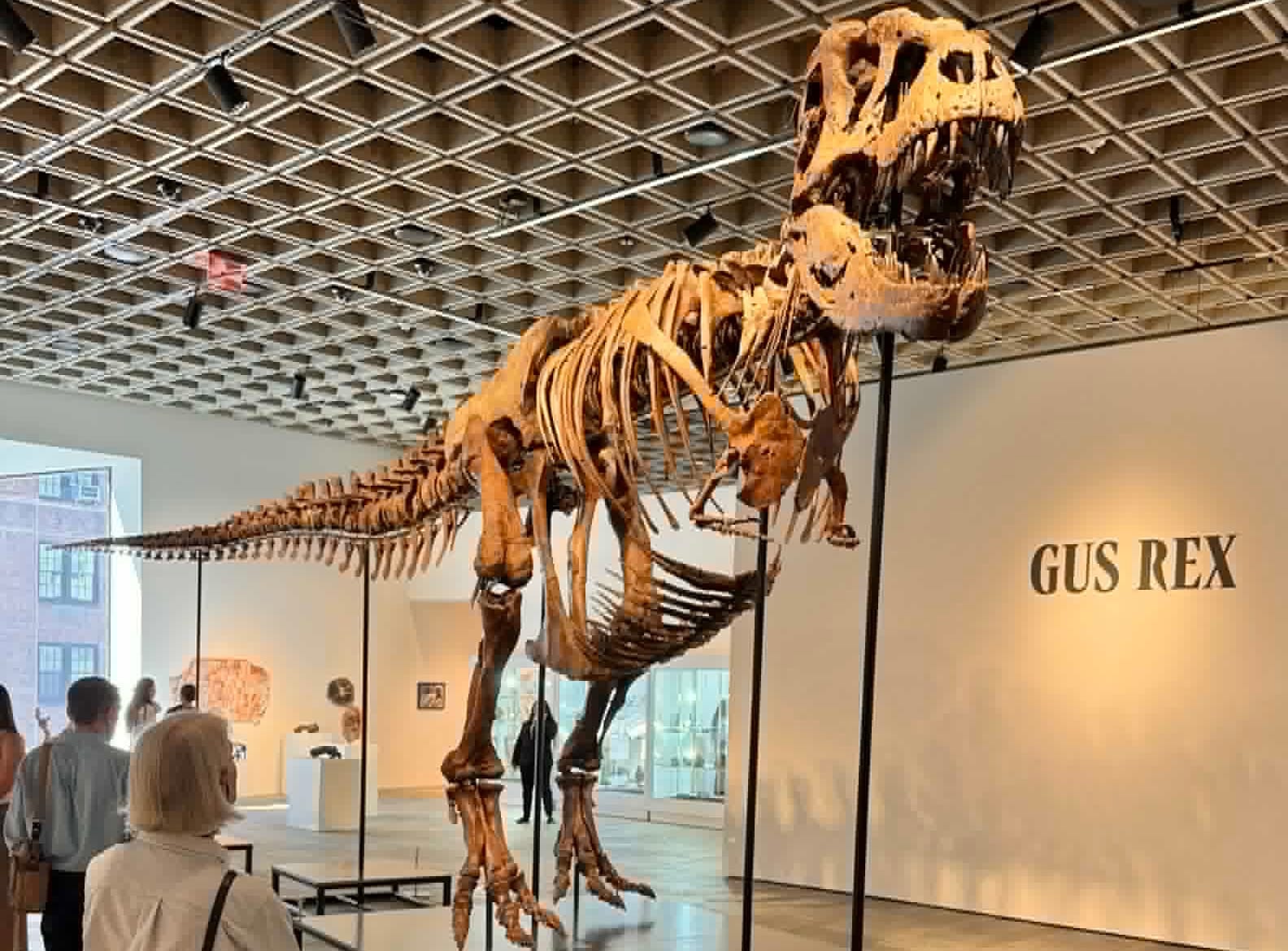
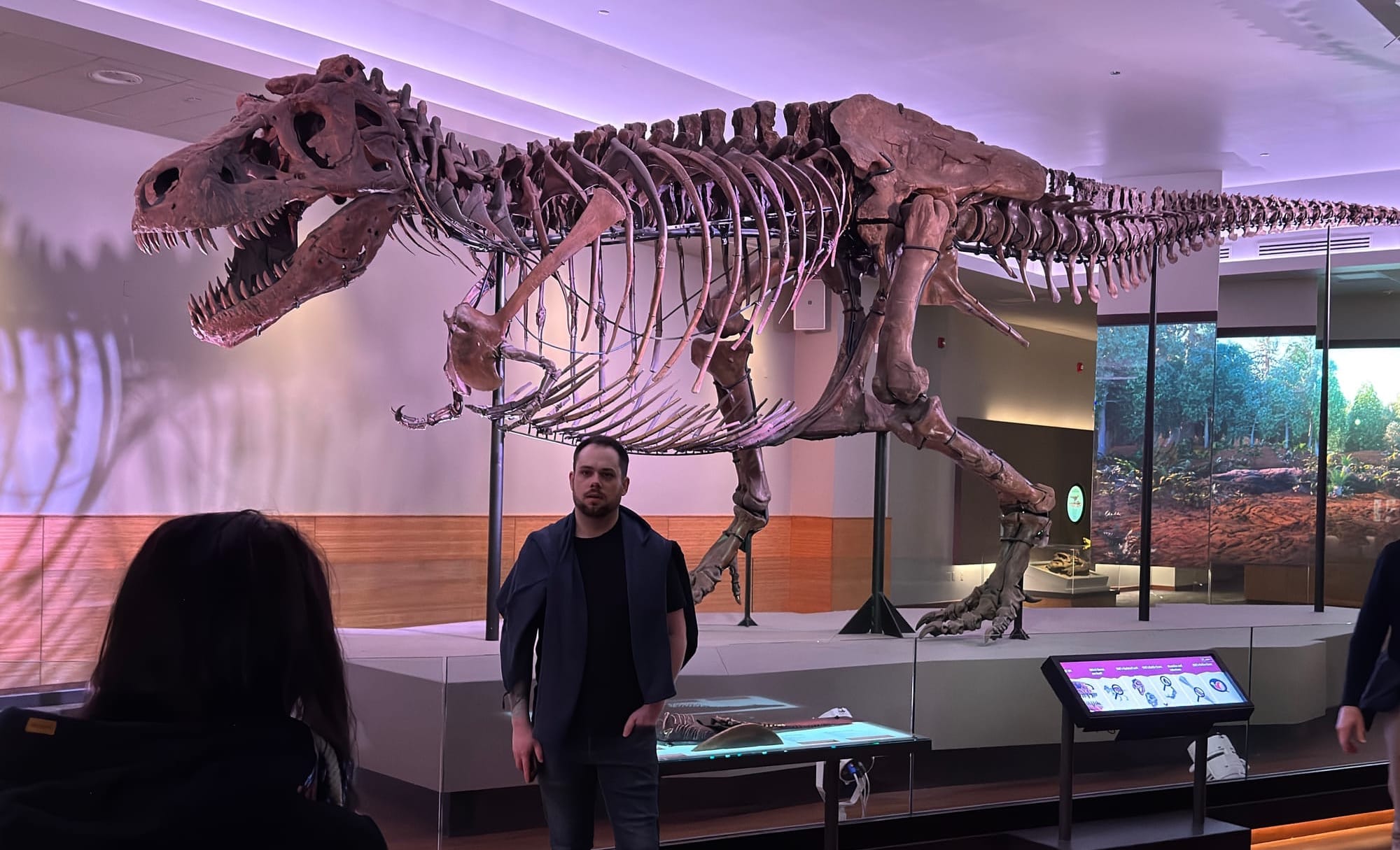
The 38-foot long skeleton stands more than 12 feet tall and has one of the most complete T. rex skeletons ever found at roughly 61% of bones recovered.
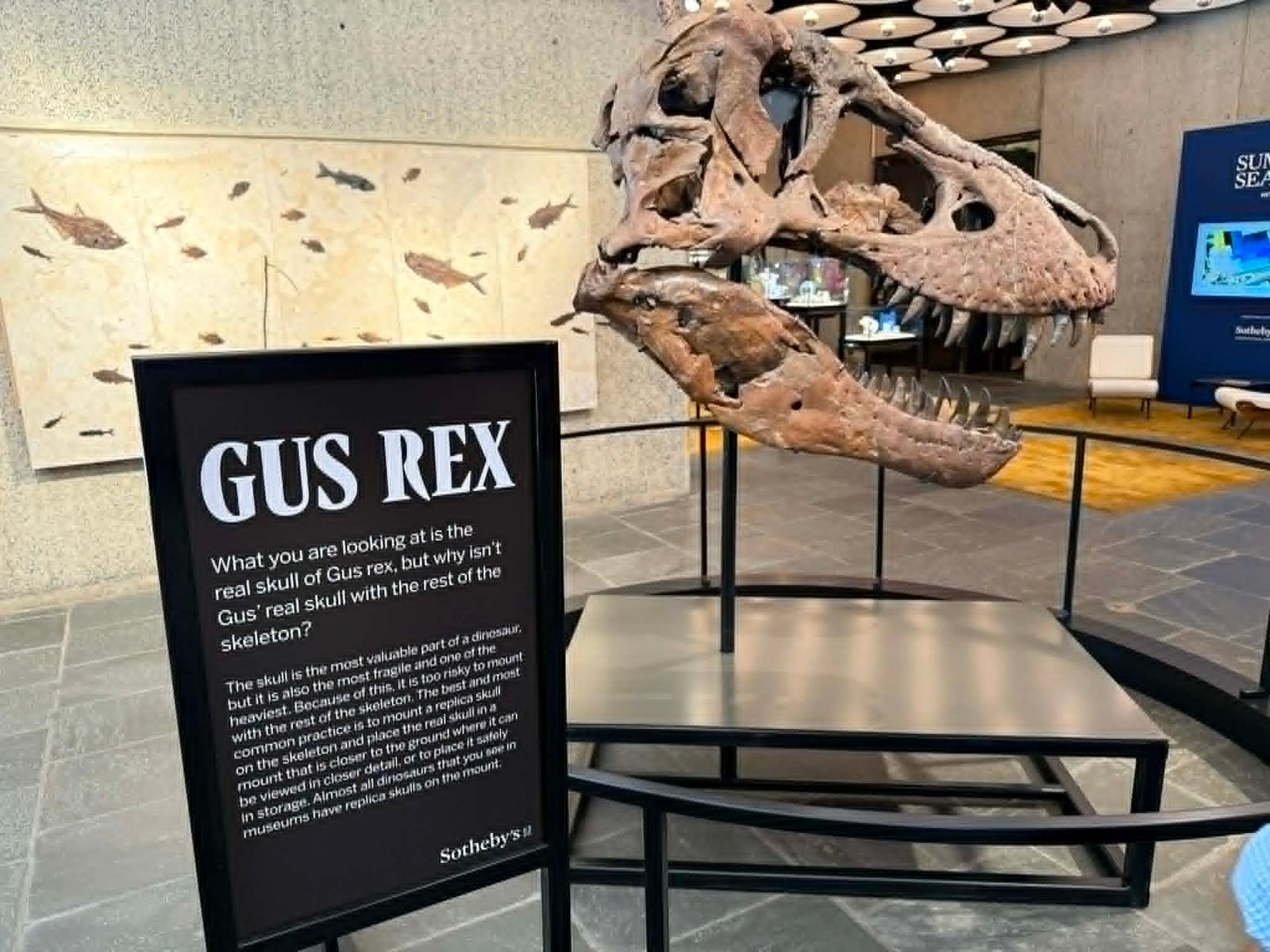
The dinosaur, believed to have lived on Earth during the late Cretaceous Period about 67 million years ago, is mounted in an upright walking position and was on display at Sotheby’s offices prior to the sale.
The mood in the auction room was tense as bidding began, Larson said.
“There was some anxiety with the sellers and the potential buyers and the auction company because they were hoping it would break records,” Larson said.
According to The Associated Press, the winning bidder participated by phone and outbid six other prospective buyers during Tuesday’s 10-minute bidding battle that was conducted both live and online.
At one point, auctioneer Phyllis Kao tried to stimulate more bidding. “Try a bigger bite,” Kao said. “It’s a T. rex, after all.”
As the price climbed into record territory and the sale eventually closed, a sense of accomplishment fell over the room, Larson said.
“A lot of people were anxious, but once it was done, everybody breathed a sigh of relief and said, ‘Wow, this is great,'” Larson said.
Good for science – and for South Dakota
The record sale price for Gus the T. rex could have several ripple effects that will land in South Dakota, said Walter Stein, a paleontologist from Belle Fourche.
The Licking ranch lies in the famed Hell Creek Formation, a geological region of northwestern South Dakota and parts of Montana, North Dakota and Wyoming where dinosaur finds are fairly common.
Hearing about a $50 million sale could draw more fossil hunters to western South Dakota and nearby environs, Stein said.
“Historically we can see that,” said Stein, who runs PaleoAdventures and the Dinosaurs of the Hell Creek Museum in Belle Fourche. “When Sue sold for $8.3 million (in 1997), you had everyone and their grandma digging up here.”
The negative side of that heightened interest is that it could attract unscrupulous or careless fossil hunters who trespass on private lands, destroy fragile fossils or poach other paleontologists’ active dig sites.
“If somebody thinks they’re going to get rich by pulling up to an outcrop and tying a log chain to a dinosaur’s tail and dragging it out and selling it for millions of dollars, it doesn’t happen that way,” Larson said.
Larson cautioned landowners who believe fossils are on their land to be careful and work only with experienced, established paleontologists who hold reputations for honesty and scientific rigor.
On the plus side, more fossil activity could increase the number of dinosaur finds, Stein said.
“More people digging means more discoveries,” Stein said. “Whether you like commercial paleontology or not, the profit motive certainly drives and sustains us to find and recover more fossils and learn more about this incredible science.”
Stein said he was shocked but pleased to see the record-breaking price for Gus.
“Absolutely it gives us motivation to keep pushing on,” said Stein, who on July 15 was leading a group of clients on a fossil dig in Harding County, not far from where Gus was discovered. “We’re pushing forward right now in 105 degree temperatures with a 60 mph wind that kicks up every once in a while.”
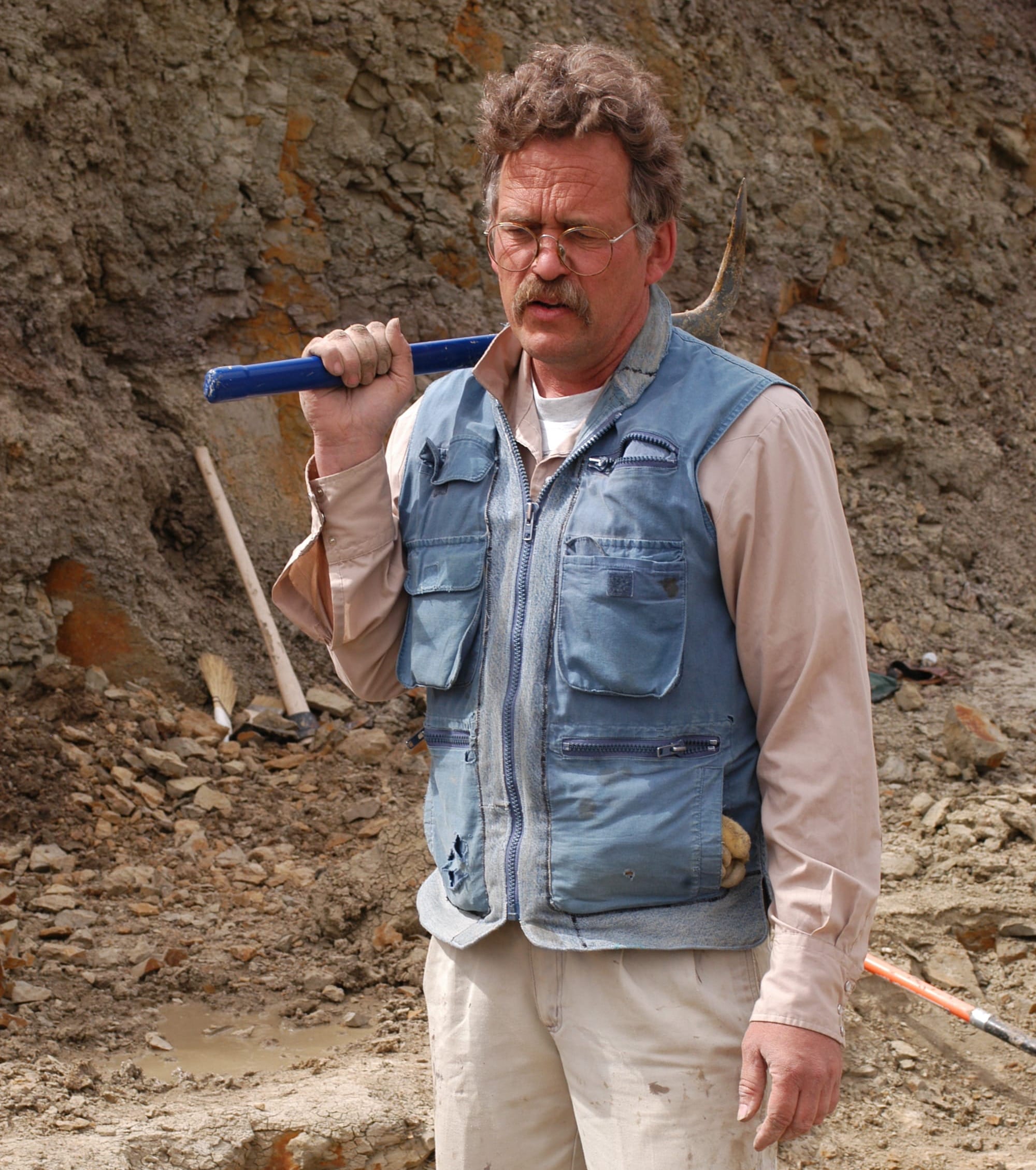
The high-profile sale of Gus could also generate greater interest in the science behind paleontology and in the history of dinosaurs, Larson said.
That would be good news for the dinosaur museum industry in western South Dakota, including for the Black Hills institute, which recently purchased the former Prairie Berry Winery building near Hill City. The winery is being converted into a 40,000 square-foot dinosaur museum, Larson said.
“I tell people that dinosaurs and fossils are the gateway drug to science for both kids and adults,” he said. “This definitely shows how important these dinosaurs are, and it shows that the public is super interested in them.”
Both Stein and Larson said they are aware of the concerns that skyrocketing prices are leading to increased private ownership of dinosaur fossils, which critics say could limit the public’s ability to view them and learn more about the animals, earth history and paleontology.
But Stein said there are enough dinosaur skeletons on display in museums these days that it’s fairly easy for people to see them.
Larson noted that most dinosaurs bought by private owners eventually make it into a museum under some form of display agreement.
“They’ll end up in museums, not to worry,” he said. “We should be happy that people respect our science and respect the fossils to that degree.”