
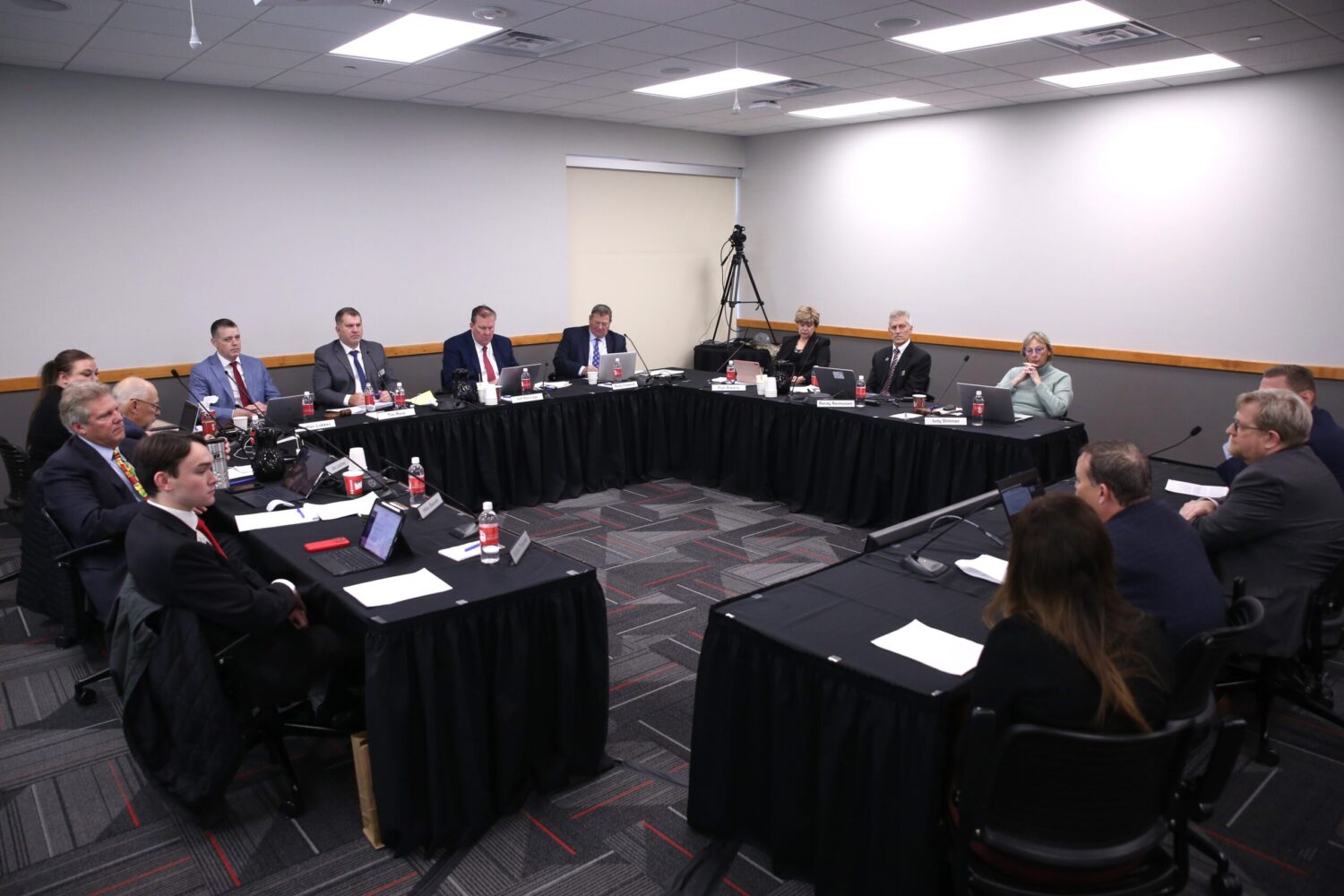
Makenzie Huber/South Dakota Searchlight
The board that oversees South Dakota’s public universities plans to ask state lawmakers for nearly $60.5 million for building projects and maintenance, the launch of a national defense center in Rapid City, and technology upgrades related to artificial intelligence.
The Board of Regents also endorsed construction funding requests Thursday during a meeting in Spearfish, including funding to begin the previously announced move of the University of South Dakota Sanford School of Medicine to Sioux Falls.
Board member Pam Roberts said the requests are an “investment in South Dakota’s future.”
“It helps keep us affordable, it helps with workforce development and makes sure that we’re responsive to all the needs of South Dakota,” Roberts said.
Gov. Larry Rhoden will take up the requests later this year and decide whether to include them in his fiscal year 2028 budget proposal ahead of the legislative session, which begins in January.
Funding for artificial intelligence
As the board plans to use artificial intelligence in its business and educational operations, it’s requesting $20 million in one-time funding to build out its AI technology system and $4.5 million in ongoing funding to maintain it.
The board approved a new AI policy at its Thursday meeting, and the board will launch a system-wide software this fall that supports several AI uses and future emerging technologies, said David Overby, interim system chief information officer.
“This policy provides a way to enable AI innovation across the regental system while maintaining clear boundaries around data protection, security, oversight and accountability,” Overby said. “It supports responsible adoption without treating AI as unmanaged or standalone technology.”
The board also approved four AI academic programs on Thursday: a doctorate in AI at Dakota State University and bachelor’s, master’s and doctoral degrees in artificial intelligence engineering at South Dakota State University.
The $4.5 million additional ongoing request would be used to maintain the AI infrastructure by replacing aging equipment, building out technology infrastructure and funding cybersecurity needs. South Dakota State University President Barry Dunn said AI is increasingly used at universities across the nation.
“This opportunity is not simply to make AI tools available, but to use AI responsibly to improve service efficiency, accessibility and decision-making across the regental system,” Dunn said.
The ongoing funding request is essential, said Northern State University President Alan LaFave.
“Core technology is now core infrastructure,” LaFave said. “It has to be maintained, replaced and funded on a predictable cycle just like buildings, utilities and other essential campus systems.”
The regents plan to use another $1.6 million annually from student tuition fees to support the technology updates.
Launching a national defense center
Several university presidents spoke in support of a $1 million request to launch a Center for National Defense in Rapid City, which aligns with Gov. Rhoden’s creation of the South Dakota Defense Institute in April. The center will require seven full-time workers.
The defense industry is one of the “fastest growing sectors in our state’s economy,” Black Hills State University President Steve Elliott said.
The center will develop the workforce needed for defense acquisition, systems engineering and emerging defense technologies, among other needs, Elliott added.
Elliott said the collaboration would offer students work-based learning projects, internships and fellowships with nearby Ellsworth Air Force Base, the South Dakota National Guard, defense contractors and government agencies in the area.
Dakota State University President John Ballard said he’s spent “most of my life in this area.” He attended the United States Naval Academy, served in faculty and administrative roles at several military and defense colleges, and served as president of the National Intelligence University in Washington, D.C., where he led technology integration across the intelligence community.
“I can tell you with a great deal of certainty that programs like this are not only highly productive but also highly beneficial to the people that they’re designed to serve,” Ballard said.
Return to building maintenance goals
The board sets an annual goal to fund campus maintenance needs at 2% of the total replacement cost for campus buildings. For fiscal year 2028, that would be $18.78 million.
Last year, lawmakers underfunded the maintenance request, which board member Roberts called “shortsighted and disappointing” at the time.
Sheila Gestring, University of South Dakota president, said university buildings are among the state’s “most valuable public assets” because they support economic and workforce development.
“When maintenance is deferred, costs don’t disappear, they grow,” Gestring said.
The fiscal year 2028 request is about $1.65 million more than fiscal year 2027’s request.
Capital project requests
Gestring requested $6.2 million to begin relocating the Sanford School of Medicine from Vermillion to Sioux Falls. The relocation includes moving instructional, office and faculty space, and an anatomy lab temporarily to existing buildings on the Sanford Health campus in central Sioux Falls.
The university plans to build a new Sioux Falls facility within the next decade, costing about $150 million. Gestring told South Dakota Searchlight in an interview last year that she hopes most of the funding will come from donors.
Dunn requested $10 million to construct a new building to house SDSU’s business and economics programs. The programs’ enrollment grew from 730 students in 2018 to 1,300 in 2025, and is expected to reach 1,500 in 2030.