
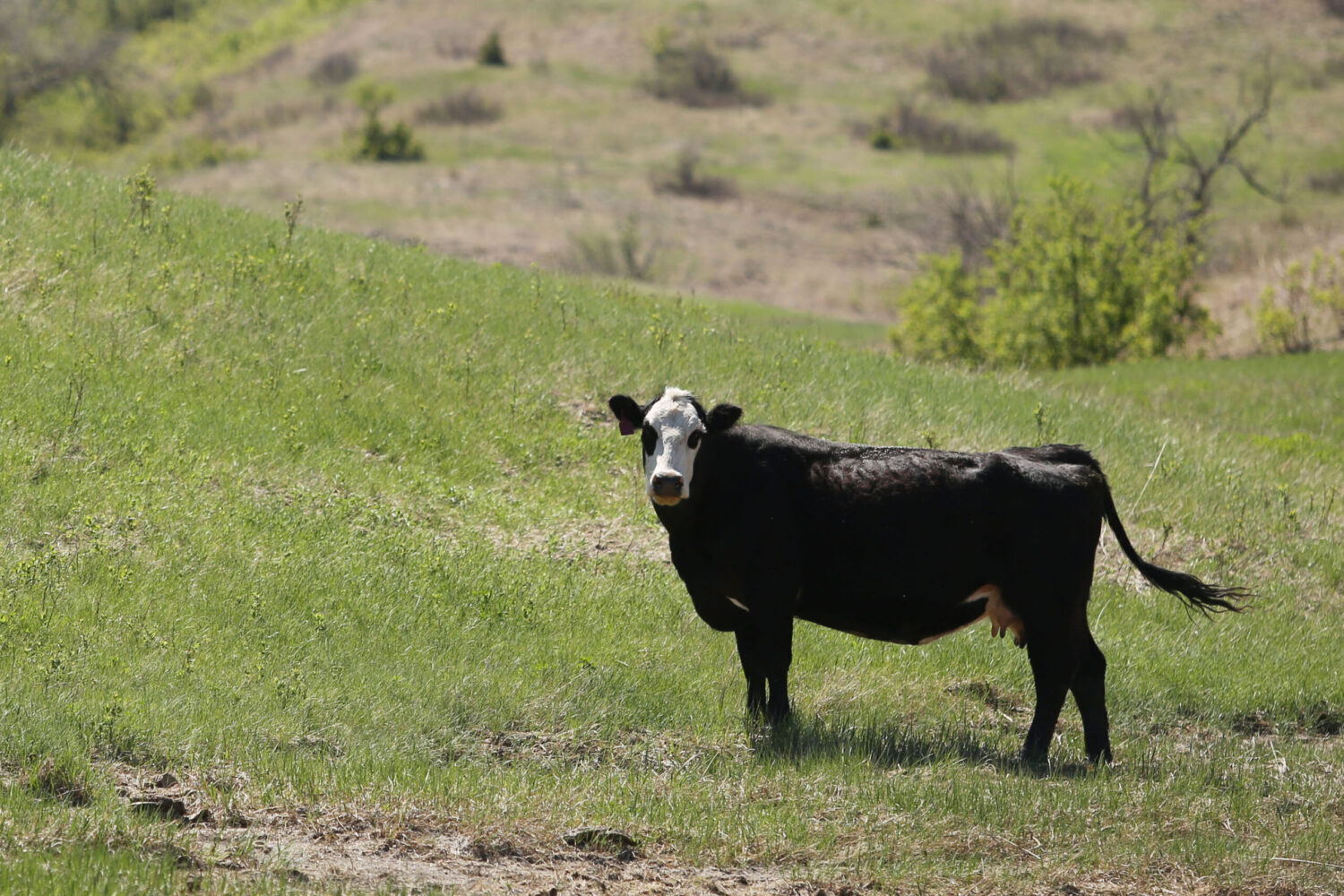
Meghan O’Brien/South Dakota Searchlight
George Kenzy said he did all he could to prepare his family’s feedlot for extreme heat and humidity. That included extra water tanks, covering the ground with light-colored bedding to reduce heat absorption, and keeping the ground as wet as possible.
“And it seemed like Mother Nature just had the upper hand on this one,” Kenzy said.
Thousands of cattle in South Dakota died of heat stress last month. Though locations across the state experienced unusually high temperatures, data from the Rapid City office of the National Weather Service help illustrate the historic nature of the heat wave: It was the city’s second hottest July on record, according to several indicators, and the city experienced its highest-ever recorded temperatures on July 25 downtown (110 degrees) and at the airport (112 degrees).
July was also the warmest month on record for the contiguous United States, according to the National Oceanic and Atmospheric Administration, with an average temperature of nearly 77 degrees.
Days of heat, high humidity, a lack of wind and cooler nighttime temperatures created a dangerous mix, according to Warren Rusche, a South Dakota State University Extension feedlot management specialist.
“Heat stress is one of those issues we have to be ready for all the time in South Dakota,” Rusche said. “What’s different is we haven’t seen widespread death losses like we saw in quite a few years. Normally the approaches we’ve taken have been successful enough that we’ve avoided some of these larger scale death-loss events.”
Rusche estimates at least 2,000 cattle deaths across the state, though he said that’s “likely too low.” No official count is available and likely won’t be for weeks as producers document their losses, he said.
Individual and overall financial impacts
South Dakota ranks seventh in the nation with 3.6 million cattle, according to the U.S. Department of Agriculture.
Brule County, which includes Chamberlain and Kimball, lost between 1,500 and 2,000 cattle from heat stress, Rusche said, which equates to about $6 million of financial losses.
“As devastating as this is for individual ranchers, it’s going to have minimal effect on our beef industry as a whole, just because a lot of producers didn’t get hit with significant death loss,” Rusche said. “The drought, probably, is going to play more of a role in cow numbers than the actual death loss events that we experienced.”
Cattle producers should report their losses to their local Farm Service Agency office, Gov. Larry Rhoden said in a statement on social media. The U.S. Department of Agriculture offers livestock indemnity payments to producers who face “livestock deaths in excess of normal mortality caused by adverse weather.” Those payments are equal to 75% of market value of the livestock lost.
Financial impacts are not the only thing on the minds of producers like Kenzy.
“Initially, it’s shock and awe,” he said. “It’s the absolute gut-wrenching loss of life of the cattle that you’ve cared for so much, put so much work into and then, yeah, you have to clean up the carnage and move on.”
Much of the impact spread through central and southeast parts of the state, including Kenzy’s operation near Gregory. He did not specify how many cattle he lost.
Feeding operations were more heavily impacted by the heat than cow-calf operations, according to Warren Symens, past president of the South Dakota Cattlemen’s Association.
“When you get a 1,500-pound animal that’s been fed to gain fast and grow fast and be ready for consumers, they suffer a lot more because they’re much bigger and they’re in a different environment,” he said. “They can’t go stand in a water pond like a cow on a pasture can.”
The nation’s cattle herd is at a 75-year low, Symens said, “so, anything that’s removing pounds of cattle from the system has an effect,” including on the already high price of beef.
Rising temperatures across the state
South Dakota’s average temperatures are climbing, according to State Climatologist Laura Edwards.
“Most of those increases are driven by warmer nights,” she said. “So, really, that’s not unusual to see warmer nights, but that stretch in July was really unusual, even for the trend that we’re on.”
The state’s also seeing increased humidity levels due in part to a difference in row crops in recent decades, Edwards said. Some farmers have transitioned from spring wheat, which is usually harvested by this time of year, to corn and soybeans, which are continuing to pump water into the air, creating humid conditions, Edwards said.
“We see that it may be affecting humidity on a local scale, which could be a contributing factor to the cattle,” she said. “But it’s not enough on its own to really make that much of a difference, when we’re talking about livestock issues that we’ve seen all across the region.”
Larger-scale weather patterns, like hot air being pushed north from the Gulf of Mexico, creates more humidity than regional crop changes, Edwards said.
A Sioux Falls-based nonprofit, South Dakota Green Project, reported earlier this year that the state’s average temperatures have increased by two degrees since 1900. Days with extreme heat are becoming more frequent, according to the report. Compared to the 1970s, Sioux Falls now experiences 10 more heat warning days per year and Mitchell experiences 16 more.
“As our climate continues to warm, bouts of extreme heat become longer, more frequent, and more intense, increasing the risk of heat-related illness and mortality,” the report reads.
Encouraging producers to ‘check on each other’
Symens, of the Cattlemen’s Association, noted producers might have disagreements about issues affecting the industry, “but we’re all in this together.”
“With these losses, give your friends and neighbors a call and see how they’re doing and just check on each other,” he said. “We’re pretty notorious for not asking for help when we need it. There’s nothing wrong with reaching out to each other.”
Andrea Bjornestad, a professor and mental health Extension specialist at SDSU, said cattle deaths and financial losses could cause chronic stress and anxiety for ranchers that manifest as physical symptoms — chest tightness, shakiness, rapid heart rate — and emotional symptoms such as feelings of hopelessness, guilt and shame.
Chronic stress can also push people to isolate themselves to avoid talking about their struggles with friends and family, and to avoid social activities.
“All of these things can contribute to stress on the body, the mind, as well as stress within relationships, whether it’s family members or friends,” Bjornestad said, “and contribute to a decline in mental health.”
Bjornestad’s been researching the mental health of farmers and ranchers for more than a decade. She’s worked with producers during past major losses such as the ongoing avian flu outbreak that’s killed millions of birds and during the COVID-19 pandemic when large pork packing plants closed, forcing farmers to reckon with euthanizing their pigs.
“The ranchers talk so much about their connection with their animals and how their animals actually help them have positive mental health,” Bjornestad said. “So, I think to significantly lose animals in itself is such a huge loss, not just financially, but emotionally, because that connection is lost.”
Counselors can be a “neutral party” for producers who want to talk about their struggles, Bjornestad said. SDSU offers a grant-funded agricultural behavioral health voucher program for five free counseling sessions for producers and their immediate family members.