
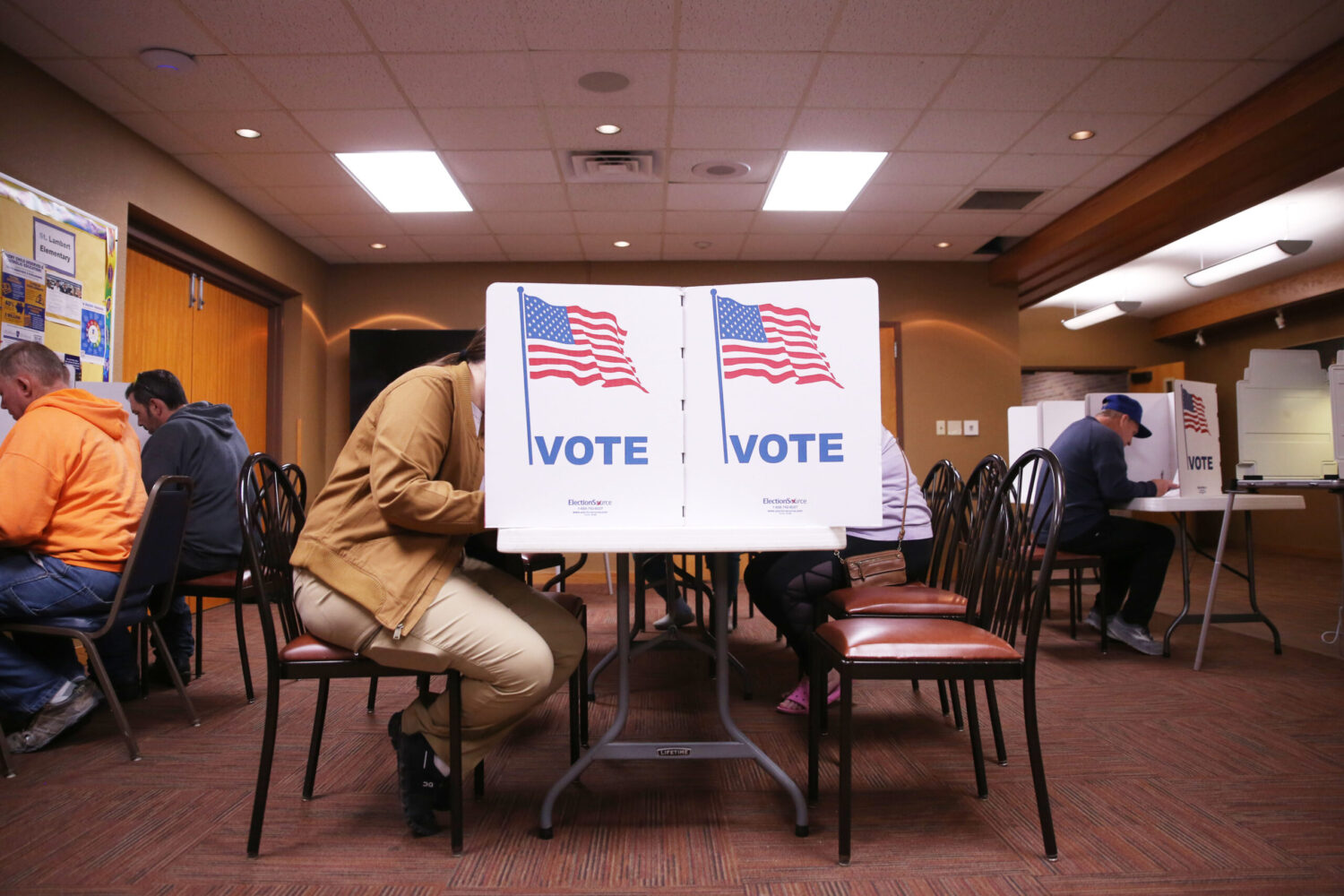
Makenzie Huber/South Dakota Searchlight
Chris Lee will drive hundreds of miles to vote in person.
The truck driver from Cleveland plans his route through South Dakota on Election Day. The Republican has been registered in South Dakota for nearly 10 years and has followed the campaigns for the June 2 primary election closely. He knows who he wants to vote for.
But he’s not allowed to vote in state and local races this year. To his surprise, Lee is designated as a federal-only voter in South Dakota.
Since January, a person who lists only the address of a mail forwarding service or post office box without describing the location of their “habitation” must be categorized as a federal-only voter when the person “applies to register as a voter or vote by absentee ballot,” according to a new state law. Since March, a person who doesn’t provide proof of U.S. citizenship when registering to vote must also be designated as a federal-only voter. That means the person can only vote in federal contests such as presidential and congressional races — not other statewide, legislative, county, city or local races or ballot questions.
“I took it for granted that I was able to vote in all the elections,” Lee said.
South Dakota and Arizona are the two states that have implemented a federal-only voting system.
According to a South Dakota Searchlight analysis of voter registration data from all 66 South Dakota counties, there are over 1,500 federal-only voters in the state — a number that is likely increasing as more people register or request absentee ballots. More than 180 of those federal-only voters are due to a lack of U.S. citizenship documentation upon registration.
Some federal-only voters in South Dakota won’t have anything to vote on in June. Many of them are not Republicans, and the only federal races are Republican primaries, which are closed to non-Republican voters.
Of Minnehaha County’s 575 federal-only voters, 168 are non-politically affiliated, 148 are Democratic, 97 are independent and two are Libertarian. Of Pennington County’s 572 federal-only voters, 122 are Democratic, 106 are non-politically affiliated, 82 are independent, seven are Libertarian and three are listed as “other.”
Dispute over federal-voter law implementation
Lee did not know he was a federal-only voter until South Dakota Searchlight informed him.
He registered to vote in 2016, when he was working for a company based in South Dakota. He currently lives in Cleveland with his wife, but he retains his South Dakota driver’s license, vehicle registration and voter registration in Minnehaha County.
“I like the state. I might retire there. That’s why I haven’t changed anything,” Lee said. “I stay up to date with the state.”
But Lee renewed his driver’s license and updated his voter registration simultaneously in January. He uses DakotaPost mail forwarding, and he likely received a card in the mail informing him that he’s been switched to a federal-only voter. If he did, he didn’t read it.

Voters can use the Voter Information Portal on the South Dakota Secretary of State’s website to check their registration status. But it does not tell Lee — or any federal-only voters — of their new status.
Lawrence County Auditor Brenda McGruder said her office changes voters’ statuses when they update their registration or request an absentee ballot. Her county had 184 federal-only voters as of April.
Amber Hobert, president of the mail forwarding service DakotaPost in Sioux Falls, said that’s not how she remembers the legislation described during the 2025 legislative session.
It was not supposed to be “applied retroactively” to current voters, even if they were updating their address or their political affiliation, Hobert said. She added that changing people to federal-only voters any time they interact with the election system — to update their registration or request an absentee ballot — leads to disenfranchisement.
“If you request an absentee ballot, you’re going to be treated differently than someone with the exact same address who manages to vote in person,” Hobert said.
Deputy Secretary of State Tom Deadrick told the legislative Rules Review Committee in September that the law was intended to apply to new registrations.
“For those who are already registered, nothing changes,” Deadrick said. He did not define whether a new registration includes updated voter registrations that come through the system.
Despite the dispute, state Rep. Tony Kayser, R-Sioux Falls, said he is pleased with how the law is being implemented. Kayser introduced the bill during the 2025 legislative session that changed how full-time RVers’ voter registration is handled.
“Keep the local elections local, for people who actually live here,” Kayser said, adding, “If you don’t qualify, then you should be updated to a federal-only ballot.”
RVer: ‘We ought to have a say’
Earnest Weaver lives in Virginia. As a member of the military, he moves frequently and chose South Dakota as his home base for vehicle registration, voter registration and mail forwarding.
Since he doesn’t live in the state, he planned to vote just for federal races even before learning he has a limited ticket. But he thinks that should be his choice, not a limitation imposed by law.
“My instinct is, if you are accounted for somewhere, then you should have the option to vote in any and all elections that take place there,” Weaver said. “I don’t do it as a personal choice — I would just vote in federal elections — but I think it should be a choice for anyone accounted for there.”
Janet Suffel, a fulltime RVer with her husband, misplaced her driver’s license in February and had to request a new one. She said she likely updated her voter registration information on the application, making her a federal-only voter.
If the couple came back to South Dakota to vote in person, her husband — who has not changed or updated his registration — could vote in federal, state and local races, but she could only vote in federal races.
Suffel and her husband, originally from Virginia, chose South Dakota for its lack of income tax and personal property taxes. The 64-year-old last visited three years ago but has paid fees and taxes in South Dakota when renewing her license and registration.
“I’m not driving on the roads, I’m not using any local services, I’m not using Medicaid, and I’m providing jobs for people at America’s Mailbox by using that service,” Suffel said, referencing the Box Elder-based mail forwarding company. “South Dakota is getting something for nothing.”
“I think, at the very least,” Suffel added, “we ought to have a say at the state level about who is going to decide on whether we can vote only in federal or state races.”