
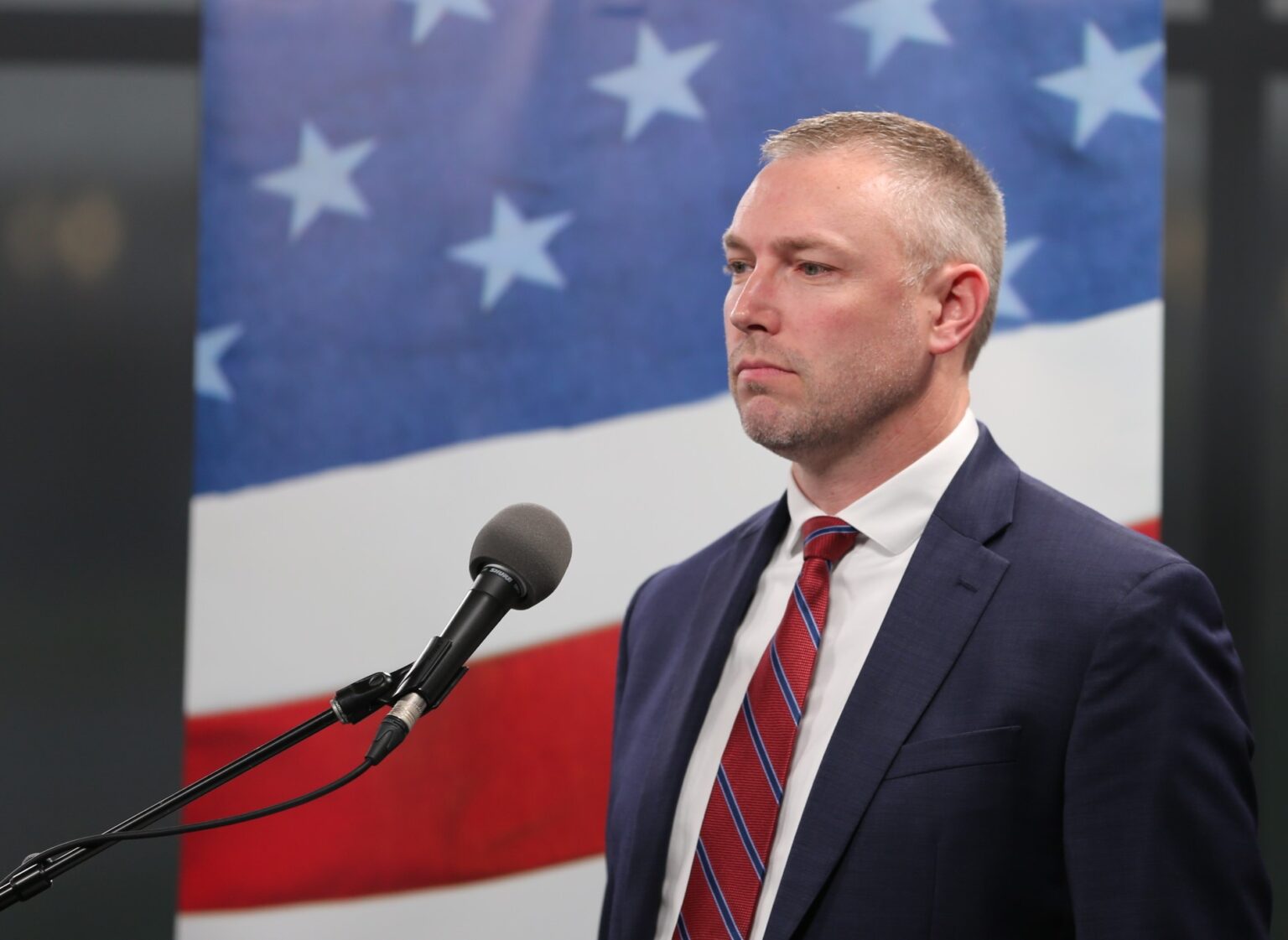
Meghan O’Brien/South Dakota Searchlight
Republican South Dakota governor candidate Jon Hansen wants to pause the state’s gas tax this summer and use an economic development fund to cover the cost, but none of his opponents endorsed the idea, and one called it a gimmick that could imperil the state’s federal highway funds.
President Donald Trump has suggested temporarily suspending the federal gas tax as the national average cost per gallon increases — due largely to Trump’s war in Iran and its impact on crude oil shipments.
“President Donald Trump is calling for the suspension of the federal gas tax, and South Dakota should do the same thing,” Hansen said Tuesday in a press release.
Hansen, the speaker of the state House, said state lawmakers could consider suspending the state gas tax in a special legislative session. A special session can be called by the governor, or lawmakers can petition for it with two-thirds support from both the House and Senate.
South Dakotans pay 28 cents per gallon in state tax, whether they’re fueling up with gasoline or diesel. Federal tax is an additional 18.4 cents per gallon on gasoline and 24.4 cents on diesel.
South Dakota’s average gas price, $4.22, which includes taxes, is more than a dollar higher than it was a year ago, according to the AAA motor club. A pause on the state tax would lower the state’s current average price to $3.94 per gallon.
The pause could save taxpayers up to $50 million, Hansen estimated. He would use the state’s Future Fund, a pool of money under the governor’s exclusive control, to replace the revenue in the state budget. The state gets money for the Future Fund by charging a fee to employers. They pay the fee when they submit payroll taxes that support unemployment benefits.
In the press release, Hansen’s campaign said in reference to the Future Fund that the state “is currently sitting on more than $60 million in ready reserve dollars which can be used to completely fill any highway funding gap created as a result of the gas tax holiday.”
But after Gov. Larry Rhoden’s most recent Future Fund grant to a teacher apprenticeship program, which was announced Monday, the unobligated balance of the Future Fund fell to $23.9 million, according to a spokesperson for the Governor’s Office of Economic Development.
A spokesman for the Hansen campaign told South Dakota Searchlight that the Legislative Research Council “reports that the Future Fund has roughly $68 million in it,” without distinction between obligated and unobligated funds.
Given that employers pay into it routinely, “millions more will continue to pour into it,” said Hansen’s spokesman, Austin Goss. “Further, the state is reporting higher than expected revenues for the month of April, outpacing legislative estimates by $12.1 million. As he has throughout his political career, Jon Hansen has one obligation — to South Dakota families and workers. Any and all obligations outside of that are secondary.”
Republican candidates respond
Rhoden, who is campaigning to keep his job, has awarded more than $10 million from the Future Fund since the start of April.
He also signed a bill into law earlier this year that makes reforms to the Future Fund, including the addition of definitions for acceptable uses, requiring more reporting to legislators about awards, stipulating information required of applicants, directing the Governor’s Office of Economic Development to formulate rules governing the fund’s use, and requiring the office to make recommendations to the governor about potential awards.
Hansen voted in favor of that legislation in the House.
Ian Fury, a spokesman for the Rhoden campaign, told Searchlight that Hansen’s gas tax idea “is not ready for primetime,” pointing to the current balance of the Future Fund and the new law, which takes effect July 1. Fury said “this use of Future Funds would not be legal” under the new law.
The state could also lose out on federal highway funding if the tax holiday took effect and the state failed to pay its required percentage of matching funds for federal highway projects, Fury said.
“Maybe worst of all — doing this would cost South Dakota taxpayers $216 million in federal highway funding,” Fury said in a statement to Searchlight. “A governor should lead with thoughtful policy, not political gimmicks.”
U.S. Rep. Dusty Johnson, who’s led the race in all public polling, sent a statement to Searchlight.
“After voting for a new tax on just about everything South Dakotans buy, I understand why Jon Hansen is looking for a holiday from his record. I agree that gas is too expensive, and that’s why I’m working this week to get E15 across the finish line here in Congress. That will save South Dakotans millions of dollars at the pump.”
Earlier this year, Hansen voted in favor of a new law that gives counties the option to enact up to a 0.5% sales tax and use the revenue for homeowner property tax relief. He also voted in favor of a new law that will use the revenue from a 0.3-percentage-point increase in the statewide sales tax for homeowner property tax relief. Rhoden signed both bills into law.

Throughout the campaign, Johnson has criticized Hansen and Rhoden for raising sales taxes, but the two have defended the use of the higher sales taxes for homeowner property tax reduction. A third bill that Hansen opposed but Rhoden signed into law gives cities the option to implement an additional 1% temporary sales tax to pay for special projects, if approved by 60% of a city’s voters.
Johnson has been part of an effort to pass a bill that would authorize the sale of 15% ethanol-blended gasoline, known as E15, nationwide and year-round.
A spokesman for businessman Toby Doeden said the state “should be making cuts that directly benefit our residents.”
The summer is “peak visitor season,” when out-of-state tourists contribute the most to South Dakota’s economy, the spokesman said. “If Speaker Hansen cared to make a real substantive improvement for state residents, why didn’t he want to suspend the gas tax during harvest season so that our amazing farmers and ranchers would be able to save more on fuel as their operating costs increase?”
The Republican primary election for governor is June 2, and early voting is underway. The winner of the Republican primary will advance to the November general election to face Democratic candidate Dan Ahlers.