
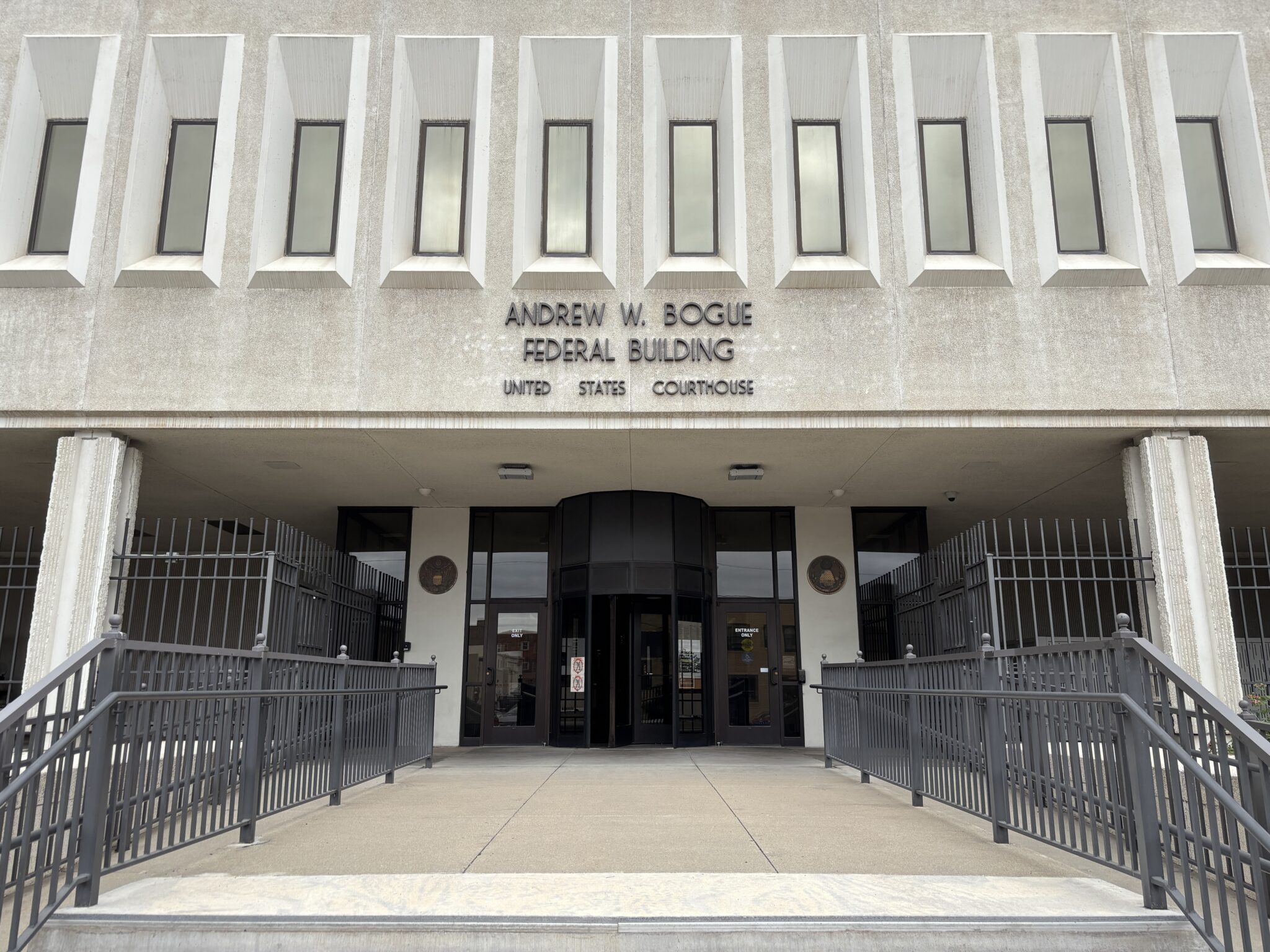
Seth Tupper/South Dakota Searchlight
RAPID CITY — A nonprofit organization argued Tuesday that the information it provides about abortion pills is protected as free speech even in a state that bans abortion, while the state of South Dakota equated the nonprofit’s messaging with soliciting and facilitating illegal activity.
The opposing sides presented their arguments during a court hearing on the eve of the four-year anniversary of the U.S. Supreme Court’s ruling that overturned nationwide abortion rights.
The hearing was about New York-based Mayday Health’s request for an order blocking a new South Dakota law from taking effect. The judge will issue a ruling later.
The new law prohibits the dispensing, distribution and advertising of abortion pills and other abortion-related items, and makes violations punishable by felony prosecutions and fines. Another South Dakota law that took effect four years ago bans abortion in all cases except when necessary to save the mother’s life.
South Dakota’s Republican governor signed the new law in March after the Republican-controlled Legislature passed it. The law is scheduled to take effect on July 1.
Jim Leach, the Rapid City-based lawyer representing Mayday, said the law unconstitutionally targets free speech about abortion that state officials don’t like.
“The state absolutely hates our speech,” he said in his opening statement.
A team of state lawyers at the hearing included Attorney General Marty Jackley, who is also the Republican nominee to run for U.S. House in the Nov. 3 general election.
Jackley said the type of speech Mayday practices on its website is not protected by the U.S. constitution.
“What the First Amendment doesn’t do is protect an illegal drug transaction in South Dakota,” he said.
Plaintiff’s case
The clash between Mayday Health and the state predates Mayday’s lawsuit. It began in December when Mayday posted advertising placards on gas-station pumps in South Dakota. The placards included the address of Mayday’s website, which provides information about abortion pills and links to providers who send abortion pills in the mail.
Jackley sent Mayday a cease-and-desist letter, accusing Mayday of falsely advertising abortion as legal in South Dakota and making misleading statements about the safety of abortion pills. Dueling lawsuits arose and were settled in early March when Mayday agreed to remove the placards.
By that time, the Legislature was on its way to approving the new law. Mayday and a South Dakota woman, Nancy Turbak Berry, filed their lawsuit against that law last month in federal court.
Turbak Berry is a lawyer, a Democratic former legislator and an abortion-rights proponent from Watertown. The lawsuit’s argument about free speech is partially built upon her purchase of a sweatshirt from Mayday’s website. Text printed on the sweatshirt says, “They don’t want you to know this: You can still get abortion pills in all 50 states” and “learn more at mayday.health.”
Turbak Berry alleges the state could use the new law to label the shirt as abortion-pill advertising and prosecute her for wearing it. She alleged that would violate her free-speech rights.
As Leach’s first witness Tuesday, Turbak Berry explained why she got involved in the lawsuit.
“I was disgusted that the state was trying to keep information from South Dakota women about the fact that abortion pills are available,” Turbak Berry said.
Leach’s next witness was Leo Raisner, who lives in Brooklyn, New York, and works as executive director of Mayday Health. He testified that he co-founded Mayday Health in 2022 after seeing survey data indicating that many people in the United States are unaware that abortion pills are available. Raisner testified that Mayday provides information for people to use for themselves, and does not promote abortion or encourage anyone to have an abortion.
“What I really, really want women to have is reliable, trustworthy information about abortion pills,” Raisner said on the witness stand.

State’s witnesses
In the state’s questioning of Turbak Berry, Raisner and the state’s own witnesses, the state’s lawyers attempted to show that Mayday’s website goes beyond the mere dissemination of information.
The state’s first witness was Kayla Klemann, an investigator for the Office of the Attorney General’s Division of Consumer Protection. She testified that the Mayday website provided her with links to abortion pill providers after she input her age as 14, that the site never asked her where she lived or whether abortion was legal in her state, and that after she input 23 weeks and four days as the duration of her pregnancy, the site told her that pills were not her best abortion option but allowed her to go back and change her response.
Klemann testified that her interactions were with a chatbot on the Mayday website. Raisner testified that the chatbot was removed from the website on Sunday. That removal was a frequent point of contention during the hearing, with Leach contending the judge should only consider current conditions when deciding whether to issue a court order against the new law, and Jackley and the state arguing that the chatbot’s past existence remains relevant to the case.
Klemann additionally testified that she found information from Mayday advising people to use mail-forwarding services to receive abortion pills — which Jackley described as part of a “scheme” to help people obtain illegal drugs. Raisner testified that the mail-forwarding information was removed from Mayday’s site several years ago.

The testimony concluded with dueling South Dakota OB-GYN doctors, both of whom are retired.
Patti Giebink, who acknowledged she considers herself “pro-life,” testified for the state that prescribing abortion pills — mifepristone and misoprostol — online without an in-person consultation is potentially dangerous, especially for patients who are alone and have conditions that might make them susceptible to complications. The state’s attorneys attempted to show that Mayday misleads people about those potential safety risks.
Marvin Buehner, who acknowledged that he has won awards for his “pro-choice” advocacy, testified for Mayday and Turbak Berry that complications from abortion pills occur in “astoundingly small numbers” and that abortion pills are safe and effective.
In closing arguments, Leach said Mayday provides information vetted as accurate by experts and does not sell abortion pills. He said the state failed to prove that Mayday committed a crime, or engaged in commercial activity involving abortion pills, or provided misleading information.
Jackley said Mayday chooses the content and links on its website, that it describes abortion pill providers as trusted partners, and that it instructs users how to obtain abortion pills that are illegal in South Dakota. Jackley characterized Mayday’s actions as conspiring, soliciting, and aiding and abetting the distribution of illegal drugs.
Mayday and Turbak Berry are initially seeking a temporary injunction that would prevent the state from enforcing the new law while the lawsuit proceeds. Judge Camela Theeler gave the parties until June 30 to file additional briefs, and until July 3 for responses to the briefs.
Although the new law takes effect July 1, Jackley told the judge he does not intend to initiate any enforcement actions against Mayday during the time between the hearing and the judge’s ruling.