
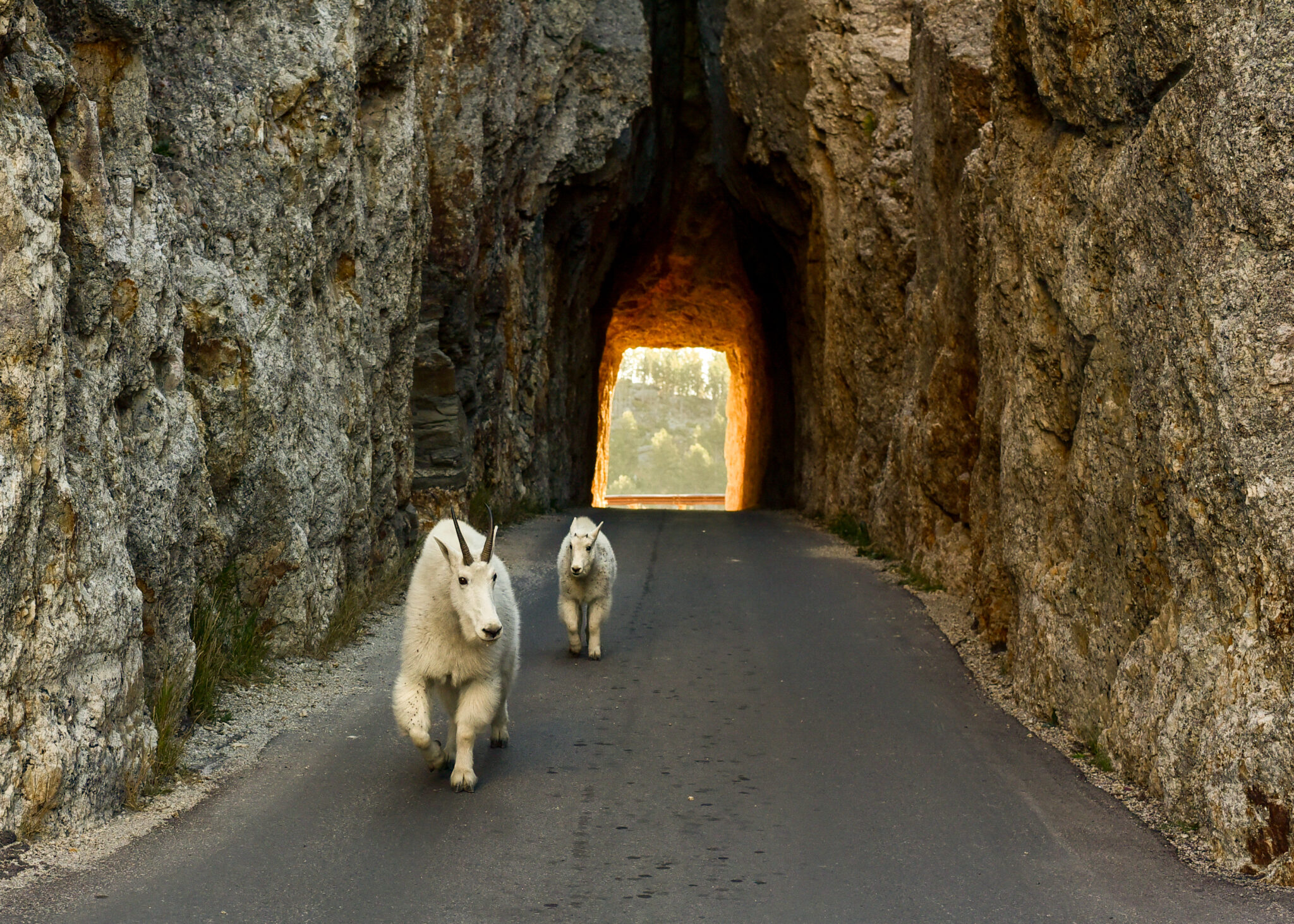
Nicole Schlabach/South Dakota Searchlight
Daniel Milks, the founder and lead guide at My XO Adventures, has introduced many visitors in South Dakota’s Black Hills to mountain goats.
“It’s an eye-opener, and a jaw-dropper,” he said. “I’ve had adults just lose their minds when they see a mountain goat.”
Some wildlife photographers enjoy seeing the goats more than the bison on his tours. “They look like something out of a children’s storybook,” Milks said, “like little magical creatures from a fairytale land.”
He sometimes asks his clients what they loved best about a tour. “And if they saw the mountain goats,” he said, “I guarantee you it will be in their top three.”
But mountain goats in the southern Black Hills haven’t been doing so well in recent years. If the goats disappear from the area, it would be hard to estimate the impact on Milks and his business.
It probably wouldn’t affect the number of tours he books. But “would it affect the way we feel as guides going through the Hills? Yes, big time,” Milks said. “Would it decrease the experience of a guest in South Dakota, and leave less of a good impression? Absolutely.”
To keep track of the goats, South Dakota Game, Fish, and Parks counts the animals observed by helicopter at the same rock outcroppings roughly every other year. This helps officials estimate their population size, while using other variables including radio collar data.

The department counted 29 goats in the southern Black Hills in 2024 — a continuation of a downward slide since a peak of 106 in 2016. The low numbers led to the cancellation of the mountain goat hunting season for 2026, the fourth year in a row.
“That is not good. That is definitely indicating we are in a big-time decline,” said Chad Lehman, senior wildlife biologist at the GF&P. “If they persist on that decline, that trajectory, my estimate would be that they would be gone in the core area by 2030.”
The core area extends over 150 square miles from Custer to Mount Rushmore and north of Keystone.
Meanwhile, an isolated population in Spearfish Canyon, in the northern Black Hills, has been growing ever since a nanny left the southern Black Hills herd around 2014. Last year, there were up to 25 goats in the canyon, as reported to the GF&P by Spearfish residents.
If the Spearfish population continues to do well, Lehman said, the GF&P could potentially reinvigorate the southern Black Hills population with younger goats from the canyon.
“At least we have a secondary population that is keeping us from going completely extinct in the Black Hills,” he said.
Yet the long-term outlook is uncertain for animals in a place they may not be built to thrive in.
Challenging environment in the southern Black Hills
In the 1920s, six goats from Alberta, Canada, escaped from a zoo in Custer State Park. Accustomed to mountainous regions, they headed straight for the area around Black Elk Peak. By the 1950s, the population had grown to more than 300, and by the late 1960s, hunting seasons were underway.
The rest of their history is defined by periods of decline and recovery. Based on these fluctuations, the GF&P has both moved goats from the southern Black Hills to other western states and added goats from other states to the population.
The recent dip marks roughly the third time the population has declined.

There is no research on the recent numbers, but a 2006-2018 study led by the GF&P theorized that the goats’ survival was connected to the pine forest in the southern Black Hills.
“It’s important to note that survival was heavily tied to the vegetation up there. If you have a lot of vegetation, it seemed like their survival rates declined,” Lehman said.
The forested Black Hills are different from many other mountain ranges where goats live, explained Greg Van Den Berg, the treasurer of the Rocky Mountain Goat Alliance, a conservation nonprofit.
Mountain goats thrive in exposed, alpine environments with grassy foraging areas where it’s easier to see predators approaching. When the goats sense danger, they quickly escape onto steep terrain.
The Black Hills have less visibility. “The elevation is not super high. We have a lot of cliffs, for example in the Black Elk Wilderness, but a lot of those trees are right up against that mountainous area,” Van Den Berg said.
Because mountain lions rely on stealth, they can use trees to stalk and attack. Mountain lion predation was the leading cause of death identified for radio-collared goats during the GF&P study.
Spearfish Canyon has more open areas leading to cliffs, Van Den Berg added, which might contribute to their growth in that area.
Although wildlife managers can’t change the geography of the southern Black Hills to help mountain goats avoid predators, there are ways to create more open areas.
Natural and other ways to help the goats
The goats’ survival in the southern Black Hills improved when a pine beetle epidemic, which peaked in 2012, killed many of the trees in their range.
“From about 2012 to 2018 we saw a huge resurgence in mountain goat survival,” Lehman said. “The beetle essentially came in and cleaned out a lot of the trees around those precipitous terrain spires.”
Over the last couple of years, pine beetle activity has increased a little bit. “It’s hard to say. If they do come back, that could potentially have a big impact on the goats,” Lehman said.

Forest and wildlife managers could also pursue human-made solutions.
The GF&P’s 2024-2028 Mountain Goat Management Plan says “prescribed burning and timber management in these landscapes can enhance mountain goat habitat.” The plan’s first objective is to “maintain, manage, and protect existing mountain goat habitat.”
But those habitat interventions haven’t begun. The next steps are dependent on collaborations with the U.S. Forest Service, which manages much of the land in the Black Hills.
“Hopefully we can continue to collaborate and work with our U.S. Forest Service partners in that area to try and provide more openings for them, especially around the granite outcroppings,” Lehman said.
South Dakota Searchlight did not receive a response to questions sent to the Forest Service.
Because of the difficult terrain, the habitat work could cost hundreds of thousands of dollars. The funding would likely need to come from multiple sources, including the Forest Service, the GF&P, and outside sources such as nonprofit organizations.
Adding mountain goats from other states is another option. But that is expensive, too, and those goats might face the same challenges upon arrival.
“I would not encourage us to bring goats in if we’re going to have a problem with our current landscape and vegetation,” Lehman said. “I would prefer to maybe do some habitat manipulations first.”
Even if everything else were in place, timber management is not permitted in a substantial portion of the goats’ habitat: the federally designated Black Elk Wilderness. In that area, “you’re relying on Mother Nature to either provide mountain pine beetles or wildfires,” Lehman said.
Look, but don’t approach
A mountain goat lowered her head and snorted at Greta Alms, a travel blogger from Minnesota, during her visit to Mount Rushmore in 2014. It was probably a nanny protecting her kid, Alms guessed.
She wasn’t expecting to see goats during her trip, but the encounter ended up defining her visit. “My goal was the sunrise. It turned into a way cooler experience. It ended up being about the mountain goats,” she said.
Mountain goat tourism in the Black Hills started more than a century ago. A February 1924 issue of the Kadoka Press described one of the first times that captive goats were viewed by visitors. The goats, along with bison, elk and other animals, were placed in enclosures next to a highway through Custer State Park.

“This summer every one will have the chance to see at least a few specimen of the rare animals from his car as he passes on the beautiful highway,” the Press reported.
One hundred and two years later, Les Heiserman regularly takes photos of the Spearfish Canyon goats, usually right from the road where he can see and listen to visitors’ reactions. “People will say, ‘I was just in Yellowstone, and I didn’t see this much wildlife. We’ll talk about this all the way home.’”
But visitors might like the goats a little too much. “People don’t want to keep their distance,” he said. “They think they’re animal lovers, and so they want to feed them banana chips, or trail mix, whatever they have in their car. They get the goats used to people, and that’s no good.”
In a rare incident, a mountain goat approached and fatally gored a hiker in Washington in 2010. Eleven years later, a mountain goat revealed the species’ strength by killing an attacking grizzly bear in Canada.
“They can’t look at humans as food sources because then they’ll start approaching people. They’re still wild animals with big horns,” Heiserman said, explaining that the goats get closer to the road and are easier to view in South Dakota than many other alpine places where they live.
Heiserman wants to see educational signage in Spearfish Canyon that explains how to behave around the goats.
“We’re lucky to have them here,” he said. “If people can leave them alone, hopefully they’ll stay here, there won’t be any problems, and they’ll continue to amaze us.”
In mid-April, a dead mountain goat was reported near Bridal Veil Falls in Spearfish Canyon. The GF&P believes it probably fell from a cliff or was hit by a car. Before officials could remove the goat, someone illegally cut the head off the body.
John Esposti, co-owner of GeoFunTrek Tours, said he often sees the goats in Spearfish Canyon, but he has noticed a decline while leading tours in the southern Black Hills. He doesn’t mention the goats to clients, because he doesn’t want to create an expectation that could lead to disappointment.
If the goats disappear, he said, “there would be one less pleasant surprise along the trip.”
Does it matter that the goats aren’t native?
People disagree about how important it is to invest in keeping the goats around.
“One person may think, well, they’re not native, so why are we managing for them?” Lehman said. “Another person who sees them as being on the landscape for more than 100 years as a naturalized species might consider them to be really important.”
His personal opinion is that the GF&P should continue to manage them. “We’ve had them here for over 100 years, the public really enjoys seeing them,” he said, adding “they’re an iconic species of the upper elevations of the Black Hills.”
Van Den Berg said the Rocky Mountain Goat Alliance doesn’t exclude non-native mountain goats from its conservation work. He is glad to hear support within the GF&P for that approach. “Most of the biologists I’ve talked to, they really feel strongly that they’ve been here. They don’t necessarily view them as an outsider.”
William Severud, a wildlife biologist and assistant professor at South Dakota State University, shared a different personal philosophy. “For me, it seems like trying to manage as close to pre-European contact would be ideal,” he said, acknowledging that South Dakota won’t have populations of grizzly bears or wolves anytime soon, even though both are native to the state.
It would be interesting from a research standpoint, he said, to let the situation play out and see what happens. “But I understand they are popular, and there is interest in keeping them around.”
South Dakota isn’t the only state where mountain goats are facing challenges.
Different states, different approaches
Most native mountain goats are in the mountainous regions of Alaska and British Columbia. They were introduced to many western states in the 1900s for hunting and wildlife viewing. Since then, both native and non-native populations have experienced mixed success.
Brought to the state in the 1940s, Colorado now has more than 1,000 mountain goats, and more than 100 are hunted each year to manage the population.

Grand Teton National Park has culled almost all of its non-native goats to protect its native bighorn sheep from a bacterial disease they pass to each other. The disease is a risk in the Black Hills, but the populations rarely cross into each others’ territory, Lehman said.
After ecosystem damage and the fatal goring of a hiker in Washington, officials culled or translocated hundreds of non-native goats from Olympic National Park to the Cascade Range where they are a native species.
However, most goats brought to the Cascade Range did not survive long. A study found a link with climate changes, including a rapid spring snowmelt contributing to drier summer foraging conditions.
In Glacier National Park, a study found the native population has declined 45% since 2008, with scientists finding that climate variables, including decreased precipitation, correlated with the decline.
Van Den Berg wonders if climate changes might also affect the goats in the Black Hills. “I don’t have anything to back that up, but I would believe that not having that typical summer, fall, winter, spring maybe plays into it,” he said.
More broadly, he notices that habitat changes, whether due to recreation, development or weather shifts, are affecting goats across the United States. Because mountain goats are slow to breed, they are slow to recover from any threat.
The GF&P will count the goats in the southern Black Hills again in June. The data will inform revisions to the Mountain Goat Management Plan, which will be brought before the GF&P Commission for approval in 2028.