
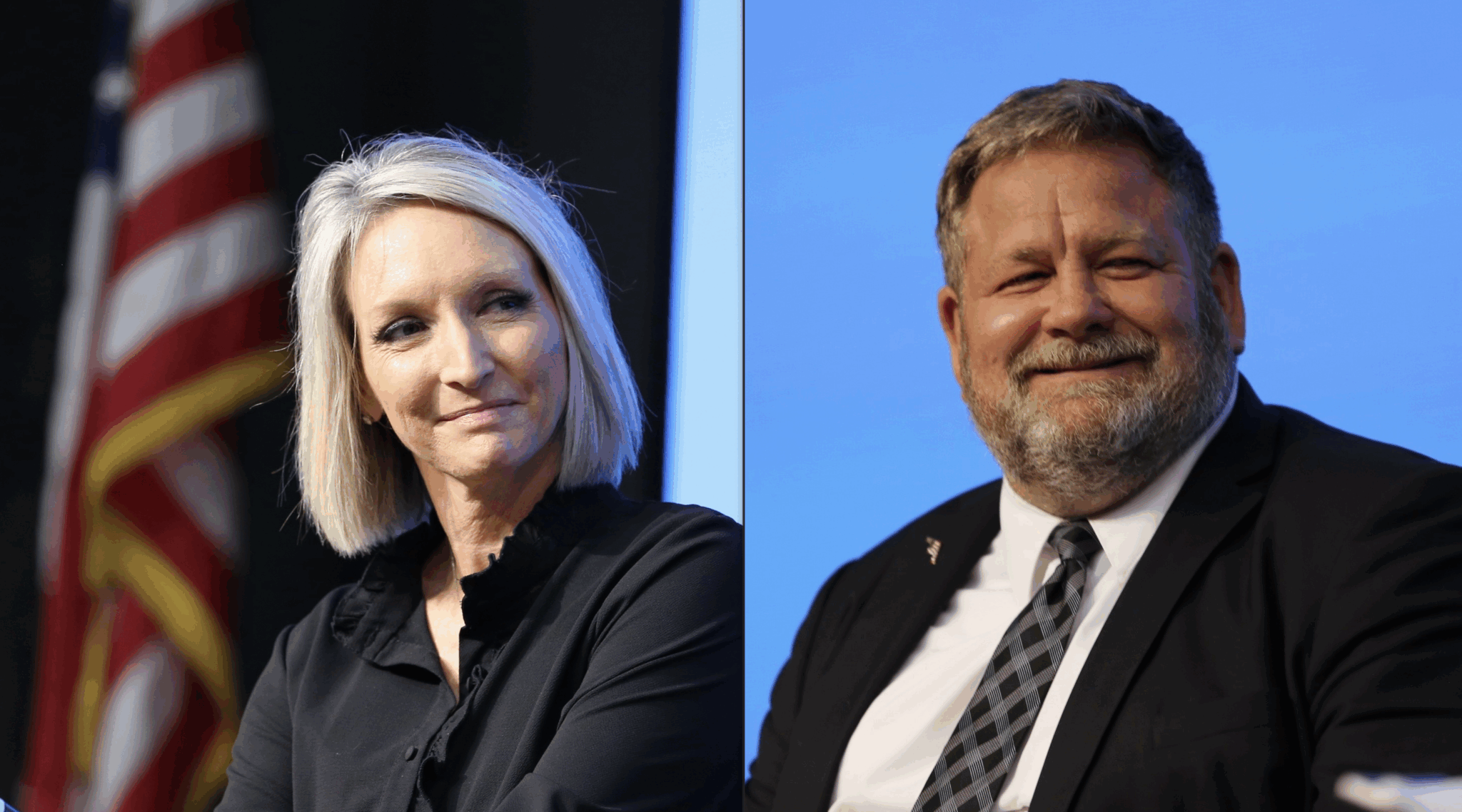
Joshua Haiar/South Dakota Serarchlight
SIOUX FALLS — The race for mayor of South Dakota’s most populous city is officially nonpartisan, but some Democrats and Republicans are treating the June 23 runoff as a contest with political ramifications beyond the city.
Christine Erickson, a former city council member and Republican former state lawmaker, and Democratic state Sen. Jamie Smith were the first- and second-place finishers, respectively, in the five-way race on June 2.
State party leaders are watching the runoff closely.
South Dakota Republican Party Chairman Jim Eschenbaum said the party’s executive board discussed the race and decided to endorse and back Erickson.
“If that’s the Democrats’ attempt to gain a foothold in the state of South Dakota, by electing a mayor of the largest city, I guess they can attempt to,” Eschenbaum said. “But the Republican Party is going to back the Republican in that race, even though it’s a nonpartisan election. We’re still going to back the Republican principles and ideals.”
Not all Republicans agree. Republican state Rep. Greg Jamison, one of the losing candidates in the mayoral race, has since endorsed Smith. He said their friendship runs deeper than partisan politics.
“It’s more important than that,” Jamison said. “I’ve gotten to know him very well.”
For Democrats, Smith’s candidacy offers a rare chance to win a major executive office in a state dominated by Republicans.
Dan Ahlers was the state Democratic Party’s executive director when he announced his campaign for governor earlier this year. He told South Dakota Searchlight recently it would mean “a lot” to have Sioux Falls led by a Democrat. He said a Smith victory would bring more balance to South Dakota politics and create an opportunity to show that Democrats can work across party lines and deliver results for everyone.
“So, I think having a person like that, with that kind of experience, is also incredibly important,” Ahlers said of Smith.
No Democrat has held a statewide office in South Dakota since Tim Johnson left the U.S. Senate in January 2015 after not seeking reelection. Sioux Falls’ last Democratic mayor was Mike Huether, who left office in 2018 after he announced in 2016 that he was switching his affiliation to independent.
Philosophical differences surface
During a debate on Monday hosted by the Downtown Sioux Falls Rotary Club, Smith said he supports exploring a “tri-share” childcare model, in which the cost of care is shared among families, employers and a public entity or other funding source. He said the goal would be to reduce costs for families and help more people stay in the workforce.
“We have to find the funding to do that,” Smith said.
Erickson said she does not believe government should be “the end-all, be-all for everyone.” She said there are things she is open to trying, such as removing “red tape” to start a daycare.
“We just can’t have government be everybody’s everything,” Erickson said.
Regarding data centers, Smith said he supports a moratorium on large “hyperscale” projects within Sioux Falls city limits, citing concerns about potential effects on electricity rates and water availability.
Erickson said she would evaluate projects on a case-by-case basis, and that keeping data in the United States is important for national security.
Other comments made individually by Erickson and Smith also revealed the candidates’ political philosophies.
Smith said he had the “luxury” in the Legislature of “voting his conscience,” and contrasted that with lawmakers “across the aisle,” a reference to Republicans.
“They oftentimes get told how to vote on certain things,” Smith said.
When asked to describe how they would manage a crisis, Erickson pointed to her time on the Sioux Falls City Council during the COVID-19 pandemic, and said she advocated to keep businesses open and prioritize “personal freedom.”
The runoff will decide who succeeds Mayor Paul TenHaken, a Republican who’s prevented by term limits from seeking a third consecutive term.