
Meghan O’Brien/South Dakota Searchlight
Dignitaries and scientists celebrated the next step Thursday toward what one official called the “largest science experiment ever attempted on U.S. soil.”
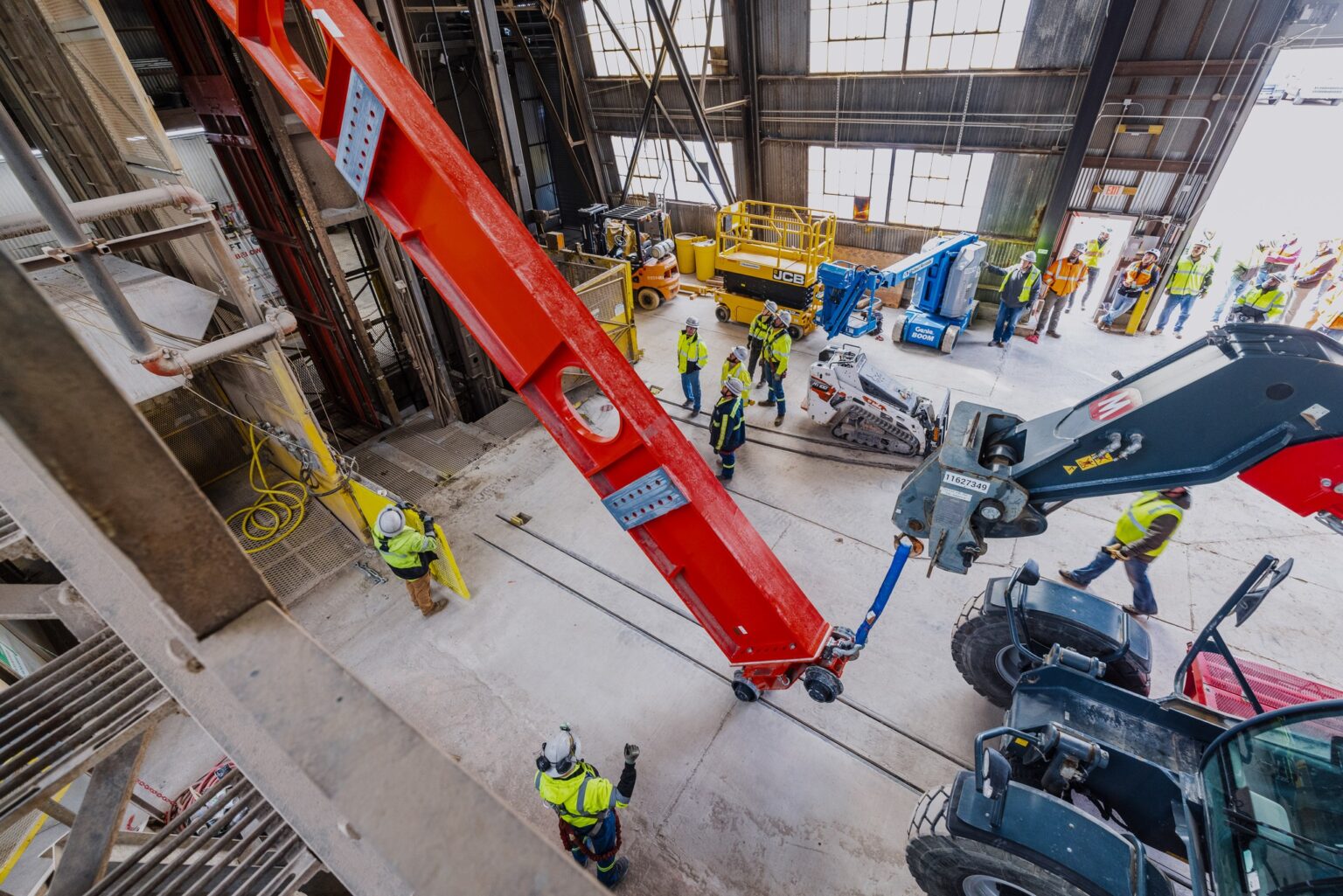
Over the coming months, 6,000 steel beams will be moved nearly a mile underground to build infrastructure for the Deep Underground Neutrino Experiment within a former gold mine at Lead, in the Black Hills of western South Dakota. The steel beams come from the European Organization for Nuclear Research, known as CERN.
Neutrinos are elusive subatomic particles. Studying neutrinos could help scientists learn why matter exists, how black holes form, and if neutrinos are connected to dark matter or other undiscovered particles.
Better understanding of neutrinos could lead to innovations in fields like communication and healthcare.
“It will open the door to exploring new physics in domains previously out of reach, with a capacity to fundamentally reshape our understanding of the laws of nature,” said Darío Gil, U.S. Department of Energy undersecretary for science.
What’s learned in the experiment “will ripple far beyond the laboratory, strengthening industries and improving lives in ways we’re only beginning to envision,” Gil said.
The Sanford Underground Research Facility in Lead, which houses the equipment headed underground, and the Fermi National Accelerator Laboratory in Batavia, Illinois, are collaborating in the experiment.
The plan is to shoot a beam of neutrinos through the earth from Fermilab to the detectors in South Dakota — an 800-mile trip. That will allow scientists to study how neutrinos change as they travel long distances. The deep underground location protects the experiment from cosmic radiation.
Five-story-tall detectors will be built underground at Lead in what will be called the Long-Baseline Neutrino Facility. The detectors will use 17,000 tons of liquid argon to catch the neutrinos. The liquid argon needs to be kept cold, so the detectors will be housed inside an insulating container, called a cryostat.
The Sanford facility is in the former Homestake Mine, which was once the largest and deepest gold mine in North America. It closed in 2001, and in the years that followed, then-Gov. Mike Rounds supported the conversion of a portion of the mine into the Sanford Underground Research Facility.
Rounds, now a U.S. senator, spoke at Thursday’s ceremony.
“Science and research, healthcare, quantum physics all go together,” Rounds said. “But it all starts someplace with people having an idea, and having a place to see whether or not their idea holds fruit.”
Crews at the facility finalized cavern excavations in 2024, which allowed for the team to start building infrastructure.
The U.S. Department of Energy, which includes Fermilab, has estimated the total cost of the experiment to be more than $3 billion. Dozens of countries and more than 1,400 scientists are involved in the project.