
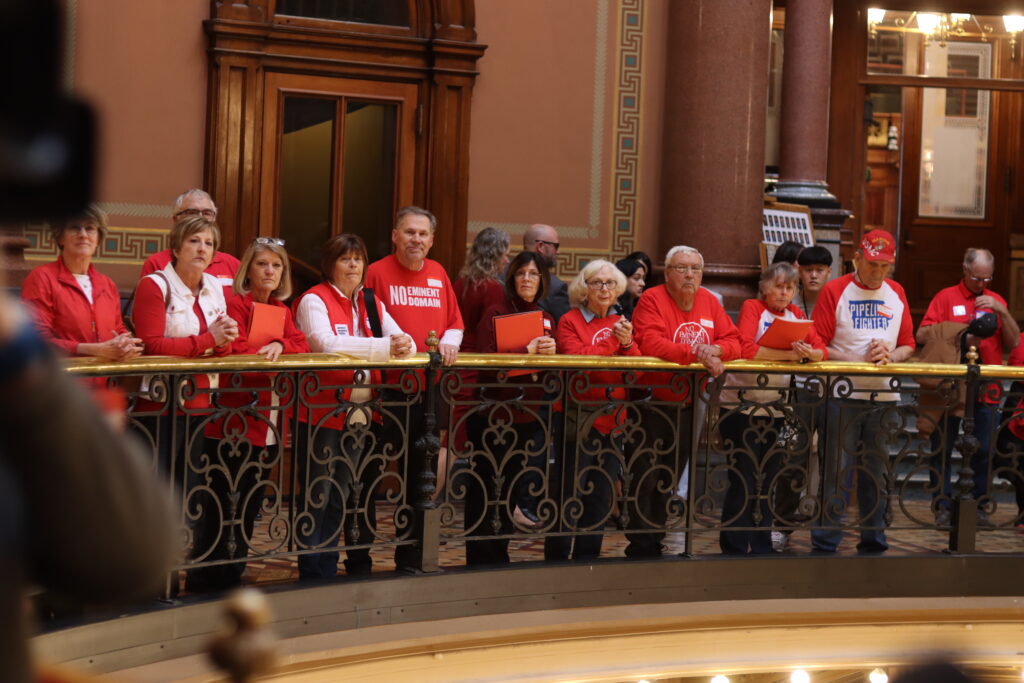
Kadin Luhmann/Iowa Capital Dispatch
Iowa property owners asked the Iowa Utilities Commission Wednesday to deny Summit Carbon Solution’s recent filing seeking to modify its pipeline project, while ag group members and some others called for approval of the plan.
Summit announced May 13 that its new proposal would remove previously planned routes through Shelby, Pottawattamie, Montgomery, Adams, Page, Fremont, Mitchell and Worth counties and reduce pipeline mileage that runs through Sioux, Crawford, Floyd and Dickinson counties.
Summit added that the changes would affect 400 fewer landowners and reduce the extent of the project by about 200 miles.
Colleen Tucker, a Mitchell County landowner and resident, said she feels “cautious optimism” about the proposed changes, but emphasized that there are still many Iowa landowners still impacted by the pipeline. She and others asked the IUC during the public comment period of its monthly meeting to deny Summit’s proposal.
“The question is, when will those landowners finally see an end to this nightmare that has been dragged on since 2021,” Tucker said. “The citizens of Iowa are asking you to uphold the U.S. and Iowa constitutions by denying a private company the extraordinary power of eminent domain for this project. You have the authority to stop this, and you should use that authority.”
Jann Reinig, a Shelby County landowner, said despite her county being exempt from the new proposal, uncertainty about other parts of Iowa and the potential for Summit’s return after their initial project is completed leaves little room for celebration.
“We landowners have no right to celebrate. We’ve tried to be Iowa nice for five years and that’s running kind of thin,” Reinig said. “We aren’t Iowa stupid. Even though this proposal has been cut back, there are still almost 4,000 parcels of Iowa land that we have no idea what’s going to happen to.”
Darlene Partlow, a Guthrie County landowner, said she has attended Iowa legislative sessions for the past two years and believes that Summit has a hidden agenda behind its new proposal.
“I’ve come to the conclusion that our state government, starting with the governor, Senate leadership and some senators, are bought and paid for,” Partlow said. “Why else will we be fighting this battle when our state constitution specifically states eminent domain can only be used strictly for public use.”
While most public comments asked the IUC to deny Summit’s proposal, some asked the commission to expedite the request.
Steve Kuiper, the vice president of the Iowa Corn Growers Association, encouraged the IUC to expedite and approve Summit’s proposal, adding that the pipeline would be “tremendous help” to Iowa farmers.
“Currently, the Iowa farming economy has some serious financial difficulties ahead,” Kuiper said. “Other states are competing against us for this … low-carbon fuel initiative. If we don’t do low-carbon ethanol, we will start to lose ethanol business in the state of Iowa. It’ll detrimentally affect the price of Iowa’s corn.”
Under Summit’s new plan, the pipeline will continue to operate through Nebraska and parts of Iowa, and captured emissions will be stored in Wyoming, deviating from its original sequestration plan to store emissions in North Dakota.
Kuiper added that he has friends in Nebraska who have “picked up that price, and it has helped their bottom line tremendously. I respectfully ask that you folks take up this debate this summer, so construction can begin as soon as possible. We would like to see the construction phase start this winter and get this pipe in the ground.”
The Iowa Renewable Fuels Association (IRFA) filed a formal request to IUC on Tuesday to schedule a hearing for the approval of Summit’s proposal, saying that IUC’s permit request was submitted six months ago.
Colin Gorton, IFRA’s policy director, said in a news release the repeated delays hurt Iowa’s rural economy, and asked the commission to take swift action.
“After six months, the IFRA can see no reason to delay holding a scheduling conference for this important issue,” Gorton said. “The 27 ethanol plants that are part of the Summit project stand to generate nearly $2 billion annually in additional revenue from carbon capture, use and sequestration. To underscore the urgency of the situation, that is nearly $5.25 million of forgone revenue for Iowa’s ethanol plants each and every day. At a moment when farmers are struggling and rural economies are hurting, this is incredibly critical.”
The commission has not set a timeline for its next order in the Summit Carbon Solutions docket, an IUC spokesperson said Wednesday in an email response to Iowa Capital Dispatch.