
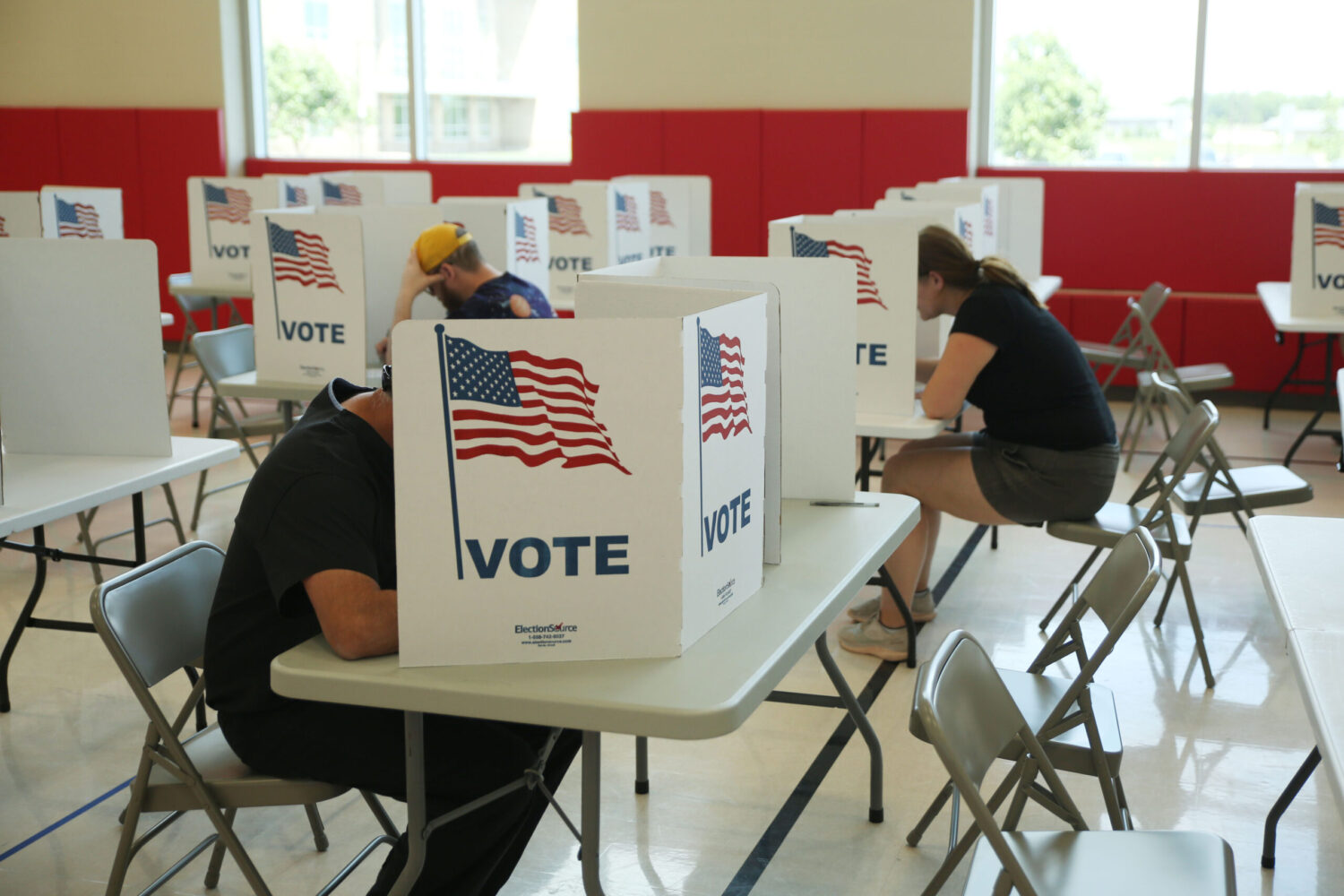
Makenzie Huber/South Dakota Searchlight
The stakes are high enough in the race for the South Dakota Republican Party’s nomination for governor that Nancy Turbak Berry became a Republican, at least temporarily.
The former Democratic state lawmaker intends to rejoin her preferred party after the July 28 runoff election.
“I wish we would elect Democrats,” said Turbak Berry. “but until the state changes enough so that’s a likely scenario, I think it’s important to have a voice in the primary.”
Turbak Berry voted for Gov. Larry Rhoden in the June 2 primary and intends to vote for him again in the runoff. Rhoden faces businessman Toby Doeden, and the winner will advance to the Nov. 3 general election to face Democratic nominee Dan Ahlers.
Turbak Berry is not alone.
In South Dakota, only registered Republicans can vote in Republican primary elections, while Democratic primaries are open to registered Democrats, independents and people who register without any affiliation. Democrats did not have any statewide primary races this year.
Voters don’t need to explain their choice to switch parties, and parties gain voters ahead of elections for a host of reasons. But registration statistics suggest that a desire to participate in Republican primaries could drive more voters to the party during election years.
In the three months before the June 2 primary election, the total number of Democratic, independent, minor-party or non-politically affiliated voters in the state declined by 1,253.
The Republican Party added 4,452 voters during the same period.
The number of non-Republican voters has dropped before the primary in four of the last decade’s six election years – every year without a Democratic presidential primary – with the most significant drop appearing this year. That is a pre-primary phenomenon. The ranks of registered Republicans and non-Republicans both grow in the months leading up to general elections and in non-election years.
In 2026, the pre-primary effect continued through the month of June and early July as voters anticipated casting ballots in the July 28 Republican governor runoff. Between the June 2 primary and July 9, non-Republican voter registrations dropped by 2,919 — more than double the decline in the three months leading up to the primary.
The Republican Party added 5,717 voters in those 37 days.
The registration changes could be attributable to everyday life events, such as coming of age to vote, deaths or relocations from and to other states. But at least some of the shift involves temporary party switchers like Turbak Berry.
Lincoln County Auditor Sheri Lund said auditors often see voters switch their party affiliation ahead of primaries in South Dakota.
“You’ll see them switch back after the primary,” Lund said. “When they realize they can’t vote for something unless they’re a registered Republican, they might do that.”
GOP leader: ‘Decide who you are’
Former Sioux Falls Mayor Rick Knobe co-authored an opinion piece for The Dakota Scout newspaper shortly after the June 2 primary, encouraging people to temporarily change their voter registration to vote in the runoff. Knobe said he switched from an independent to Republican to vote for Rhoden ahead of the primary.
It was the first time he’s temporarily switched, he said, because he felt compelled to vote for what he described as the “least offensive” candidate in the Republican race. He expects he’ll vote for Democrat Dan Ahlers in the November election.
Knobe plans to eventually return his registration to independent.
South Dakota Republican Party Chairman Jim Eschenbaum said those who temporarily register as Republicans play “political games” that hurt the Republican Party because it tampers with which candidates will run in November, he said. Eschenbaum himself switched permanently from a Democrat to Republican over a decade ago.
“These people have to decide who they are,” Eschenbaum said. “If you’re a Democrat, vote for the Democrats. Work on your own party. Don’t try to sabotage our party. That’s what they’re doing.”
Eschenbaum said he would support legislation that would restrict South Dakotans’ ability to switch party affiliation, such as only allowing one switch a year.
But Knobe said outrage at South Dakotans switching parties is more partisan than civic.
“On a broader scale, they’re trying to limit people’s participation in the government we all pay for, and I find that un-American,” Knobe said.
Open primary advocate: Shifts are inevitable in closed system
Joe Kirby, a lifelong Republican in Sioux Falls, said non-Republican voters feeling motivated to “game the system on occasion” to participate in elections is a result of South Dakota’s closed primary system. Kirby has led unsuccessful efforts to restructure South Dakota’s primary system into an open primary.
Of South Dakota’s registered voters, about 52% are Republican and 47% are something else: Democratic, independent, a minor party, or not politically affiliated.
“All voters want to have a say in who is going to lead the state or represent them in Congress or in the Legislature. Right now, we have a system that doesn’t give all groups an equal say,” Kirby said. “It’s a warped system that doesn’t make a whole lot of sense, but it’s in place and tough to change.”
Kirby said he believes the increased interest and discussion around temporarily switching party status is partly due to his and others’ efforts to open primaries in 2024 through a citizen-initiated ballot question.
“I think the voters are more aware now of the possibility of open primaries and the negative aspects of our closed primary system,” Kirby said.