
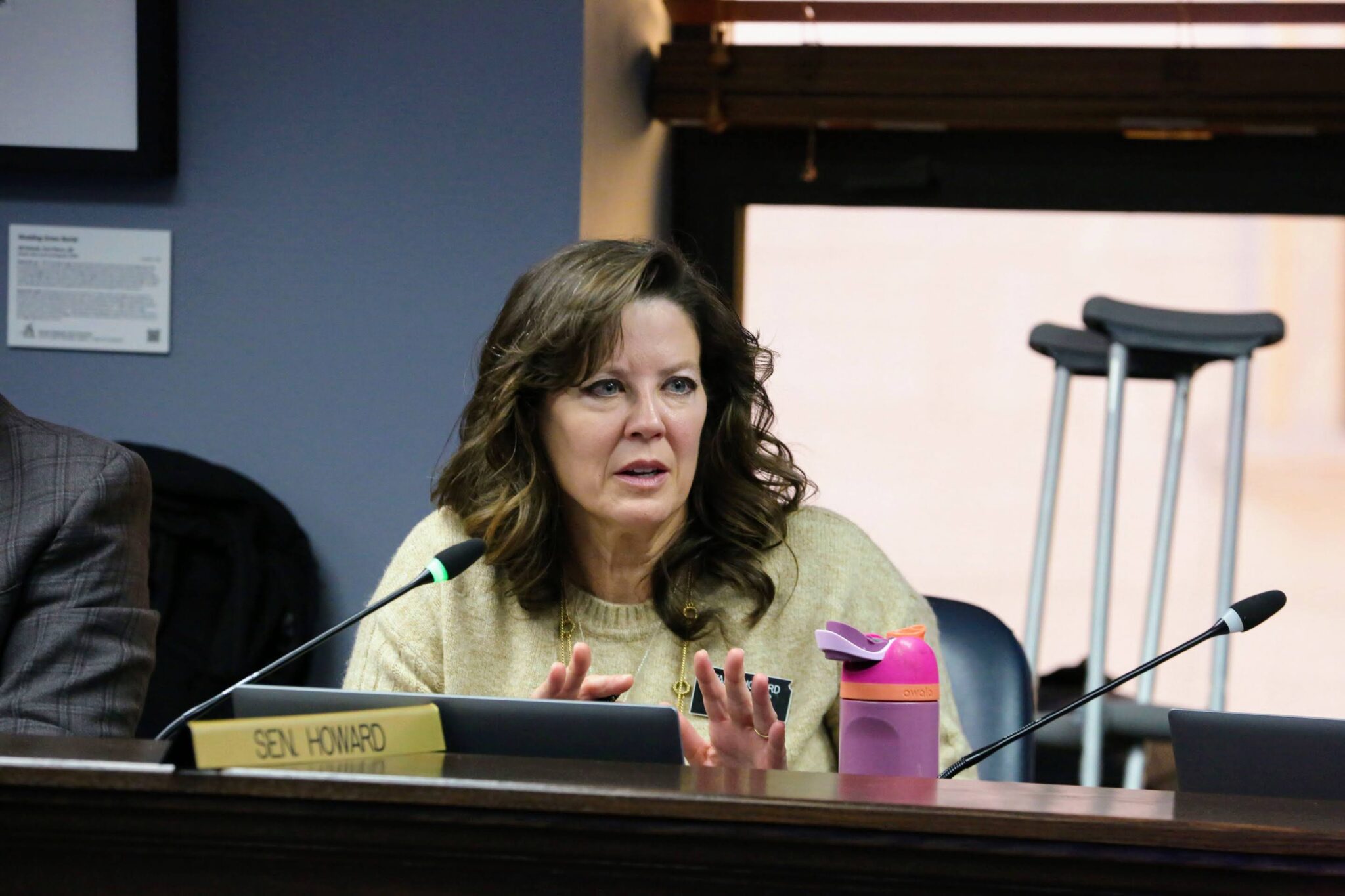
Joshua Haiar/South Dakota Searchlight
A committee of South Dakota lawmakers deadlocked on Friday in Pierre on a bill that would remove an economic development fund from the governor’s exclusive control.
A motion to approve the measure tied on a 4-4 vote with one senator excused due to illness, leaving the bill to potentially be considered again later.
The bill would change how money is awarded from the Future Fund, which receives money from a fee paid by employers. The bill would require any Future Fund award to be approved by a majority vote of the governor-appointed Board of Economic Development, rather than by the governor alone, which is already a requirement of many other funds administered by the Governor’s Office of Economic Development.
The bill would also require the office to write rules outlining an application process, methods of assessing economic impact, selection criteria, requirements to qualify for a grant, and the process for disbursing awards.
Bill sponsor Sen. Taffy Howard, R-Rapid City, told the committee the measure is not meant to eliminate the fund, but to add minimum safeguards and transparency. The only specific legal restraint on the fund currently is a state law that says it must be used “for purposes related to research and economic development for the state.”
“Under current law, millions of dollars can be committed without mandatory board approval, without a standardized application process, without objective economic impact criteria, and without consistent public reporting,” Howard said. “This is not conservative governance. It’s simply an oversight failure.”
“And we have seen the consequences through the years,” she added.
The Future Fund has drawn controversy in recent years over former Gov. Kristi Noem’s uses of it, including funding for a shooting range that lawmakers declined to fund, a rodeo where Noem rode in on horseback with the American flag and a workforce development advertising campaign that featured Noem as the star.
Opponents prefer governor’s new executive order
Opponents of the bill included Gov. Larry Rhoden’s economic development commissioner, Bill Even, along with multiple economic development and business organizations. They said the bill would slow South Dakota’s ability to compete for projects by adding bureaucracy and reducing flexibility.
Even pointed to Rhoden’s recent executive order, signed Thursday, as a better approach, saying it adds transparency while keeping the governor as the decision-maker so the state can “move at the speed of business.”
Rhoden’s executive order lays out procedures for how Future Fund awards are handled and requires public posting of awards and agreements, while still preserving the governor’s sole authority over the fund.
When asked during a Thursday press conference if he’s pushing back against allegations that he and his predecessor improperly used the fund, Rhoden said that’s not the case.
“I think it’s just to put in writing and give the legislators a comfort level that this is what we’re looking at when we’re making these decisions on Future Fund projects,” Rhoden said.
Howard and other supporters of her bill countered that executive orders can be changed or rescinded by future administrations.
The tie vote was on a motion in the Senate State Affairs Committee to send the bill to the full Senate. Sen. Arch Beal, R-Sioux Falls, was excused due to illness, leaving the panel one vote short of the majority needed to advance the bill.
Among the seven committee members who were present, four Republicans voted in favor of the bill and three voted against it. The committee’s only Democrat, Sen. Liz Larson, of Sioux Falls, voted against the bill.
Last month, the Governor’s Office of Economic Development told South Dakota Searchlight that the unobligated Future Fund cash balance was $20 million. The state budget gives Rhoden the authority to spend $7 million more from the Future Fund this fiscal year, which ends June 30.
Broader debate over economic development
Separately on Friday, state senators declined to reconsider a nonbinding resolution from Sen. John Carley, R-Piedmont, asserting that “the free market and the private sector, left alone, will best serve our economic interests” without “enticement from tax credits and subsidies.” The Senate rejected the resolution Thursday, and after Carley had announced his intention to seek reconsideration, no reconsideration motion was made Friday.
Howard’s bill and Carley’s resolution are part of a broader discussion this legislative session about economic development in the state.
Another bill, from Sen. Tim Reed, R-Brookings, would require former state officials or employees to wait for two years before going to work for any entity that was the beneficiary of a contract the officials or employees approved, awarded or administered, if the contract value was more than $1 million. Existing state law requires a one-year waiting period for all such officials or employees.
Reed’s bill is a response to South Dakota Searchlight reporting about Steve Westra, who was the commissioner of the Governor’s Office of Economic Development during the Noem administration.
Westra left his state job in 2023 and took a job with CJ Schwan’s a year later. While Westra worked for state government, he signed the first pledge of state aid benefiting the company. That aid now totals $69 million of grants, loans and tax rebates for the company’s $550 million, 650-employee food production plant under construction in northern Sioux Falls.