
Seth Tupper/South Dakota Searchlight
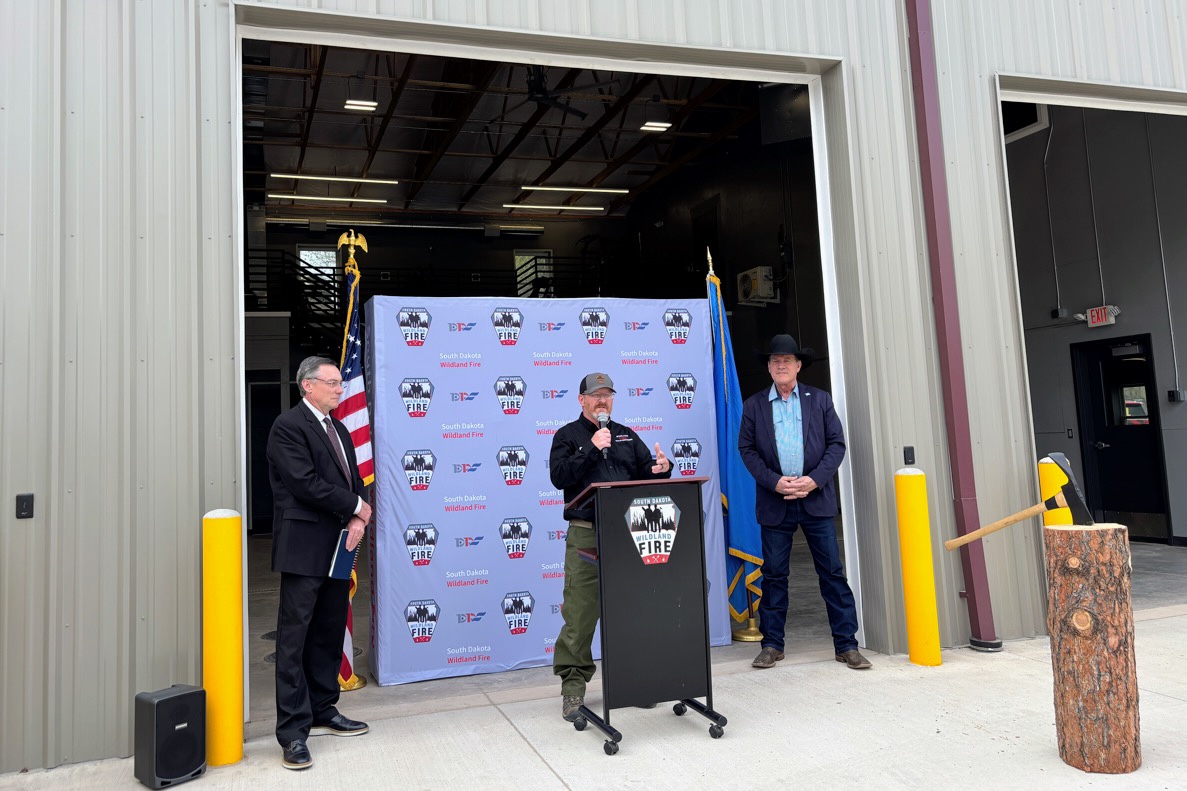
RAPID CITY — Firefighters who’ve been busy battling wildfires in South Dakota’s Black Hills celebrated the opening Monday of two state-funded buildings to house their trucks, equipment and training.
Jay Wickham, the director of South Dakota Wildland Fire, has advocated for new facilities for many of the 28 years he’s worked with the division.
He used the word “grateful” to describe his feelings Monday.
“Just a huge gratitude so that our people have a place they can call home, that they can be proud of,” Wickham said.
In a building that formerly housed Wildland Fire’s Rapid City employees, firefighters had to move equipment out of a storage loft above a meeting room several years ago after discovering the weight was 180% of the safe load, Wickham said. In Hot Springs, firefighters were parking trucks in a building with a dirt floor.

The new buildings cost the state about $4 million, split nearly evenly between the two locations.
Lawmakers provided about $2.5 million in 2023 at the request of the state Department of Public Safety, which includes the Wildland Fire division. After the cost estimates grew, then-Sen. David Johnson, R-Rapid City, sponsored successful legislation providing another $1.4 million in 2024.
The Hot Springs building is dedicated to Trampus Haskvitz, a firefighter who died fighting the Coal Canyon wildfire in 2011.
Republican Gov. Larry Rhoden said during a ribbon-cutting in Rapid City that he has gained “a whole new appreciation” for wildland firefighters in the Black Hills after witnessing their work recently.
“You deserve proper equipment and proper facilities to make you safe and prepared for the dangers that you face every day,” Rhoden said.
Firefighters have battled several major Black Hills wildfires in recent weeks, including the Qury Fire, which burned more than 9,000 acres near Custer, the Coyote Flats Fire, which burned more than 300 acres near Rockerville, and the 79 Fire, which burned more than 5,000 acres near Buffalo Gap.
Fire danger remains high due to a historically warm and dry winter followed by similar conditions this spring.
South Dakota Wildland Fire has about 45 full-time employees, plus roughly the same number of seasonal employees, spread among Black Hills locations in Lead, Custer, Rapid City and Hot Springs.
The state division works closely with local and federal firefighting agencies in the Black Hills, where the land is a checkerboarded mix of private, state, tribal and federal ownership.
During the recently concluded state legislative session, lawmakers took several other actions to help firefighters and prevent wildfires, which Rhoden highlighted Monday. Those actions included providing $5 million for grants to purchase protective equipment for volunteer firefighters, approving a law that allows private landowners to conduct prescribed fires on state land in certain circumstances, raising the meal cost allowance for wildland firefighters, and budgeting $160,000 for an eastern South Dakota fire management office.