
John Hult/South Dakota Searchlight
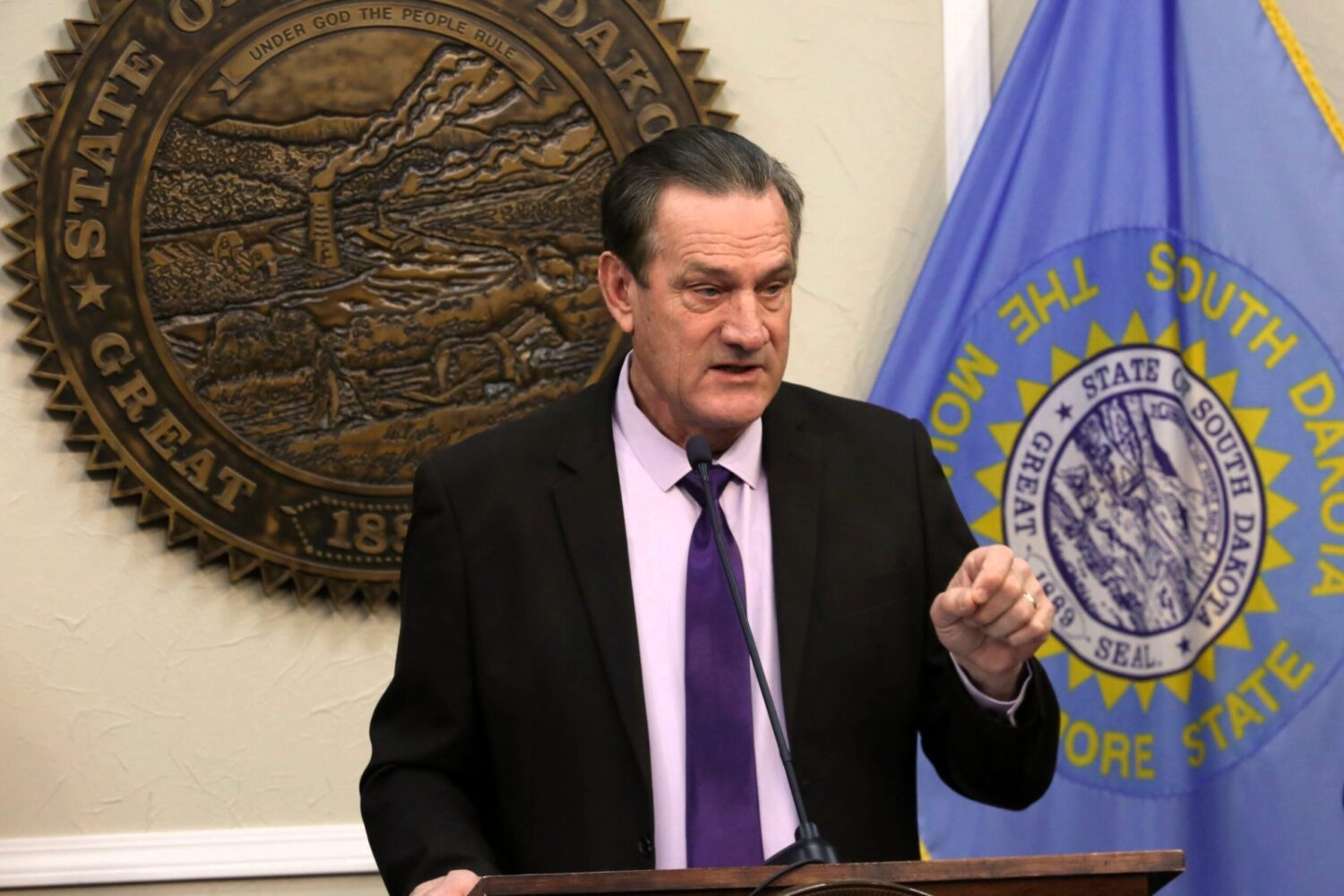
PIERRE — A day before lawmakers were set to debate a bill that would dash his exclusive authority to dole out awards from an employer-funded pool of economic development dollars, Gov. Larry Rhoden signed an executive order to place “guardrails” on his use of the funds.
When asked during a Thursday press conference if he’s pushing back against allegations that he and his predecessor improperly used the fund, Rhoden said that’s not the case.
“I think it’s just to put in writing and give the legislators a comfort level that this is what we’re looking at when we’re making these decisions on Future Fund projects,” Rhoden said.
The Future Fund was created in the 1980s to allow South Dakota governors to nimbly advance economic development projects without intervention from lawmakers or oversight from a state board or committee. The fund’s money comes from a fee employers pay when they submit payroll taxes to the state’s unemployment benefits program.
The fund falls under the umbrella of the Governor’s Office of Economic Development. That agency has a board that reviews and approves awards in most circumstances, but the board doesn’t sign off on Future Fund awards.
The fund has drawn controversy in recent years, largely for the manner of its use by Rhoden’s predecessor, former Gov. Kristi Noem.
Noem, now the secretary for the U.S. Department of Homeland Security, used Future Fund dollars to pay for a gun range lawmakers declined to help pay for, and to help pay for a rodeo at which she appeared and workforce development ads that featured her as the star.
Rhoden has used the money a handful of times during the year he’s spent in office, funding industrial parks in Aberdeen and Watertown and supporting a biotechnology company in Brookings.
His executive order preserves the governor as the sole decision maker on the use of dollars from the Future Fund. The board would remain tangential and have no authority to review or overturn a decision.
The order does, however, lay out procedures on how Future Fund beneficiaries get the money, and it requires transparency on the awards.
- Grants must come on a reimbursement basis, the order says, and the entity securing the grant must prove it’s paid its bills before accessing the money, but the economic development commissioner can waive that requirement.
- The economic development office ought to, “when feasible,” require that the beneficiaries invest matching dollars into funded projects.
- Awardees must have conflict-of-interest policies in place.
- Awards and award agreements must be posted on the OpenSD.gov website, and the economic development commissioner must sign the agreement.
- The economic development office must report on its use of Future Fund dollars biannually to the legislature’s Joint Committee on Appropriations.
Rhoden told a group of reporters that the order’s dictates offer transparency on the process, and that they are essentially “a direct reflection of how we do business today.”
Legislative interest
The Appropriations Committee already gets reports on Future Fund spending. Some lawmakers had aimed to reduce the fund’s revenue in 2024, but ultimately opted to back a bill that created the reporting requirement.
A bill to repeal the Future Fund’s revenue source failed by four votes in the state House of Representative in 2025.
The first bill filed in the Senate for 2026 would move the authority to spend Future Fund dollars from the governor to the economic development board, which has 13 members appointed by the governor. It would also require the economic development office to spell out the criteria for awards and set interest rates for loans.
The bill’s sponsor, Sen. Taffy Howard, R-Rapid City, said she still hopes her bill is approved. It’s scheduled to receive its first hearing Friday morning in the Senate State Affairs Committee.
It’s important, Howard said, that guidelines for the expenditure of taxpayer dollars are set by the Legislature. Governors can rescind executive orders, and there’s no clear mechanism for enforcement if a governor were to ignore existing executive orders.
“Different governors will do different things,” Howard said. “Certain governors will spend this money on rodeos, and other governors may spend it the way it was originally intended.”
When asked if he’d support a bill if it contained the exact language of his executive order, Rhoden said Thursday that he hates to comment on hypotheticals, but that he couldn’t see a reason why he wouldn’t.
Howard said she would consider bringing such a bill if her own proposal fails.
“I do believe something needs to be in statute,” she said.
Even so, she said, the question on who has the authority to spend money from the fund is a point of contention for her. The economic development board ought to review awards, she said.
“I don’t believe one person should be the deciding factor in how those funds are spent,” Howard said. “So I want it to go before several people.”
At Rhoden’s Thursday press conference, Lt. Gov. Tony Venhuizen said the executive order, in leaving the decision-making authority with the governor, preserves what he sees as the Future Fund’s primary value.
“You need to have a tool that is flexible and they can act quickly,” Venhuizen said. “And I think a positive thing about the Future Fund is that there is one person who’s accountable, the governor.”
Broader debate on economic development
The Future Fund discussion dovetails with a larger discussion on the role of economic development that’s grown into a rift among Republicans.
Speaker of the House Jon Hansen, R-Dell Rapids, is one of three candidates running against Rhoden in this year’s Republican primary for governor. Hansen has repeatedly decried state funding for economic development projects as “corporate welfare,” and his running mate, Canton Republican Rep. Karla Lems, is the prime sponsor of Howard’s Future Fund bill in the House of Representatives.
A few hours after Rhoden’s press conference, the state Senate took up a resolution meant to encourage “honest economic development rooted in the republican principles of limited government, deregulation, and organic entrepreneurial growth.”
The resolution asked senators to agree that “the free market and the private sector, left alone, will best serve our economic interests.”
The resolution’s sponsor, Republican Sen. John Carley of Piedmont, told his fellow lawmakers that the businesses that wish to develop and thrive in South Dakota ought to be able to do so without the aid of taxpayer dollars.
Carley said offering taxpayer dollars to companies instead of pushing for lower taxes amounts to “corporatocracy.”
“Instead of choosing corporations, let’s choose the taxpayers,” he said.
The resolution failed on a 15-17 vote, with one senator absent. Carley signaled his intent to have the vote reconsidered.