
Joshua Haiar/South Dakota Searchlight
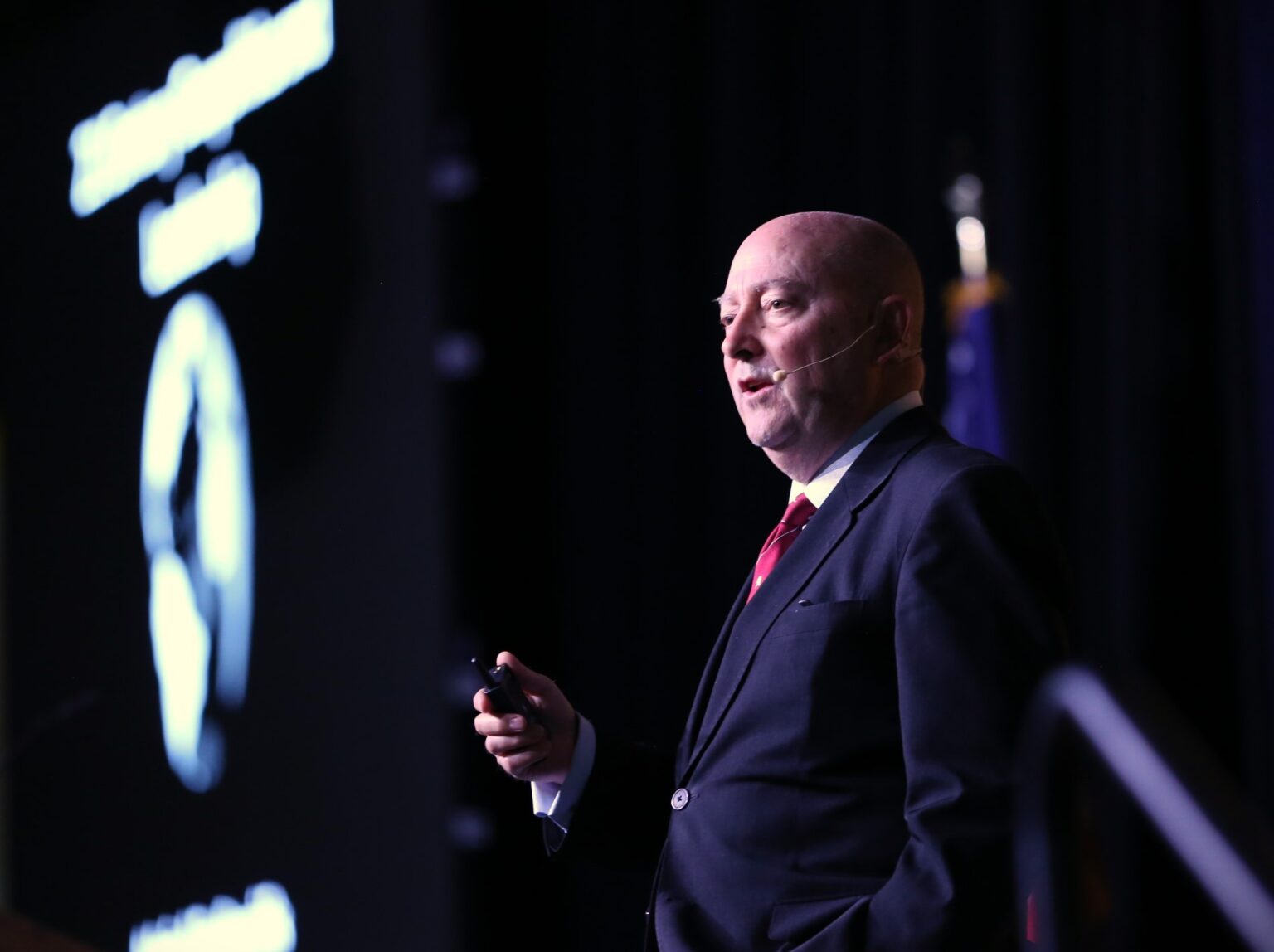
SIOUX FALLS — Former NATO Supreme Allied Commander James Stavridis told an audience Thursday evening at Augustana University that the war with Iran is “not going well” strategically, and America’s leaders are stretched too thin with conflicts around the globe.
Stavridis also described Ukraine as a grinding war likely headed toward a disappointing settlement, China as a long-term strategic test, and Venezuela as a place where the recent U.S. removal of the country’s dictator was strategically risky but could produce an opening for democratic reforms.
With its involvement in those and other international matters at the same time, Stavridis said, the Trump administration has created a “bandwidth” problem for the few people President Donald Trump has entrusted to handle each situation.
“It’s too much, and they don’t have the professional support that they need,” Stavridis said.
Stavridis was the longest-serving combatant commander in recent U.S. history. He is a retired four-star U.S. Navy admiral who oversaw operations in Afghanistan, Libya, Syria, the Balkans and counter-piracy efforts off the coast of Africa. He also led operations across Latin America.
Stavridis was the featured speaker for Augustana University’s Boe Forum on Public Affairs at the Elmen Center athletic arena.
Iran
“We’re a month into it,” Stavridis said of the war against Iran. “How’s it going? It’s not going well, in my view.”
Stavridis said the war has gone better militarily than strategically. He said U.S. strikes have been effective at hitting their targets, with four goals in mind: “snip the nuclear capability,” “beat down the Iranian Revolutionary Guard,” “take out the Iranian navy,” and “take out the ballistic missiles.”
“Our strikes are very effective, and we’re quite good at this,” he said, aside from fatal errors, including a Tomahawk missile that hit an Iranian elementary school adjacent to a military base.
“But strategically, how’s it going?” he said. “Not very well.”

Stavridis said the military successes have not resolved the larger problem: Iran still has ways to impose pain, such as controlling the Strait of Hormuz by attacking oil and gas shipments passing through it. That has driven oil prices higher, and “the Trump administration is trying to get out of this,” Stavridis said. “They’re trying to stand down. They want to find a solution.”
But Stavridis said Trump cannot end the war by declaring victory and walking away, because “you may not be interested in war, but war is interested in you,” meaning both sides must agree to stop launching attacks for a war to end.
Stavridis said his best guess is that there’s a “70% chance” the war ends by the U.S. promising to stop the bombing, Iran releasing its grip on the Strait of Hormuz, and both sides leaving Iran’s efforts to build nuclear weapons to be addressed later.
“That would be sufficient for Trump to declare a win,” Stavridis said. “He’ll say it’s the greatest victory in military history; whatever,” he added, to which the audience erupted in laughter and applause. He added that the conflict is costing the U.S. about $2 billion a day.
Stavridis said there is a 30% chance of a prolonged war. Stavridis said in that scenario, Iran would keep pressuring global energy markets and activate terror networks throughout the Middle East, Europe and the United States.
He said putting boots on the ground in Iran would be a mistake that would increase the likelihood that the war escalates and continues.
“For that, you need a big plan, a big strategy,” he said. “They have neither.”
Ukraine
Stavridis said Ukraine has survived because of its own fighting spirit against Russia’s invasion, reinforced by Western weapons, sanctions on Russia and NATO’s backing.
“It’s really the war of Putin’s ego,” he said of Russian dictator Vladimir Putin.
“You can forget this idea that he purports of histories, destiny and Ukraine ‘has always been part of Mother Russia, and the Rodina,” Stavridis said, referencing a Russian term for the homeland. “That’s a crock.”
He said what Putin wants is the country’s natural resources.
Stavridis is pessimistic about a clean Ukrainian victory. He said Russia controls 20% of Ukraine’s territory, having invaded from the east, and an end to the war will likely include Ukraine giving up that land, “and I hate it.” Though Stavridis added that Ukraine would likely join NATO shortly after.
“And believe me, we want them in NATO,” he said, to which the audience again applauded.
Stavridis said negotiations could come soon, given that Russia and Ukraine are both “burning through troops.”
Stavridis added that Putin “wants desperately” to build an alliance with China, “and he’s kind of getting there.”
China
Stavridis said U.S. tensions with China span trade, cyber attacks, threats to Taiwan’s independence, and China’s militarization of the South China Sea, including its buildup of artificial islands that function like mini-bases.
Stavridis said Taiwan must become a “porcupine,” meaning well-armed and hard to conquer, to deter China from invading. He said Taiwan’s military lacks the modern weapons it needs.
But Stavridis said he does not see a U.S. military conflict with China as inevitable. Instead, he suggested the goal should be competition without tipping into war.
“I think we will probably get there,” he said of that balance.
Venezuela
Stavridis said the U.S. operation that removed the former Venezuelan dictator Nicolás Maduro was militarily impressive, but that the harder and more important test is what comes next.
“You can debate the legality of it, or the strategy of it, but as a military operation, quite extraordinary,” he said.
Stavridis said removing Maduro has resulted in a, “shall we say, cooperative regime.”
He suggested that the best-case scenario is a transition that leads toward free and fair elections.
“And then, you have the opportunity to really flip the table in Latin America,” he said. “It’s not a terrible outcome.”